concept

phase space

Phase space is a mathematical framework representing all possible states of a physical system, used to analyze particle dynamics and chaos.
11 related articles · 2 who worked here

Description

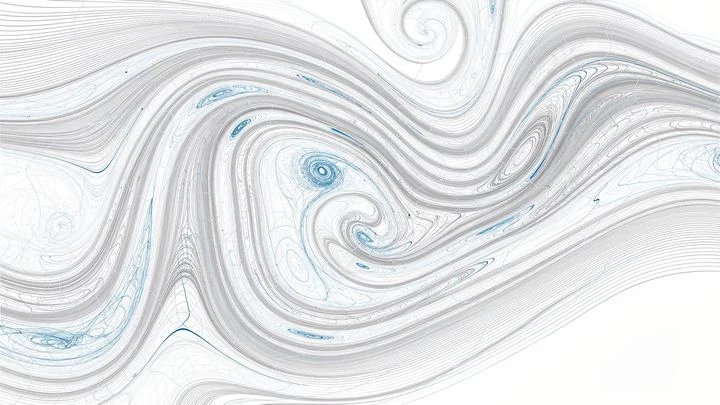
Phase space is a map of all possible states of a system: where each object is and how fast it is moving. For a pendulum, it is a circle: height and speed always change together, tracing a closed loop.

History

The geometric interpretation of mechanics goes back to Lagrange and Hamilton (early 19th century). The concept of phase space was formalized by Liouville (1838), who proved the theorem on conservation of phase volume. Henri Poincaré (1890s) applied it to the three-body problem and discovered homoclinic tangles—the seed of chaos theory. In the 20th century, the Krylov–Bogolyubov school and Kolmogorov–Arnold–Moser developed ergodic theory and KAM theory.

How it works

The Hamiltonian vector field is generated by the Poisson bracket with the scalar Hamiltonian H(q,p). Liouville's theorem (a direct consequence of Hamilton's equations) asserts the incompressibility of the phase flow: ∂ρ/∂t + {ρ,H} = 0, where ρ is the probability density. Boltzmann's ergodic hypothesis assumes that the trajectory eventually covers the energy surface uniformly, justifying the replacement of time averages with phase averages in statistical mechanics.

Fun fact

The phase space of a single particle has six dimensions (three coordinates and three velocities), and a dust speck dancing in a light beam already wanders in a twelve-dimensional world.

Concept graph →

Related articles · 14

Optics2026-08-012 minarXiv:2608.00618express
An Event Takes Shape
In the familiar picture of the world, an event is a point on the map of spacetime: 'here and now,' with no size or internal structure.
Cosmology2026-07-273 minarXiv:2607.24694
The Universe's Zero Isotherm: How a Geometric Compass Sidesteps the Biggest Problem in Cosmology
A weather forecaster draws a thick black line across Europe: north of it, frost; south, a thaw. That boundary, the zero isotherm, won't tell you the temperature in Stockholm or Rome, but it honestly marks where winter ends. In recent cosmology, a map has emerged where a similar frontier can be drawn.
Math Physics2026-07-261 minarXiv:2607.23873express
Balls on a Curved Stage
In a vast hall, billiard balls are scattered about. At first they lie sparsely, each on its own. Then someone adds more, and suddenly the balls compress into dense clusters. This is a phase transition — the moment when matter abruptly changes its state. Physicists have long described such a picture with the hard-sphere model: particles are identical balls that cannot overlap.
Symphony of Scales: A Neural Network That Overheard Nature's Orchestra
Imagine a philharmonic orchestra playing, but the microphone picks up only a blended roar — a tutti where double basses, flutes, and timpani all merge. Physicists have grappled with a similar task for decades, staring at fields of density, temperature, or magnetic induction.
q-bio.QM2026-05-162 minarXiv:2605.16753express
Where Does Life Draw the Line?
A tightrope walker inches across a chasm. As long as they keep their balance and avoid sudden moves, they're safe. But one overcorrection, and a fall is inevitable. Life works much the same way at every level — from proteins inside a cell to entire ecosystems.
Strongly Correlated2026-05-052 minarXiv:2605.03700express
Quantum Pendulum on a Sphere and a Torus
A pendulum swings not in a single plane but in five dimensions at once. Its motion is described by a complex mathematical model, and the pendulum itself is an electron in a graphene sheet interacting with five different "flavors" of its environment.
Chemical Physics2026-04-221 minarXiv:2604.21005express
How Chaos Governs the Chemistry of Giants
A chemical reaction resembles passing through a turnstile: a crowd creates chaos and gets stuck, while an orderly line moves. In the quantum world, however, when the jostling subsides, the barrier can become ghostly — a particle passes through it as if the turnstile has vanished.
Quantum Gases2026-03-311 minarXiv:2603.29568express
A Microscope That Sees Both Speed and Place
Fireflies flash in a dark forest: you see each flash, but not the flight. A quantum gas microscope can show individual cold atoms, like those fireflies. But until now, it couldn't tell you how fast they're moving. Now scientists have found a way to fix that.
Fluid Dynamics2026-03-071 minarXiv:2603.07297express
Chaos in a Falling Film
A thin stream of water on a shower glass gathers into winding rivulets that quiver and shift before your eyes. Such a liquid film flowing down a vertical surface is a classic example of chaos in nature: it all flows downward, sure, but the surface lives its own unpredictable life.
physics.acc-ph2026-03-042 minarXiv:2603.04195express
Coupled Oscillations of Particles in an Accelerator
Particles in an accelerator can oscillate in two transverse directions at once, and these oscillations are not always independent. If you give a pendulum a push in one direction and it starts swinging sideways as well: that's coupled oscillations. In accelerators, this happens due to magnet imperfections or special insertions, making particle motion complex.
HEP Experiment2026-03-032 minarXiv:2603.02733express
Neural Network Reads Particle Beam from Screen
A particle beam in an accelerator is like a swarm of gnats: each one flies at its own speed and angle. To keep the swarm from scattering and to hit the target, engineers need to know exactly how all particles move at once — all six coordinates of their motion. But conventional sensors only show a flat shadow of the swarm on a screen, like a smudge on glass after an impact.
Chemical Physics2026-02-281 minarXiv:2603.00614express
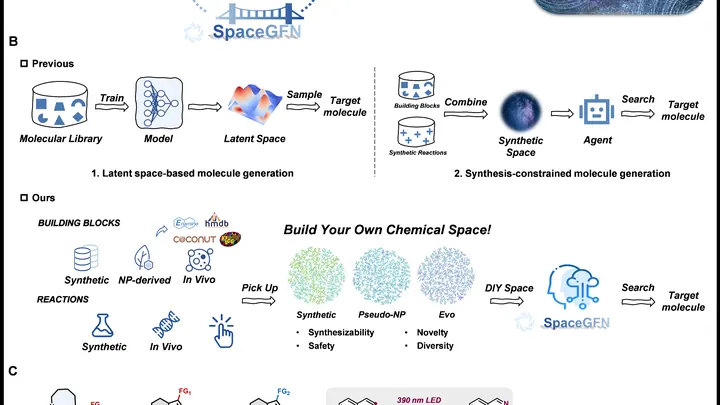
Chemical Space as a Construction Set
Previously, generative models for drug discovery worked like an artist painting without choosing a canvas. They learned from existing molecules and simply produced similar ones, without considering how the space of possible compounds is organized. SpaceGFN changes the approach: now chemical space is a construction set where the user specifies the parts and the assembly rules.
Fluid Dynamics2026-02-162 minarXiv:2602.15234express
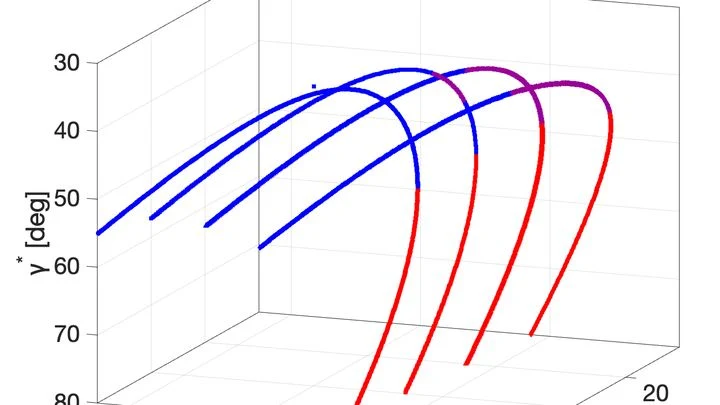
How lizards and snakes plan their falls
A lizard falling from a branch doesn't just tumble: it catches the air with its body and turns the fall into a glide. Engineers have long borrowed tricks from such feats, but until now there was no common language to compare the gliding of a snake, a lizard, and a man-made wing. The new study introduces such a language: a three-dimensional map of velocities that shows where any motion inevitably ends up.
Chaotic Dynamics2026-02-072 minarXiv:2602.07660express
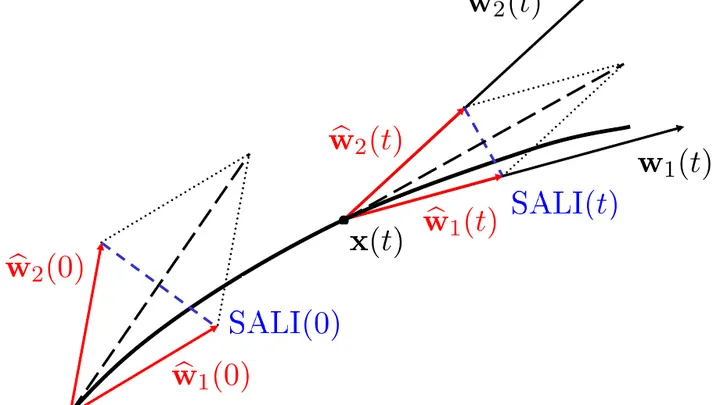
How to Tell Chaos from Order by a Particle's Trail
Drop a stone into a calm pond — the ripples spread evenly. Drop it into a churning stream — the water swirls unpredictably. Scientists have long wrestled with a similar question: how can you tell from a single particle's path whether its motion is chaotic? Previously, this meant comparing the particle's path with neighboring ones, which is complicated and time-consuming.