Quantum Wallet: Energy Teleportation Between Five Qubits ✛ ✦
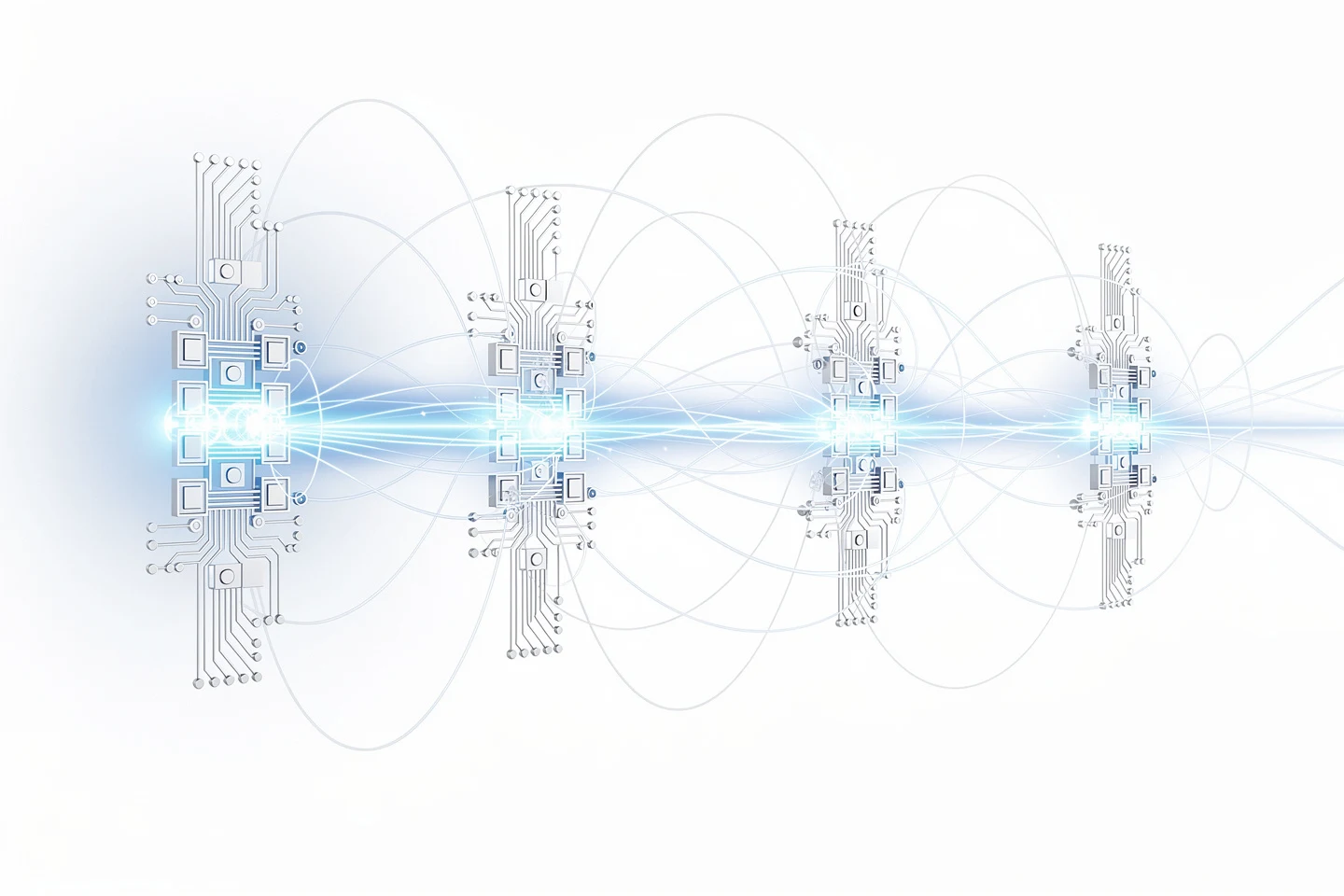
Quantum entanglement long remained a curiosity — 'spooky action at a distance,' as Erwin Schrödinger put it, which shatters our conventional picture of the world. But in 2008, physicists realized: entanglement can be used not only to transfer bits, but also to teleport energy. Early experiments were limited to two particles: the common GHZ state collapses upon measurement. The breakthrough came with the W state — an equal superposition of all arrangements with exactly one excited qubit. It's like a shared wallet that several heirs can draw from at once, without breaking their connection.
Entangled qubits in the W state form a single energy pool. When Alice performs a quantum measurement, she drops a portion of energy E₀ into the common pot. Then she sends a classical bit, and the others take turns drawing their shares. The order is strict: the first in line withdraws the largest sum, each subsequent one less. The total balance is uncompromising: the sum of extracted shares never exceeds the input. Energy is not created anew, but redistributed within the entangled ensemble, obeying the speed of light — the classical signal must arrive.
An experiment on a real quantum processor, the IBM Lagos, confirmed the theory. For three qubits with 0.707 arbitrary units injected, the first receiver got 0.526 (74%), the second 0.170 (24%) — totaling about 98% of the original energy. For four and five qubits, the pattern held, small losses attributed to unavoidable decoherence. Additional tests showed symmetry: the order of polling the receivers does not change the final figures. Thus quantum information becomes an operational resource — almost a currency that knows how to make its own change.
Another facet intrigues: perhaps energy is simply frozen information, and this experiment allows us to directly observe their mutual conversion for the first time.
Looking ahead, the scheme promises an 'energy internet' — quantum networks where nodes share energy wirelessly, regulating the thermal budget of future processors. Scaling to tens of qubits, hybrid photon-superconducting architectures, probing topological phases — these are the first sketches. The fundamental question of exactly how state reduction redistributes energy in a multipartite system remains open. But now it is backed by experiment: the quantum wallet works, and we are just beginning to read its ledgers.
Calling this teleportation is like considering cash withdrawals from an ATM magic. Energy doesn't vanish from the sender nor materialize at the receiver: it's extracted from the shared entanglement account, like heirs withdrawing money from a single account, where the first in line grabs the thickest wad.