Quantum network technology is the engineering discipline of connecting quantum devices — such as qubits, quantum memories, and single-photon sources — over distances so they can share entangled states and exchange quantum information. Unlike classical networks that transmit bits, quantum networks transmit quantum states, which cannot be cloned or amplified without destroying the information. This makes them the backbone of a future 'quantum internet' that would enable unconditionally secure communication, distributed quantum computing, and new forms of sensing.
History
The concept emerged in the 1990s with proposals for quantum cryptography and quantum repeaters, notably by Artur Ekert (1991) for entanglement-based key distribution and H.-J. Briegel et al. (1998) for quantum repeaters. Experimental demonstrations of entanglement distribution over increasing distances have been ongoing since the early 2000s.
How it works
The core mechanism is entanglement distribution: a source generates pairs of entangled photons, sends one to each of two nodes, and the nodes use measurements to establish a shared quantum correlation. Because photons are lost in optical fibers, quantum repeaters — devices that perform entanglement swapping and purification — are needed to extend range. Recent approaches include using atomic clouds to convert light frequencies for compatibility with different network components, and chip-based transceivers that control light pulses with high precision.
In practice
Quantum networks are being tested for secure key exchange between moving platforms (e.g., drones and rovers), and for building metropolitan-scale testbeds that connect quantum processors.
Fun fact
A drone and a ground rover have already exchanged quantum keys in flight, showing that mobile quantum nodes are feasible.
A drop of ink in a glass of water spreads in intricate swirls. Similarly, a quantum particle exchanging energy with its environment changes its state in a complex and entangled manner. Describing this dance between particle and environment has long baffled scientists.
The quantum networks of the future resemble the Tower of Babel: each node speaks its own dialect. Some store information in the polarization of a photon — the direction of oscillation of the light wave. Others use time bins: that is, when exactly the pulse arrives.
Once Richard Feynman saw in quantum systems a challenge for classical computers. Now we face the inverse problem: understanding what exactly the quantum processor has simulated. Among the states it births are veritable 'black boxes'—topological phases of matter.
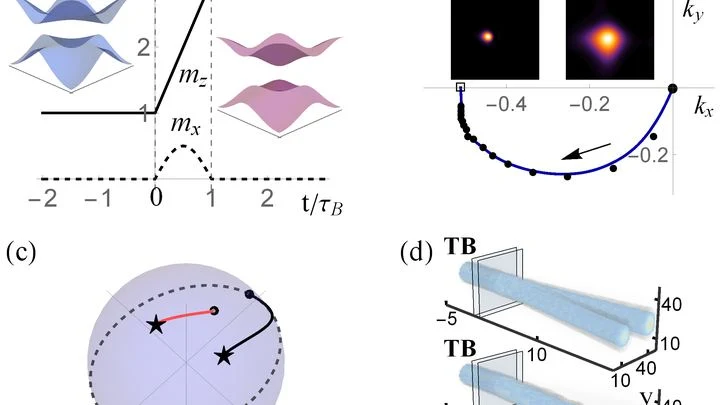
A stone falls into a pond, and ripples spread across the water. They reflect off the shore, overlap, and die out. All this motion unfolds in space. But what if the pond itself changed its depth or density for an instant — not at one point, but everywhere at once? A temporal boundary is exactly such a jump in properties over time, not space.
An ordinary envelope has a rectangular shape, and the letter inside does not change the envelope's properties. With photons, particles of light, the situation is different: their 'shape' in time can vary, and this shape itself carries information.
An ordinary laser beam carrying quantum keys trembles at the slightest movement, like a flashlight in the hand of a running person. The drone vibrates, the rover shakes, and the code falls apart. The authors figured out how to align the polarization of light (the direction of its oscillations) on both ends of the line on the fly.
Standard optical fiber is like a glass thread that carries light. But when you send weak quantum signals (individual photons) and powerful classical laser light through it at the same time, trouble arises. The glass slightly scatters light: this is called Raman scattering.
Regular quantum communication is like a postal service that sends letters strictly one at a time. If the route is long, you have to wait an indecently long time for a reply. Physicists sped up the process by dispatching ten 'postal trucks' — light pulses — into a single optical fiber, but in different time windows.
A beam of visible light enters a cloud of billions of rubidium atoms cooled to near absolute zero, and emerges on the other side already in the telecom range.
Quantum computing promises a revolution, but its real power will only unfold in a network. The best “brains” — superconducting qubits — communicate at microwave frequencies. The ideal “couriers” — optical photons — fly at hundreds of terahertz. A direct hookup is impossible.
Quantum entanglement long remained a curiosity — 'spooky action at a distance,' as Erwin Schrödinger put it, which shatters our conventional picture of the world. But in 2008, physicists realized: entanglement can be used not only to transfer bits, but also to teleport energy.
A single quantum processor is like a solo musician. It can play a simple tune, but a symphony requires an orchestra. To solve problems that demand enormous computational power, processors must be networked.