Data transmission is the physical transfer of information from a sender to a receiver, typically encoded as electrical, optical, or radio signals. In modern physics and engineering, it underpins everything from fiber-optic internet to deep-space communication. The field has recently expanded into quantum data transmission, where information is carried by quantum states like photon polarization or entanglement, enabling fundamentally new capabilities such as secure key distribution and quantum teleportation of energy.
History
The theoretical foundations of quantum data transmission were laid in the 1980s and 1990s, with Charles Bennett and Gilles Brassard proposing the first quantum key distribution protocol in 1984. Quantum teleportation was first experimentally demonstrated in 1997 by Anton Zeilinger's group.
How it works
Classical transmission encodes bits as variations in a carrier signal — voltage levels, light intensity, or radio frequency. The signal travels through a medium (copper wire, optical fiber, free space) and is decoded at the receiver. Quantum transmission instead encodes information in quantum states, such as a photon's polarization or its entanglement with another particle. This allows for effects like teleportation, where the state is transferred without the particle itself moving, and secure communication where eavesdropping is detectable.
In practice
Used in fiber-optic networks, satellite communication, and emerging quantum internet prototypes that promise unhackable encryption and distributed quantum computing.
Fun fact
In quantum teleportation, information is destroyed at the sender's location and recreated at the receiver's — the original state ceases to exist, making it a perfect 'copy' only in the sense that no copy was made.
A mail carrier delivers letters along one-way streets. As long as he only drives forward, the route is simple and predictable. But if U-turns are suddenly allowed, he'll start doubling back, crossing his own tracks, and the delivery pattern gets tangled. That's roughly how an infection behaves when people can get sick more than once.
The quantum networks of the future resemble the Tower of Babel: each node speaks its own dialect. Some store information in the polarization of a photon — the direction of oscillation of the light wave. Others use time bins: that is, when exactly the pulse arrives.
Crystals glued to the outside and inside of a metal wall act as an invisible channel. One, receiving current, starts to tremble, and these vibrations, like ripples on water, spread out in all directions through the metal. The inner crystal catches this tremor and generates electricity again.
In a room with a dead corner, sound doesn’t travel. On the wall there’s a smart mirror: it catches the sound and re-reflects it, making the hidden audible. That’s how a reflective surface works in wireless communication. But if the source is right in front of you, the mirror only creates an echo.
Data on the internet travels at the speed of light through fiber optics. In classical networks, delays aren't critical, but for quantum communication, perfect synchronization is essential: particles of light with encoded information must converge at the detector in the same instant.
Erasing even a single bit means releasing heat. This discovery by Rolf Landauer hinted that information is neither material nor illusory. Imagine that every event casts a shadow: that is information, the collection of all unrealized possibilities.
A quantum computer is like an orchestra where every musician-qubit must play in perfect silence. But when you have many such orchestras that want to perform together, they need a reliable conductor-communicator.
In the quantum world, light and matter constantly exchange energy. Previously, they were described statically, like frozen poses. The new approach follows the dance itself: the transitions between states, like a continuous sequence of movements.
Two mailboxes at opposite ends of a city. Drop a letter in one, and an identical one instantly appears in the other. That's roughly how quantum entanglement works: two particles behave as a single unit, even when separated by a great distance. But until recently, this connection could only be maintained within a single room or across a lab bench.
A quantum memory node is a tiny diamond with a defect that can store and emit single photons. But its light has a wavelength of 637 nanometers, the same red as a ruby, and is almost completely absorbed after just a few meters of standard optical fiber.
Each vowel sound is a distinct shape of the mouth, tongue, and throat. When you say 'ah,' 'ee,' or 'oo,' not only does the air inside your head change, but so does the way radio waves pass through it. Researchers peered into this process using MRI scans taken right during speech and built a precise computer model of the head — from bones to soft tissues.
Light can act as a courier carrying secret messages. But to ensure the courier doesn't lose a single letter, you need to meet and check it very quickly. The new chip made from a thin film of lithium niobate is like a turnstile that opens and closes in billionths of a second, letting light pulses through at just the right moment.
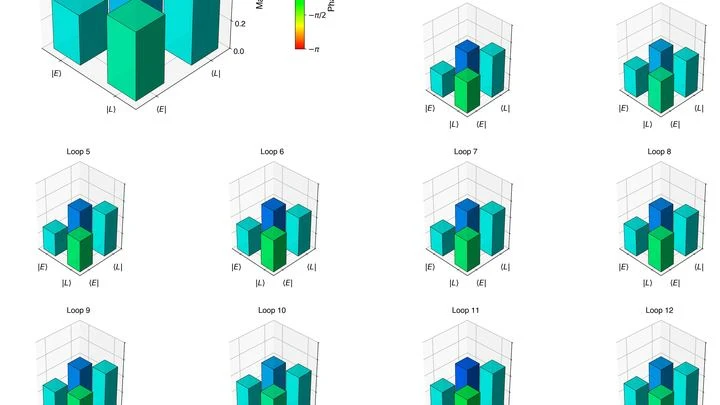
An ordinary envelope has a rectangular shape, and the letter inside does not change the envelope's properties. With photons, particles of light, the situation is different: their 'shape' in time can vary, and this shape itself carries information.
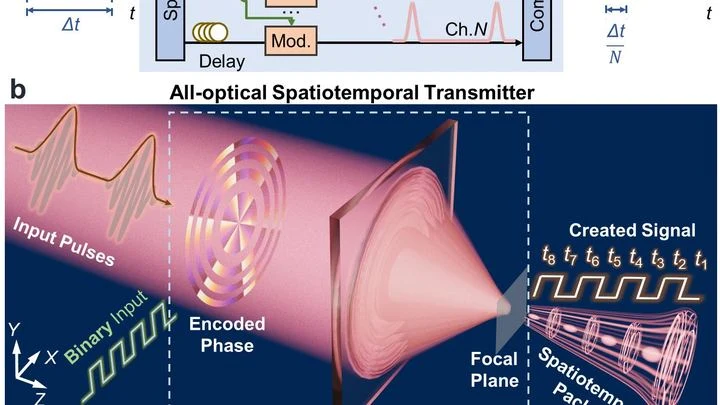
Light can carry information faster than any electronics. But usually, between a computer and a laser sits a digital-to-analog converter — a device that turns zeros and ones into electrical signals. It's the bottleneck.
The new transmitter does away with this middleman.
Lymphatic vessels are one-way streets. Through them, fluid flows only forward thanks to tiny flap valves. These valves open in just one direction, creating asymmetry, directionality, without which the flow would stop.
In the lab, scientists modeled a vessel and sent compression waves along it, like a parade of gentle nudges.
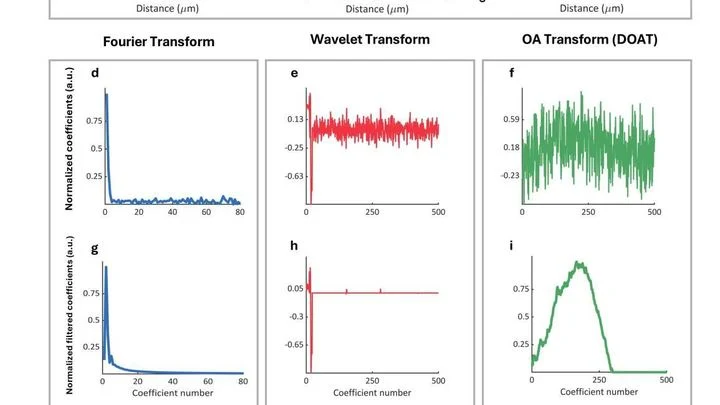
A laser beam hits the skin, and tissues respond with a barely audible ultrasonic echo. From that echo, doctors can see blood vessels and tumors without making a single incision. But before the picture appears on the screen, the signal has to be cleaned of noise, just as a cook skims the foam off a broth to make the soup clear.
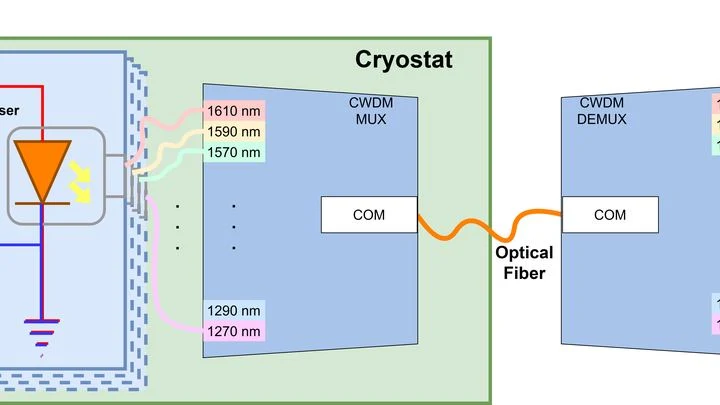
A thermos of liquid xenon cooled to minus 100 degrees Celsius. Inside are sensitive sensors that catch rare signals from dark matter particles. To bring these signals out, copper cables are usually used. But over the long haul, the signal weakens, and adjacent cables start 'cross-talking' — that's called crosstalk.
Quantum light is not just a stream of particles but an intricate pattern woven from space and time. A single photon can be stretched, squeezed, smeared across different directions.
Ordinary light is a stream of independent particles: photons fly through each other without noticing their neighbors. But in superconducting circuits cooled to near absolute zero, the situation changes. There, photons travel along narrow metal tracks, and if tiny elements called Josephson junctions are embedded in these tracks, light begins to 'feel' itself.
Imagine two synthetic diamonds, each acting as a high-precision tuning fork. Inside the crystal lattice of each diamond sits a carbon-13 atom: this is a quantum bit, or qubit, the minimal unit of quantum information.
Vanadium oxide is a material that can act as an insulator, not conducting electricity, or as a conductor, like a metal. The switch takes trillionths of a second, and that's what makes it a candidate for ultrafast electronic devices.
But exactly how it happens has long been a mystery.
Every breath you take and every muscle twitch runs on a stream of electrons flowing through proteins inside your cells. These proteins aren't static: they constantly change shape, like a spring that compresses and releases. But until now, no one has seen exactly how these movements open or close the path for electrons.
Regular quantum communication is like a postal service that sends letters strictly one at a time. If the route is long, you have to wait an indecently long time for a reply. Physicists sped up the process by dispatching ten 'postal trucks' — light pulses — into a single optical fiber, but in different time windows.
When light passes through biological tissue or frosted glass, it scatters and loses the image. Researchers at the Paris Institute of Nanosciences have shown that a scattering medium can be tuned to transmit images encoded in the correlations of entangled photons while remaining opaque to classical light.
Inside a cryostat cooled to tens of millikelvins live superconducting qubits. There aren't many of them: tens, at most hundreds. Crosstalk and thermal noise prevent packing more. But cracking RSA-2048 requires anywhere from ten thousand to ten million physical qubits.
Energy as a signature: the sign of the transferred pulse reveals the secret. This metaphor is the key to a new quantum key distribution protocol that uses energy teleportation instead of state measurement.
Quantum computing promises a revolution, but its real power will only unfold in a network. The best “brains” — superconducting qubits — communicate at microwave frequencies. The ideal “couriers” — optical photons — fly at hundreds of terahertz. A direct hookup is impossible.
Quantum entanglement long remained a curiosity — 'spooky action at a distance,' as Erwin Schrödinger put it, which shatters our conventional picture of the world. But in 2008, physicists realized: entanglement can be used not only to transfer bits, but also to teleport energy.
A postal money order doesn't arrive instantly but after a set delay, and the amount credited to the recipient's account ends up larger than what the sender deposited in cash. That's roughly how the new protocol, dubbed temporal quantum energy teleportation (TQET), works.
In ordinary quantum energy teleportation, two parties, Alice and Bob, share a common quantum state.
An orchestra without a conductor plays a complex piece. The listener hears the overall music but wants to understand who leads the melody and who merely echoes it in unison.
In a chain of eight spins, a defect lurks — a tiny magnetic moment. The Kondo effect, known since the 1930s, makes electrons around it align into a collective screen. The material's resistance abnormally increases. But detecting such an impurity hidden deep in the structure is like finding a stone at the bottom of a dark pond.
Quantum entanglement is like an invisible spring between particles — squeeze one, and the other twitches, no matter where it is. In the new work, physicists built a model of four spins (tiny magnetic arrows) in a chain, where the end spins are held by a local magnetic field.