Simple

A Simple Way to Create a Quantum Ghost State

Original: "Deterministic Mechanical Wigner Negativity via Nonlinear Cavity Quantum Optomechanics in the Unresolved-Sideband Regime"
arXiv:2505.01942v2 · 2025-05-03 · CC BY · ⏱ 1 min · Quantum Physics Mesoscale Optics
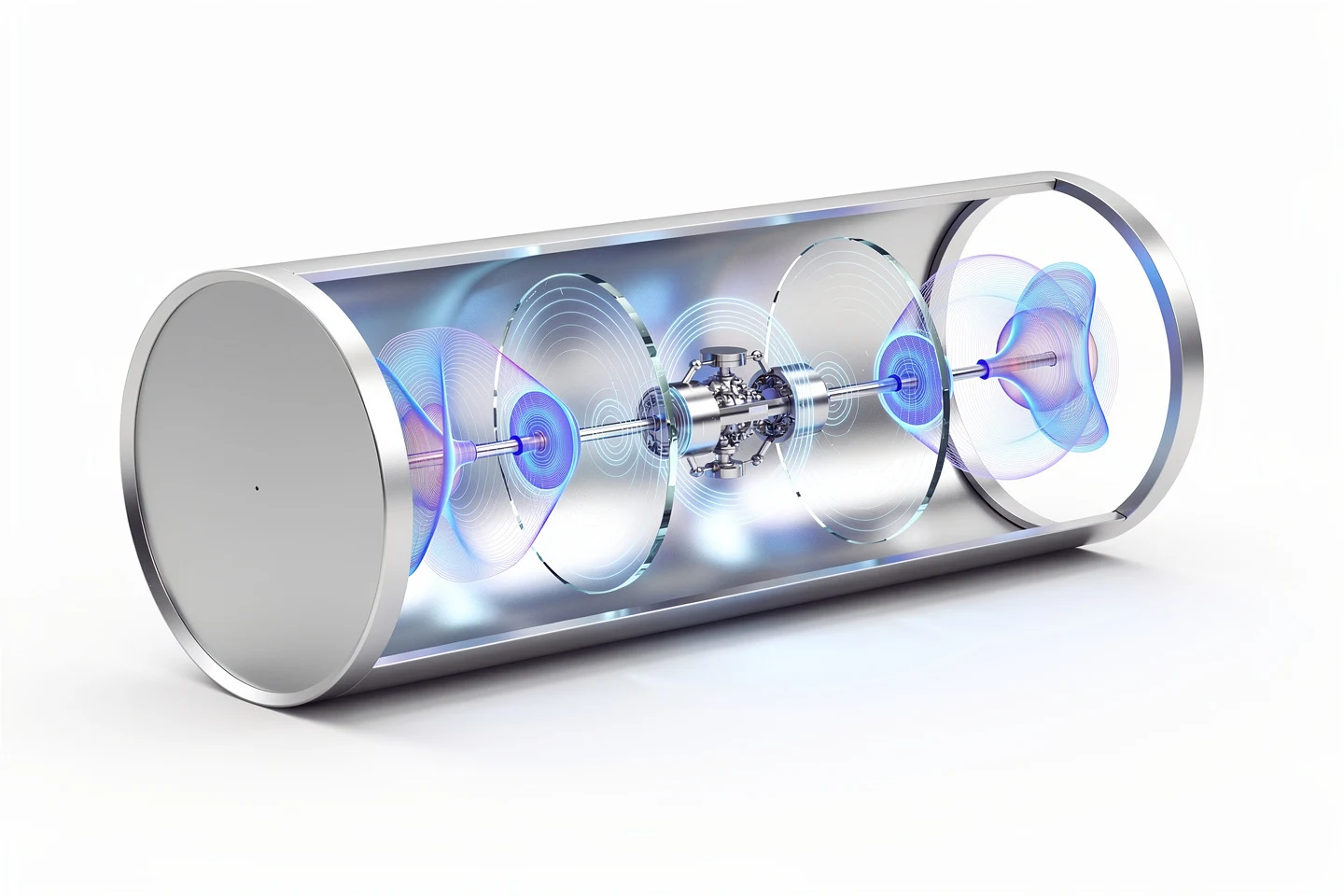
An ordinary resonator, acting like a curved mirror, itself gives birth to quantum states with negative probability.
Abstract

Light pushes on a minuscule mirror, just like wind on a swing. Scientists have found a way to illuminate this swing so that it rocks not smoothly, but in quantum leaps—as if freezing in bizarre poses. This paves the way to ultrasensitive sensors.

Links in the knowledge graph 1

Quantum mechanics allows the Wigner function — a kind of probability map that sometimes dips into the negative, like a ghost. This indicates that the system is in a superposition (overlapping of states) with no analogue in everyday life. Usually, to induce such 'negativity' in mechanical oscillations, extreme conditions are needed. But physicists found a simpler way: a resonator with nonlinear response acts like a curved mirror. A short laser pulse, reflecting, distorts and 'winds' quantum weirdness onto the motion — and now Wigner negativity emerges without extra tricks.

Astonishingly: negativity survives even if the oscillation is slightly heated (about one quantum of energy).

This is fuel for quantum computers and algorithms, a resource for quantum information. Moreover, the method promises to simplify detectors for gravitational waves, invented by Rainer Weiss — there they also struggle with quantum uncertainty and loss of quantum properties. The works of David Wineland and Serge Haroche inspired the authors and helped to lower the requirements for the experiment.

🎯 The Wigner function was devised by Eugene Wigner in 1932 as a bridge between classical and quantum physics. Its negative values are like 'probability ghosts': they signal that we're dealing with a deeply nonclassical state, but you can't measure this negativity directly, only infer it indirectly.

\delta = \int |W(X,P)|\, dX dP - 1
A measure of nonclassicality: zero for ordinary Gaussian states, but turns positive when Wigner negativity appears — like a ghostliness counter.
f(X)=\frac{1+i(\frac{\mu}{2}X+\bar\Delta)}{1-i(\frac{\mu}{2}X+\bar\Delta)}
The mathematical heart of the trick: it links the input and output light fields; its nonlinear curvature in X carves out the negative lobes in the Wigner function.
Scientists
Niels BohrPascual JordanWerner HeisenbergBernhard RiemannJoseph WeberKarl Schwarzschild
Tags
quantum measurement quantum information quantum decoherence gravitational waves superposition uncertainty principle quantum computer quantum algorithm
Laws
Heisenberg uncertainty principleEinstein field equationssuperposition principleEuler's formulatunnel effectno-cloning theorem
Original: arXiv:2505.01942v2 · CC BY · bridge42worlds