Quantum Ghosts in the Hall of Mirrors ✛ ✎ ✦
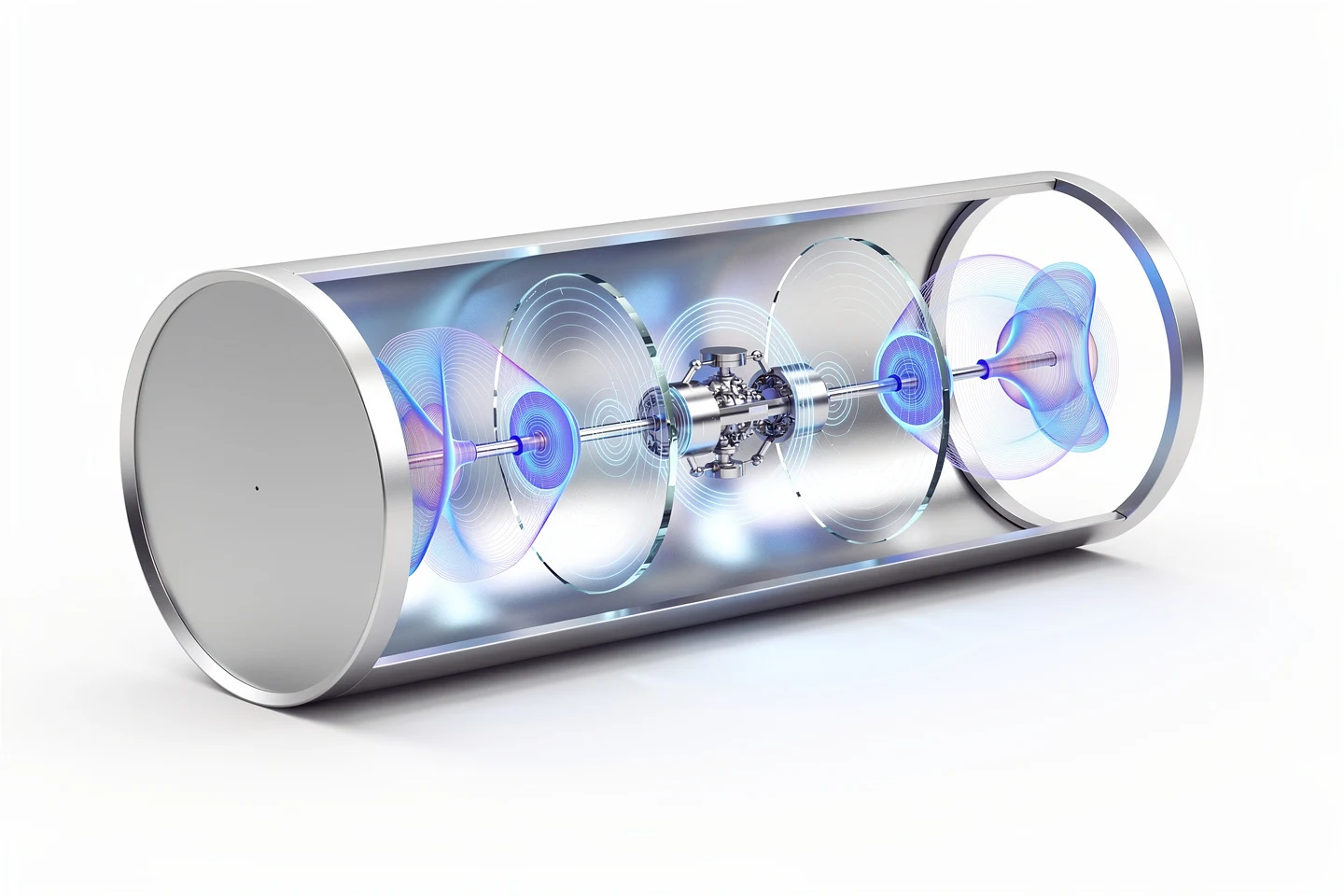
In quantum mechanics, some states defy intuition: their probability distributions dip into the negative, like mirages leaving only indirect clues. This Wigner negativity is no mere mathematical curiosity but a hallmark of genuine nonclassicality, a precious resource for quantum computation and communication. Yet how can a macroscale oscillator, quivering in a beam of light, be made to sing such unnatural notes? Standard optomechanics with linear radiation pressure fails. For a long time, the only path seemed to be either ultrastrong coupling down to single photons or probabilistic schemes with cunning measurements. A new theoretical breakthrough overturns this picture: the key to deterministic generation of quantum ghosts was hiding all along in the resonator itself — in its nonlinear response to mirror motion.
Imagine an optical resonator as a funhouse of curved mirrors. Photons bounce between the reflectors, each reflection warping their amplitude and phase — and the distortion strength depends on how much the input mirror-oscillator bends. This nonlinear response function f(X) — a mathematical portrait of how the displacement X of a mechanical mode reshapes light — serves as the chief sculptor of the quantum state. When a short light pulse rushes into the resonator, the system’s evolution collapses into an elegant formula: U = exp[iφ(X)$n_l$], where $n_l$ is the photon number, and the phase φ(X) stems from f(X). This simple yet potent construction, like a seal, stamps the intricate topography of nonlinearity directly onto the mechanical Wigner function.
The results are stunning. Even without any tricks — no squeezing, no post-selection — a quantum signature emerges: the negative volume indicator δ = ∫|W(X,P)| dX dP − 1 reaches 0.016. Time-tested mechanical state squeezing techniques, honed by David Wineland on ions, dramatically soften the conditions: just 6 dB of squeezing halves the threshold ratio g₀/κ, down to unity. If you also squeeze the light pulse itself, the threshold crumbles to g₀/κ = 0.5 — below the former 'fortress' of strong coupling, once thought impregnable. But the real fireworks come from photon detection: a single registered photon boosts δ to 0.39, nearly 25 times! Remarkably, the effect is hardy: negativity survives even with thermal noise as high as one full phonon. In the continuous regime, steady-state ghostly states appear at g₀/κ > 3.4, as certified by a dedicated nonclassicality witness.
The practical potential is breathtaking. The method operates in the unresolved sideband regime — far easier to implement — and is already employed in gravitational-wave detectors by Rainer Weiss. New quantum gates, sensors exceeding the standard quantum limit etched in the uncertainty principle, and even algorithms that inhabit negative probabilities — all become within reach thanks to nonlinear optical play. But most importantly, deterministic creation of Wigner negativity in macroscopic systems opens the door to testing hypotheses of gravity-induced quantum decoherence and unraveling why we never see superpositions in everyday life. Serge Haroche always insisted that the search for the quantum–classical boundary is one of physics’ greatest quests. Upcoming experiments will likely unfold on platforms of ultracold atoms and photonic-crystal resonators; as reservoir engineering and multi-frequency driving advance, quantum ghosts will become even more real and useful. Then a new generation of gravitational-wave observatories, absorbing this nonlinear magic, will listen to the trembling of spacetime with unprecedented acuity.
The Wigner function, invented by Eugene Wigner in 1932, is a bridge between classical and quantum reality. Its negative dips — true 'ghosts' of probability, impossible in classical physics — serve as an unmistakable brand of profound nonclassicality. It’s curious that Wigner was seeking a way to reconcile quantum mechanics with the classical picture, yet invented a tool that now helps breach that very boundary.