Non-Hermitian Gates: The Price of Imaginary Speed-Up ✛
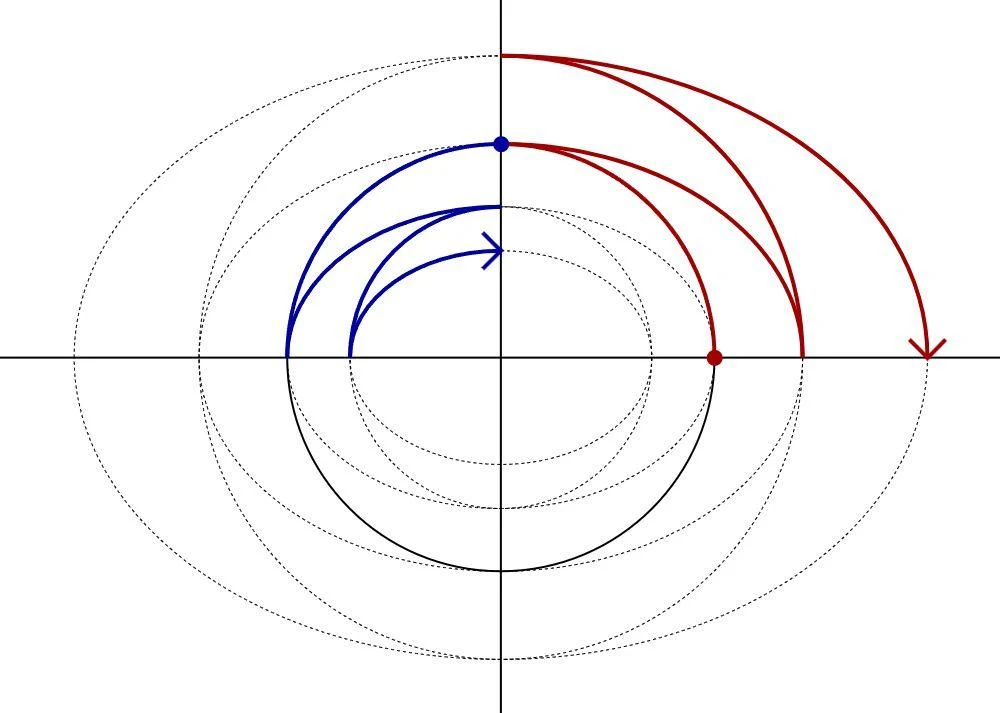
In 2019, a group of theorists asked a simple question: what would happen if you embedded a single irreversible element into an ordinary quantum computer, a gate that slightly "eats" probability? The answer was devastating. Any such gate, no matter how weak, instantly turns the machine into a device capable of solving problems in the class PostBQP = PP. That is the class that includes problems that cannot be solved in reasonable time even on a quantum computer. Formally, the gate opens the door to the world of postselection: the ability to select only those branches of reality where everything went well.
Non-Hermiticity is a microscope that sees only the successful branches of reality, but each look comes at the price of exponentially small probability. In quantum mechanics, evolution is usually described by a Hermitian operator, which preserves total probability. But if you add imaginary parts, the system starts to behave differently: some states are amplified, others decay. This is exactly how photons behave in a lossy fiber: part of the light is absorbed, and only the "surviving" photons reach the detector. Physicists have long suspected that such conditional evolution could provide a computational advantage. But no one knew how large it could be and what the cost would be.
The authors constructed an explicit "postselection gadget" from any irreversible gate surrounded by suitable unitary operations. The key step is the singular value decomposition of the non-Hermitian operator, which isolates the largest and smallest stretch factors. By repeating such a gate a polynomial number of times, one can exponentially suppress the unwanted component of the state, mimicking a projector. For the upper bound, they use purification of the non-Hermitian evolution to a unitary on an extended system, followed by postselection on the measurement qubit. In simple terms, a non-Hermitian gate is a disguised postselection: it seems to "know" which outcome we need and discards all others.
Before this work, it was unclear whether non-Hermitian quantum advantages could be scaled without hidden costs. Now it is clear: any irreversible gate combined with universal unitary gates gives the power of postselection, and hence is not efficiently realizable. The practical benefit is a criterion for rejecting unrealistic protocols. If someone proposes a lossy quantum simulator that supposedly outperforms classical computers, one should ask: what is the success probability of your postselection? If it is exponentially small, the advantage is illusory.
The circle closes. A microscope that sees only successful branches ultimately shows a picture that cannot be obtained without repeating the experiment many times. And each repetition is a new attempt, a new roll of the dice. Non-Hermitian gates promise a shortcut, but the toll for passage is an exponentially small probability. And this is not a flaw of a particular implementation but a fundamental law: irreversibility in quantum computing always costs more than it seems.
The single-qubit non-Hermitian Hamiltonian H = iσ_z suppresses the |1⟩ component as $e^{-2t}$ over time t. If t grows linearly with the number of qubits, the suppression becomes exponential, which is the simplest postselection gadget.
The idea of postselection as a computational resource is explored in Ted Chiang's story "Story of Your Life": the protagonist sees only those branches of reality where the required condition is met. Non-Hermitian dynamics formalizes exactly this kind of branch selection.