Assembling the Quantum Puzzle Piece by Piece ✛
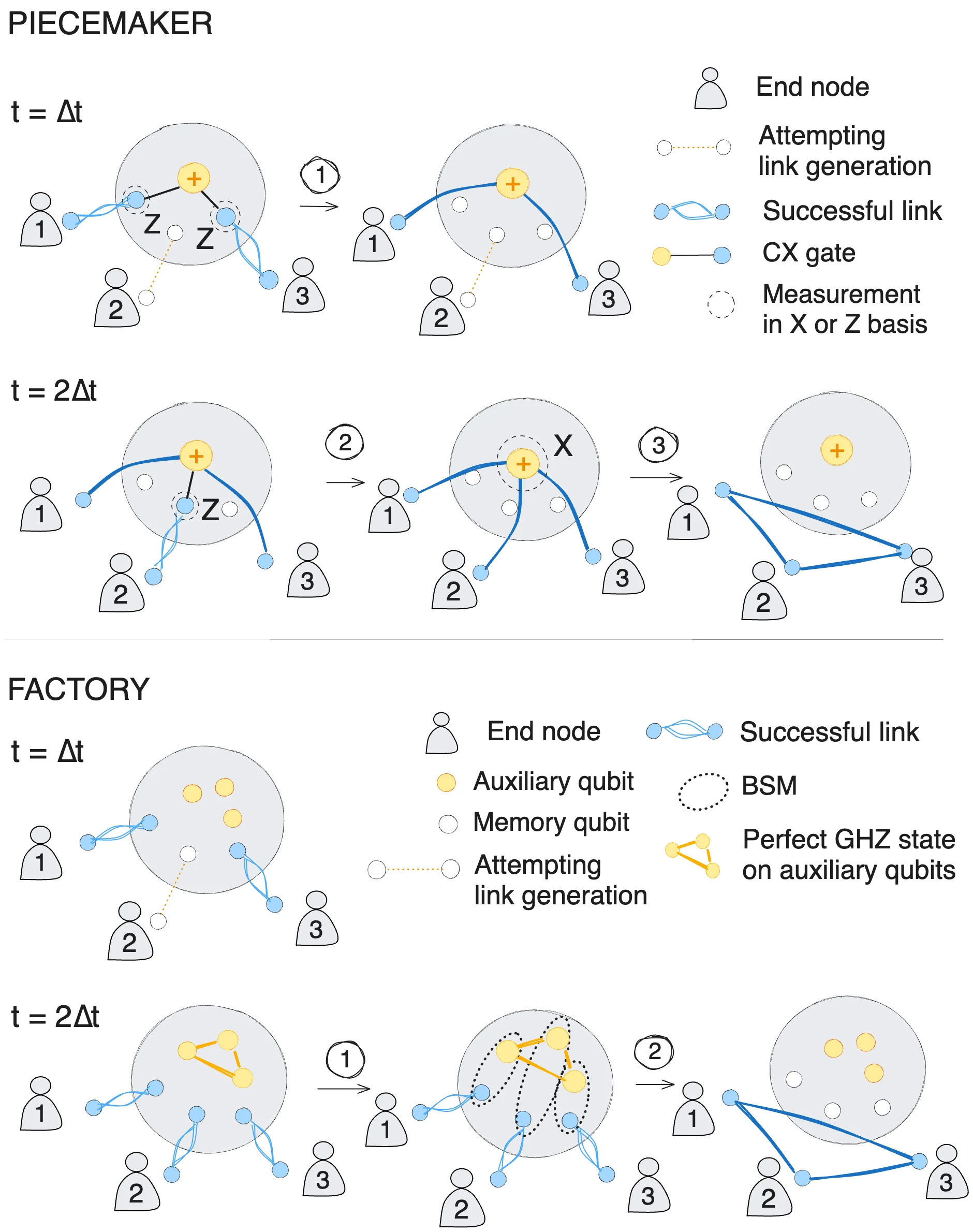
Assembling a puzzle as pieces arrive, rather than waiting for the complete set, is the philosophy behind a new protocol for distributing quantum entanglement. In quantum networks, where nodes exchange Bell pairs, the traditional approach resembles a patient assembler who waits until all pieces are on the table before starting. But quantum pieces cannot tolerate waiting: each Bell pair locked in memory slowly loses its quantum properties due to decoherence, an inexorable noise that blurs the state's purity.
The Piecemaker protocol changes the game. Instead of accumulating all Bell pairs, it processes each new pair immediately as it appears. To do this, it uses a minimal vertex cover of the graph state: a set of qubits that must be stored to cover all connections. This strategy keeps only the necessary minimum in memory, reducing waiting time and thus accumulated noise. Numerical simulations using the QuantumSavory.jl package in Julia, including up to $10^5$ Monte Carlo trials, showed impressive results: for GHZ states up to 50 qubits, infidelity reduction reached 45% compared to the Factory protocol.
The key advantage of Piecemaker is expanding the parameter region where fidelity exceeds the 1/2 threshold for genuine multipartite entanglement. For example, at depolarizing probability $p_{depo}$l=0.005, the minimum successful pair generation probability $p_{link}$ drops from 0.2 to 0.1. This means the protocol works even under adverse conditions when communication links are unreliable. In heterogeneous networks with different line lengths, Piecemaker also shows robustness: fidelity drop is only 1.6% versus 2.5% for Factory.
Generalizing the protocol to arbitrary stabilizer states opens doors to a wide range of applications. Using local Clifford equivalence of graph states, the authors showed that Piecemaker applies not only to GHZ states but also to paths, lattices, and other graph structures. For these states, improvements are more modest but significant: up to 0.074 in fidelity and 19% in infidelity. Such versatility reduces hardware requirements, since single-qubit operations suffice at end nodes.
The future of the protocol lies in implementation on real hardware, for example, on nitrogen-vacancy centers in diamond. Gate noise, which was considered negligible in the current work, also needs to be accounted for. If these obstacles can be overcome, Piecemaker could become a cornerstone of the quantum internet, where entanglement quality determines the reliability of distributed computing, quantum sensors, and secure communication. Assembling the puzzle piece by piece turns out to be not only a beautiful idea but also a practical path to scalable quantum networks.
The name Piecemaker is a play on words from 'piece' and 'peacemaker': the protocol assembles the state piece by piece, like a puzzle.