Fast Quantum Links: Delivered Before They Melt ✛
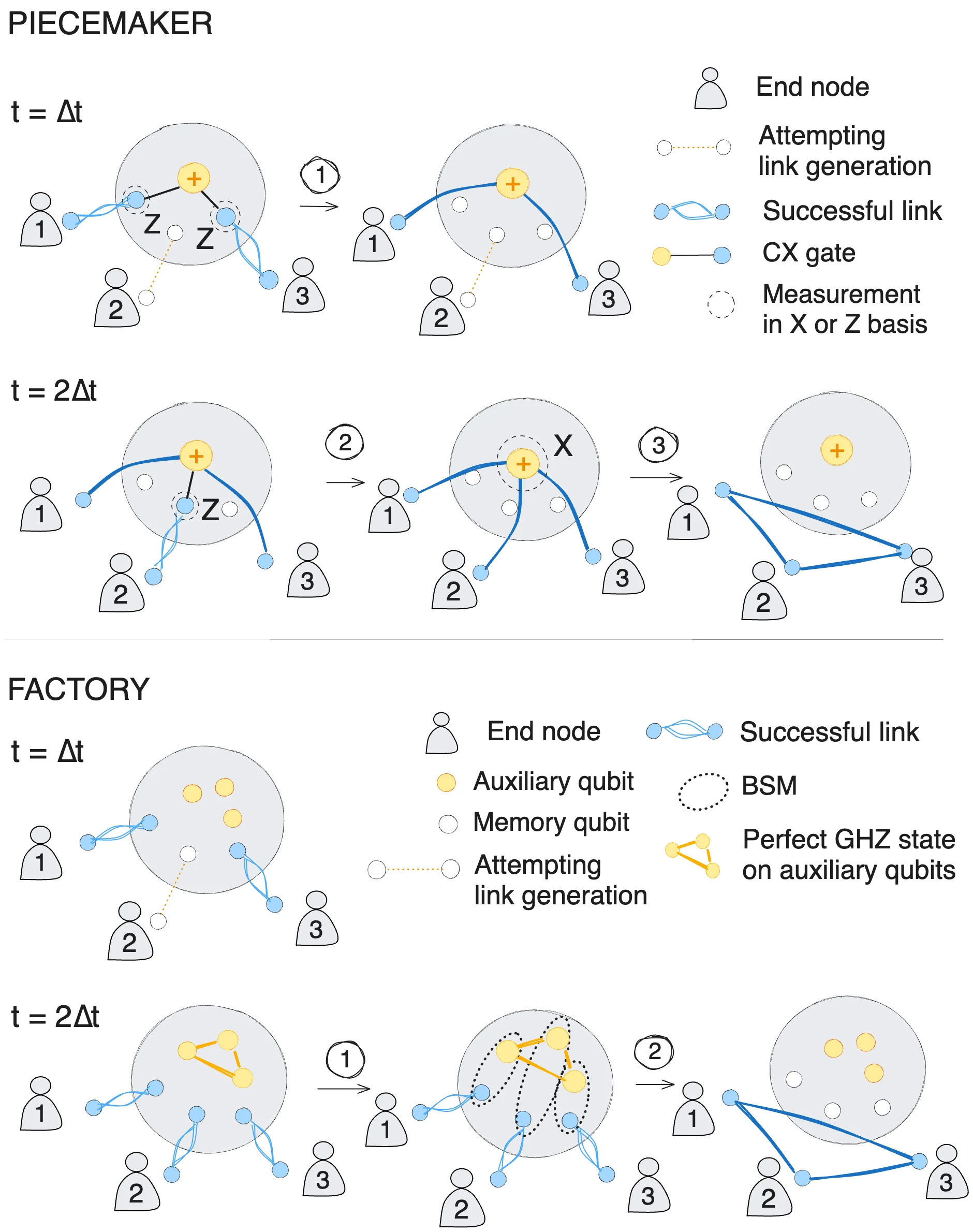
Quantum entanglement between distant points degrades over time — noise increases entropy, much like heat melts ice cream. Traditional methods wait for all pairs to appear before assembling a multipartite state. But delay spoils quality.
A new protocol acts without waiting: each Bell pair, delivered by photons at speed of light, is used immediately. Its mathematical trick is a “vertex cover” in the connection graph. This is a minimal set of nodes that holds the whole network together, like a few dominoes in a chain. Only this core is stored, while other connections are updated on the fly. The idea relies on stabilizers — recipes for quantum states developed by Daniel Gottesman.
The result: in simulations of up to 50 qubits, the error drops by 45%. The protocol confidently reaches the threshold fidelity of ½ even when noise is strong. From this threshold onward, multipartite entanglement becomes practically useful. The quality of the final “assembly” is assessed by photometry — like a dosimeter for melted ice cream.
Today’s record entangled ensemble is 20 qubits. The new method targets 50+, reducing melting and bringing the quantum internet closer.