Piecemaker: How to Distribute Entanglement Without Waiting for Everyone ✛
Context
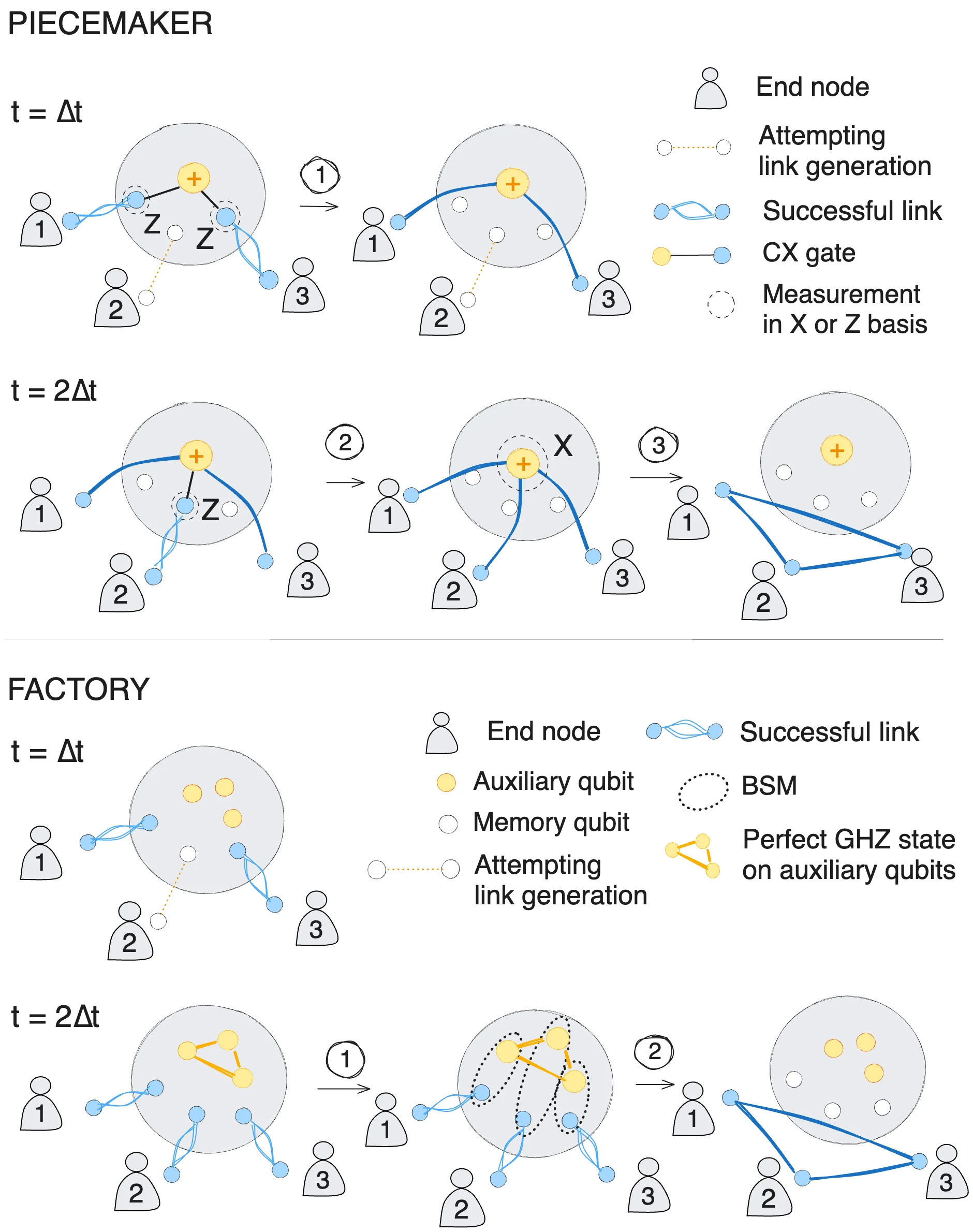
This work fits into active research on distributing multipartite entanglement through quantum switches. Existing schemes, such as Factory, wait for all Bell pairs to be created before teleporting the target state, which leads to noise accumulation in memory. Related work explores quantum communication over parallel channels, energy teleportation, and the quantum internet, but this paper stands out for its focus on saving storage time through partial processing.
Methods
The authors model a star-shaped network with a central switch and n end nodes, each with one memory qubit. Bell pairs are generated probabilistically with success probability $p_{link}$, and the memory is subject to depolarizing noise with probability $p_{depo}$l per round. The Piecemaker protocol uses minimal vertex covers of graph states up to local complementation to determine which pairs to store. Simulations were performed using the QuantumSavory.jl package in Julia, with up to $10^5$ Monte Carlo trials.
Results
For GHZ states up to 50 qubits, Piecemaker achieves a maximum infidelity reduction of 45% and a fidelity increase of 0.22 compared to Factory. The protocol expands the parameter region where fidelity exceeds the 1/2 threshold for genuine multipartite entanglement: for example, at $p_{depo}$l=0.005, the minimum $p_{link}$ drops from 0.2 to 0.1. In heterogeneous networks with different line lengths, Piecemaker is less sensitive to imbalance: a fidelity drop of 1.6% versus 2.5% for Factory. For general graph states, improvements are smaller but significant: up to 0.074 in fidelity and 19% in infidelity for paths and lattices.
Implications
Unlike related work that often focuses on GHZ states or purely photonic schemes, this paper offers a universal method for arbitrary stabilizer states, using only single-qubit operations at end nodes. This reduces hardware requirements and makes the protocol applicable to a broader class of tasks, such as blind quantum computing and secret sharing.
Future development
Future research could include introducing a cutoff time to discard overly noisy pairs, using idle qubits for parallel state generation or entanglement distillation. It is also important to assess the impact of gate noise, which is considered negligible in this work.
Impact
The protocol could improve quantum sensors, distributed computing, and quantum internet networks, where entanglement quality is critical.
Next steps
The next step is to implement the protocol on real hardware, for example, on nitrogen-vacancy centers in diamond, and to test its robustness against non-ideal gates.
Key open problems
This work directly addresses the scalability problem of quantum networks: how to maintain entanglement as the number of nodes grows and memory coherence time is limited. The proposed approach partially solves it by minimizing storage time.
The knowledge machine's view
This section is addressed to the author of the paper and their colleagues. Neighbouring works were found by meaning-based search across our archive, not by word overlap. We do not review: we show the field around the work.
What the work does
The authors propose the Piecemaker protocol for distributing multi-qubit entangled states, processing each new Bell pair immediately and storing only a minimal set of qubits. Numerical simulations for systems up to 50 qubits show a reduction in infidelity of up to 45% compared to the Factory protocol, and the protocol is generalized to arbitrary stabilizer states via local Clifford equivalence of graph states.
Where its strength is
The strength of the work lies in its universal method for arbitrary stabilizer states, which uses only single-qubit operations at end nodes, thereby reducing hardware requirements and broadening applicability.
Where it could go next
- It might be interesting to see how Piecemaker's ideas combine with methods from the work on quantum communication over 16 parallel channels, which explores multiplexing to boost throughput.based on: Quantum Communication on 16 Parallel Channels arXiv:2608.18666v1
- A related approach comes from the work on quantum state shadows: using random measurements to efficiently estimate state properties could help monitor the quality of distributed entanglement in real time.based on: Shadows of Quantum States: How to Measure Faster and More Accurately arXiv:2603.28307
- A possible direction is integrating with error correction methods that use noise as a resource, as in the work on noise that helps correct errors.based on: The Noise That Helps Fix Errors arXiv:2608.09583v1
Worth trying
- Test Piecemaker in networks with parallel channels to see if combining it with multiplexing yields additional advantages.
- Use random measurements to quickly assess the fidelity of distributed states without full tomography.
- Investigate whether the protocol can be adapted to scenarios where memory noise is correlated with channel noise.
Why this may matter
Extending applicability to arbitrary stabilizer states and lowering hardware demands could make entanglement distribution more practical for quantum networks, including tasks such as blind quantum computing and secret sharing.
Nearby works in our archive
- How to Keep a Supercomputer from Gridlocksimilarity 0.54
- The Noise That Helps Fix Errorssimilarity 0.51
- The Quantum Secret to Faster AI Trainingsimilarity 0.51
- Shadows of Quantum States: How to Measure Faster and More Accuratelysimilarity 0.50
- Quantum Translator: How to Hear an Errorsimilarity 0.50
- Topology by Aroma: How One Spin Gives Away the Quantum Phasesimilarity 0.50
- Quantum Communication on 16 Parallel Channelssimilarity 0.49
The archive is sparse around this work: the closest review is only 0.54, against a usual 0.64. It looks like few have drilled nearby.
The name Piecemaker is a play on words from 'piece' and 'peacemaker': the protocol assembles the state piece by piece, like a puzzle.
Key numbers
- maximum infidelity reduction: 45%
- maximum fidelity increase: 0.22
- number of end nodes up to: 50
- fidelity threshold for GHZ: 0.5
- depolarizing probability: 0.001–0.078