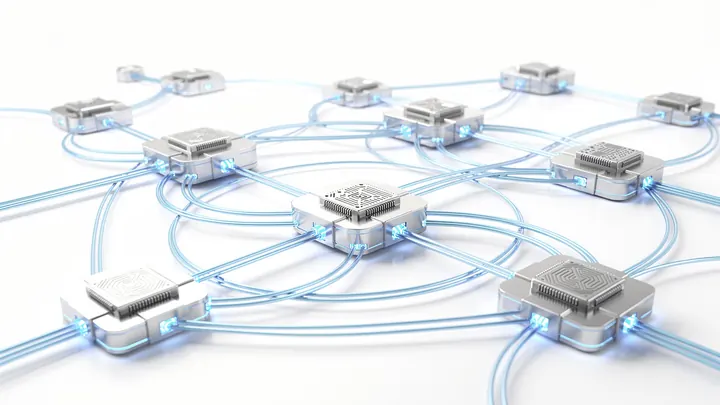
The quantum internet is a proposed network that uses the principles of quantum mechanics to transmit information, most commonly via photons, in ways that classical networks cannot. Unlike today's internet, which sends bits as electrical or optical pulses that can be copied and read, a quantum internet encodes data in quantum states, such as the polarization or phase of a single photon. This enables two revolutionary capabilities: unconditionally secure communication, where any eavesdropping attempt is detectable, and the distribution of entanglement, which allows quantum computers and sensors to work together in ways that are impossible with classical links.
History
The concept emerged in the 1990s, building on ideas from quantum cryptography and quantum teleportation. Early proposals by physicists such as Artur Ekert and Charles Bennett laid the groundwork, but the term 'quantum internet' gained traction in the 2000s with theoretical frameworks by H. J. Kimble and others. Experimental demonstrations have been ongoing since the early 2000s, with significant milestones in recent years.
How it works
The core mechanism is the transmission of quantum bits, or qubits, carried by photons through optical fibers or free space. Because quantum states are fragile, the network relies on specialized components: quantum repeaters to extend range, quantum memories to store states temporarily, and entanglement swapping to connect distant nodes. A key challenge is that photons can be lost or altered, so protocols like quantum teleportation—where a quantum state is transferred without physically moving the particle—are used to relay information faithfully. Recent advances include using atomic clouds to convert light frequencies, enabling compatibility with existing fiber infrastructure, and shaping photons to carry more information per pulse.
In practice
The quantum internet is being developed for secure communication in banking, government, and healthcare, as well as for linking quantum computers in the cloud to boost their processing power.
Fun fact
In 2024, researchers demonstrated a quantum network that served 200 users simultaneously, protected by fundamental physics rather than computational assumptions.
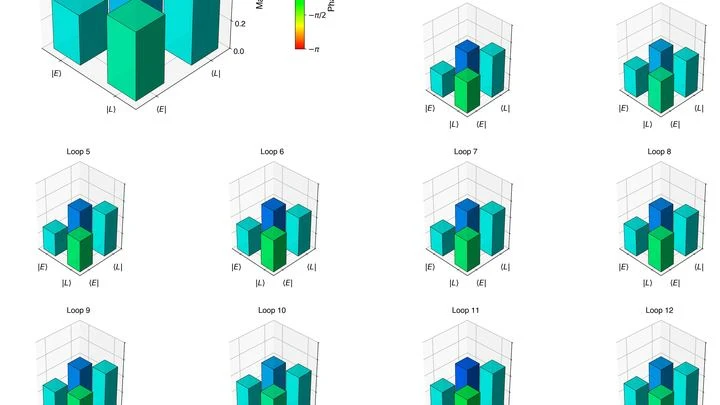
The quantum networks of the future resemble the Tower of Babel: each node speaks its own dialect. Some store information in the polarization of a photon — the direction of oscillation of the light wave. Others use time bins: that is, when exactly the pulse arrives.
Data on the internet travels at the speed of light through fiber optics. In classical networks, delays aren't critical, but for quantum communication, perfect synchronization is essential: particles of light with encoded information must converge at the detector in the same instant.
Erasing even a single bit means releasing heat. This discovery by Rolf Landauer hinted that information is neither material nor illusory. Imagine that every event casts a shadow: that is information, the collection of all unrealized possibilities.
An ordinary envelope has a rectangular shape, and the letter inside does not change the envelope's properties. With photons, particles of light, the situation is different: their 'shape' in time can vary, and this shape itself carries information.
An ordinary laser beam carrying quantum keys trembles at the slightest movement, like a flashlight in the hand of a running person. The drone vibrates, the rover shakes, and the code falls apart. The authors figured out how to align the polarization of light (the direction of its oscillations) on both ends of the line on the fly.
Standard optical fiber is like a glass thread that carries light. But when you send weak quantum signals (individual photons) and powerful classical laser light through it at the same time, trouble arises. The glass slightly scatters light: this is called Raman scattering.
Two photons fly out of a tiny box, and behave like twins who always wear matching outfits. Turn one, and the other instantly turns the same way, even if they are kilometers apart. This is no magic trick but quantum entanglement: a connection between particles that defies distance.
Researchers have built a compact source of such pairs.
The quantum network works like a series of turnstiles that open only for a pair of perfectly synchronized photons. The central node tells them which turnstile to go to, but cannot forge the synchronization. 200 users can communicate with each other over distances up to 200 km — about the size of a large city.
The idea of quantum teleportation was proposed by Charles Bennett and realized by Anton Zeilinger. It uses entanglement — when two particles are in sync, like two sheets of paper that instantly copy the same drawing. But earlier, the "ink" would blur, ruining the blueprint.
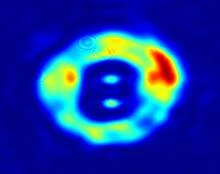
When light passes through biological tissue or frosted glass, it scatters and loses the image. Researchers at the Paris Institute of Nanosciences have shown that a scattering medium can be tuned to transmit images encoded in the correlations of entangled photons while remaining opaque to classical light.
Inside a cryostat cooled to tens of millikelvins live superconducting qubits. There aren't many of them: tens, at most hundreds. Crosstalk and thermal noise prevent packing more. But cracking RSA-2048 requires anywhere from ten thousand to ten million physical qubits.
Quantum computing promises a revolution, but its real power will only unfold in a network. The best “brains” — superconducting qubits — communicate at microwave frequencies. The ideal “couriers” — optical photons — fly at hundreds of terahertz. A direct hookup is impossible.