Entanglement generation is the process of creating a quantum state in which two or more particles are correlated in such a way that the state of one particle cannot be described independently of the others, even when separated by large distances. This phenomenon, which Albert Einstein famously called 'spooky action at a distance,' is a cornerstone of quantum mechanics and has no classical analog. Entangled particles share a single quantum state, and measuring one instantly determines the state of the other, regardless of the distance between them. This property is not just a theoretical curiosity; it is a resource that enables technologies like quantum computing, quantum cryptography, and quantum teleportation.
History
The concept of entanglement was introduced in 1935 by Einstein, Boris Podolsky, and Nathan Rosen in their famous EPR paper, which questioned the completeness of quantum mechanics. The term 'entanglement' itself was coined by Erwin Schrödinger later that year. The first experimental generation of entangled photons was achieved in 1970 by John Clauser and Stuart Freedman, with subsequent experiments by Alain Aspect in the early 1980s providing strong evidence for the violation of Bell's inequalities.
How it works
Entanglement can be generated through several physical mechanisms. One common method is spontaneous parametric down-conversion, where a nonlinear crystal splits a single high-energy photon into two lower-energy photons that are entangled in their polarization or momentum. Another approach is to use quantum gates in a controlled environment, such as a trapped ion or superconducting qubit, where interactions between particles are engineered to create entanglement. In all cases, the key is to create a superposition of joint states—for example, a pair of photons in a state where both are horizontally polarized or both vertically polarized, but not a mixture of the two—so that the particles are intrinsically linked.
In practice
Entanglement generation is used in quantum key distribution to create secure communication channels, in quantum teleportation to transfer quantum states between distant locations, and in quantum computing to perform operations that are exponentially faster than classical computers.
Fun fact
In 2017, scientists successfully entangled two photons over a distance of 1,200 kilometers using a satellite, demonstrating that entanglement can be maintained across global distances.
A quantum computer isn't just a bunch of qubits: it's a whole city, where each resident is one of the machine's possible states. Residents get to know each other through weak interactions between qubits: if one state can transition to another, a thread of acquaintance is drawn between them.
A quantum computer relies on two forces: entanglement (particles behaving as a single whole) and "magic"—a measure of how far a state is from familiar classical physics. But how these two resources relate as a many-particle system evolves in time has remained a puzzle.
The authors approached the problem through time.
Quantum entanglement — a phenomenon where the states of two or more particles become interconnected regardless of the distance between them — usually links intrinsic properties such as spin or polarization. However, a new experiment has for the first time realized entanglement of the positions of two atoms in space.
Two dice lie in different rooms. If they are 'entangled,' a roll of one instantly determines the outcome of the other — even at a distance. In the quantum world, such a link is called steering: one party, by performing measurements on their side, seems to dictate the state of the partner.
Two tiny mirrors in a vacuum are like figure skaters in a pairs routine. Their oscillations are synchronized by an invisible gravitational thread. When cooled to millionths of a degree above zero, this thread turns them into a single quantum link — the motion of one instantly echoes in the other.
Quantum entanglement is a fragile thing. Two friends move to different cities, each carrying a box with one of a pair of gloves: if one box has the left glove, the other has the right. Entangled particles behave similarly, except that until measurement, no one knows which is where.
The riddle of quantum gravity has troubled minds for nearly a century. A classical field that curves spacetime refuses to fit into the probabilistic world of superpositions. Can gravitation, while remaining macroscopic, give rise to microscopic entanglement?
On the surface of a tiny sphere live two invisible fields, like two kinds of ripples on a soap bubble. These fields don't just oscillate on their own: they constantly influence each other, like musicians playing in unison. In a new study, physicists derived exact equations that describe how this ripple changes over time, heats up, and descends into chaos.
Picture two choirs in soundproof rooms on a wobbly stage. They sing, but can't hear each other — the air doesn't carry the tune. Yet if the stage trembles, its vibrations link their songs. That's the idea behind a new test for quantum gravity.
Two musicians play a duet. In a perfect hall, they hear each other perfectly and gradually fall into resonance. But try playing in a room where someone keeps slamming the door. You'd think the rhythm would be thrown off. But no: sometimes that very random slam makes both of them sync up instantly.
Atoms settled along a chain of traps, like a line of coastal forts. Nearby, a quantum sea: a Bose-Einstein condensate (a substance with zero resistance, where particles move as a single wave).
In the quantum world, you cannot create a copy of an unknown particle's state – this was established by William Wootters and Wojciech Zurek in 1982, and Charles Bennett turned this prohibition into a data protection tool.
An ion quantum computer is like a chandelier with a dozen pendants: pull one, and they all start swinging. Each ion is a qubit, but when there are many, their collective vibrations crowd the stage. Any operation on one pair disturbs the neighbors, and the computation goes awry.
Picture heavy balls resting on a stretchy trampoline: each one sinks into the fabric, and their dents overlap, causing the balls to roll toward each other. This analogy helps explain how gravity — the curvature of spacetime — links massive particles. But what if you bring gravity and quantum mechanics together?
A single calcium ion hovers in a vacuum trap, held by electric fields like a pea in an invisible bowl. Around it are two mirrors forming an optical cavity: light bounces between them, amplifying the interaction with the ion.
In the everyday world, order preserves and disorder destroys. But in quantum computing, this logic is turned on its head. Consider a diamond: carbon atoms with their nuclei and electrons behave like tiny magnets capable of storing a quantum "whisper"—information encoded in the orientation of their spins.
Picture an orchestra of 120 musicians playing in perfect unison — one false note and the harmony crumbles. That's the metaphor for a record-breaking quantum ensemble. Physicists have for the first time entangled 120 superconducting qubits, the building blocks of future computers.
In 1989, John Wheeler proposed a bold idea: "it from bit," meaning everything that exists arises from information. For a long time, this remained a beautiful metaphor, but now physicists have found a concrete mechanism that turns bits into particles.
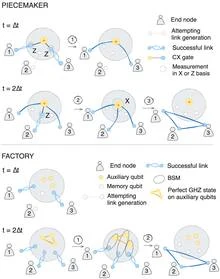
Assembling a puzzle as pieces arrive, rather than waiting for the complete set, is the philosophy behind a new protocol for distributing quantum entanglement. In quantum networks, where nodes exchange Bell pairs, the traditional approach resembles a patient assembler who waits until all pieces are on the table before starting.
Heat flow usually evens everything out: hot things cool down, cold things warm up, and in the end you are left with a uniform warm swamp. The same holds in the quantum world: the environment, whether a crystal lattice or a gas of photons, tends to destroy the fragile entanglement between particles.
A wave rolls onto the sand, leaving a pattern of foam and shells. A moment later it recedes, but the traces are no longer the same: the sand is smoothed, the shells are flipped over. Something similar happens in the quantum world when a system moves from a nonequilibrium state toward equilibrium.
Spontaneous emission, the very process that lights up lamps and stars, has long been considered a pesky noise in quantum physics. This cacophony of random photons ruthlessly destroys fragile quantum entanglement, like radio static drowning out a distant melody.
In a chain of eight spins, a defect lurks — a tiny magnetic moment. The Kondo effect, known since the 1930s, makes electrons around it align into a collective screen. The material's resistance abnormally increases. But detecting such an impurity hidden deep in the structure is like finding a stone at the bottom of a dark pond.
A drop of ink in a glass of water quickly spreads, tinting the whole liquid. Similarly, electrons in a metal move freely, like molecules in a gas. But when a magnetic impurity, an atom with its own magnetic moment, enters this medium, something strange happens.