Supernovae Point to a Changing Dark Energy express
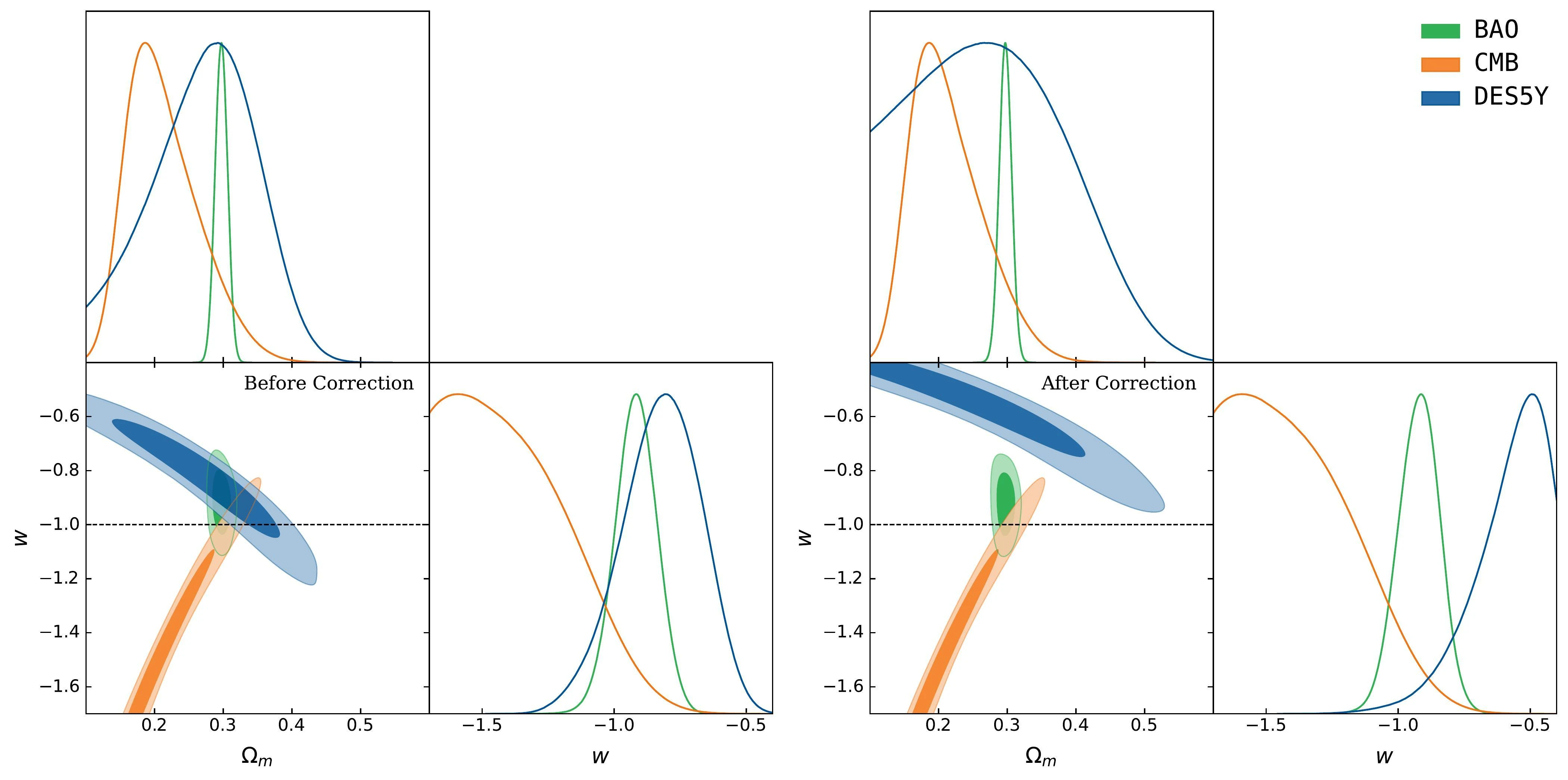
Astronomers use Type Ia supernovae as candles. Their brightness was thought to be unchanging. The discovery of the Universe’s acceleration using them brought a Nobel Prize to Riess, Perlmutter, and Schmidt. But measurements of the parent stars’ ages revealed: the older, the dimmer the explosion (5.5 sigma). The farther we look, the brighter supernovae appear — this distorts the picture of the Universe’s expansion. It’s like old candles giving off less light, and we misjudge distances.
Adding to the analysis the ‘echoes’ of the early Universe (baryon acoustic oscillations) and the cosmic microwave background, the contradiction with a constant dark energy intensifies to a staggering 9 sigma. The most unexpected outcome: the Universe’s acceleration may have already stopped.
Original abstract
as written by the authors arXiv:2510.13121
Supernova (SN) cosmology is based on the key assumption that the luminosity standardization process of Type Ia SNe remains invariant with progenitor age. However, direct and extensive age measurements of SN host galaxies reveal a significant (5.5{\sigma}) correlation between standardized SN magnitude and progenitor age, which is expected to introduce a serious systematic bias with redshift in SN cosmology. This systematic bias is largely uncorrected by the commonly used mass-step correction, as progenitor age and host galaxy mass evolve very differently with redshift. After correcting for this age-bias as a function of redshift, the SN dataset aligns more closely with the w0waCDM model recently suggested by the DESI BAO project from a combined analysis using only BAO and CMB data. This result is further supported by an evolution-free test that uses only SNe from young, coeval host galaxies across the full redshift range. When the three cosmological probes (SNe, BAO, CMB) are combined, we find a significantly stronger (> 9{\sigma}) tension with the {\Lambda}CDM model than that reported in the DESI papers, suggesting a time-varying dark energy equation of state in a currently non-accelerating universe.
Type Ia supernovae are born when a white dwarf pulls matter from a companion star and, reaching a critical mass, explodes. Despite the ‘Ia’ label, they have nothing to do with stellar classes — it’s a historical classification based on spectra.