Supernovae as Probes of Dark Energy Evolution express
Astronomers use Type Ia supernovae — thermonuclear explosions of white dwarfs — as 'standard candles': their peak luminosity was long thought to be the same everywhere in the universe. These objects led to the discovery of the accelerated expansion of the universe, for which Adam Riess, Saul Perlmutter, and Brian Schmidt received the Nobel Prize. However, new measurements of the ages of progenitor stars — those that ultimately produce supernovae — have revealed a statistically significant correlation: the older the system, the fainter the explosion. The reliability of this relation reaches 5.5 sigma, moving it from hypothesis to established effect. This creates an optical illusion: distant (and thus younger in cosmic terms) supernovae appear brighter than they 'should', leading us to systematically underestimate their distances. The candle analogy is apt but requires a caveat: unlike wax candles, whose brightness depends on the wick and composition, here the 'dimness' is inherent in the age of the progenitor star itself, making the distance scale nonlinear.
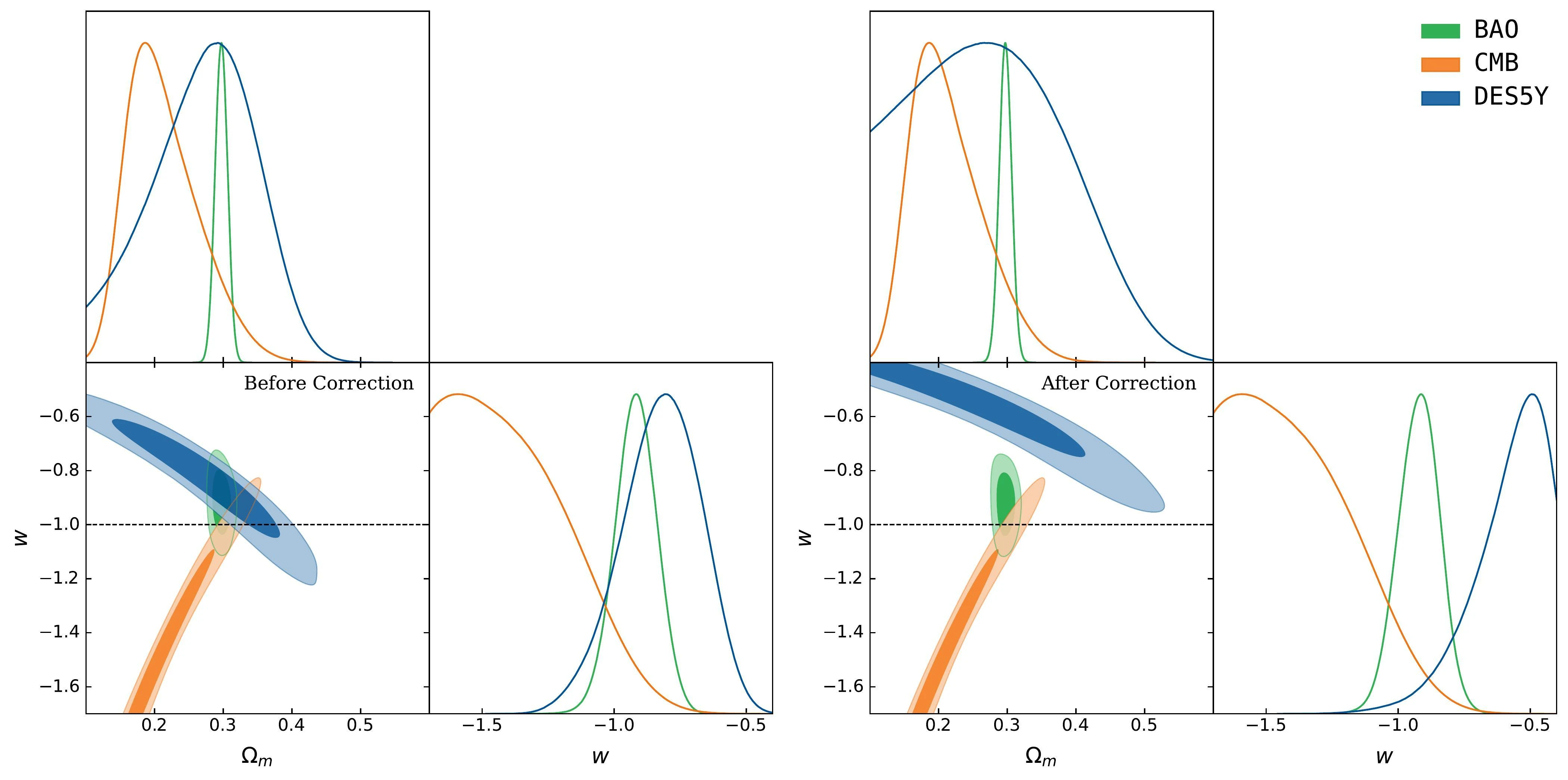
If two independent probes are added to the supernova analysis — baryon acoustic oscillations (a kind of 'echo' of sound waves frozen into the galaxy distribution after recombination) and the cosmic microwave background (the microwave remnant from the hot early universe) — the discrepancy with the constant dark energy hypothesis grows to a staggering 9 sigma. In other words, three different cosmological probes point to the same conclusion: the density of dark energy likely varied over time. The most surprising inference from these comparisons is that the acceleration of the expansion of the universe, once thought irreversible, may have already ceased.
Type Ia supernovae occur when a white dwarf accretes matter from a companion star and, upon reaching a critical mass, explodes. Despite the 'Ia' designation, they have nothing to do with stellar classes — it is a historical classification based on spectra.