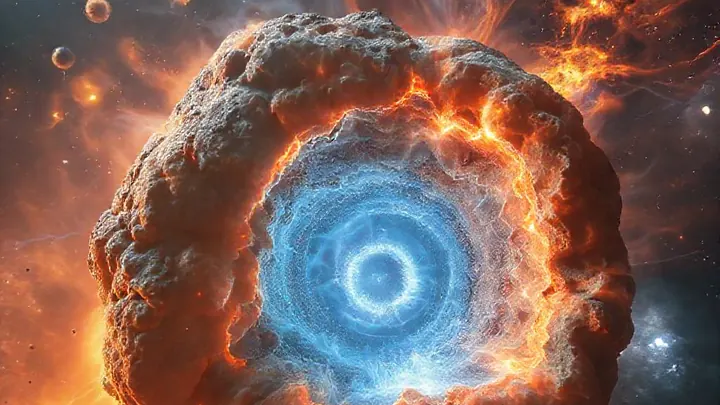
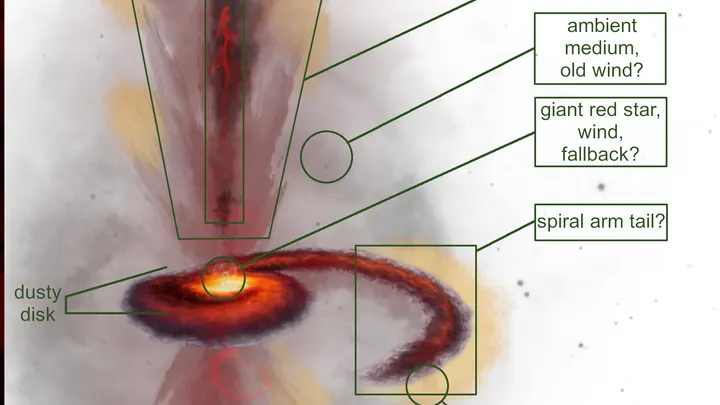
A progenitor is the massive star that exists before a supernova explosion. It is the 'parent' star whose life ends in a cataclysmic event, leaving behind a compact remnant such as a neutron star or black hole. Understanding progenitors is crucial because their properties—mass, metallicity, rotation, and binarity—determine the type of supernova, the nature of the remnant, and the chemical enrichment of the surrounding galaxy. For example, a single massive star (above ~8 solar masses) collapses as a core-collapse supernova, while a white dwarf in a binary system can explode as a Type Ia supernova.
History
The concept of a progenitor star emerged in the 1930s–40s with the work of Walter Baade and Fritz Zwicky, who proposed that supernovae are the collapse of massive stars to neutron stars. The term 'progenitor' became standard in the late 20th century as astronomers began identifying specific stars in pre-explosion images.
How it works
A progenitor star fuses lighter elements into heavier ones in its core, building up layers like an onion. When the core turns to iron, fusion no longer releases energy, and the core collapses under gravity in milliseconds. The infalling matter bounces off the newly formed neutron star, producing a shock wave that tears the star apart. The explosion's details depend on the progenitor's mass, rotation, and whether it has a companion star that strips its outer layers.
In practice
Identifying progenitors in archival images helps astronomers predict which stars will explode and calibrate supernova distances, which are used to measure cosmic expansion and dark energy.
Fun fact
The progenitor of the famous supernova SN 1987A was a blue supergiant star, not the red supergiant that models predicted—a surprise that reshaped theories of stellar evolution.
In a quiet back alley of a galaxy, where stars are rare and old, a light suddenly flares up, brighter than an entire galaxy. This is a Type Ia supernova: a thermonuclear explosion of a white dwarf that astronomers use as a standard candle to measure cosmic distances.
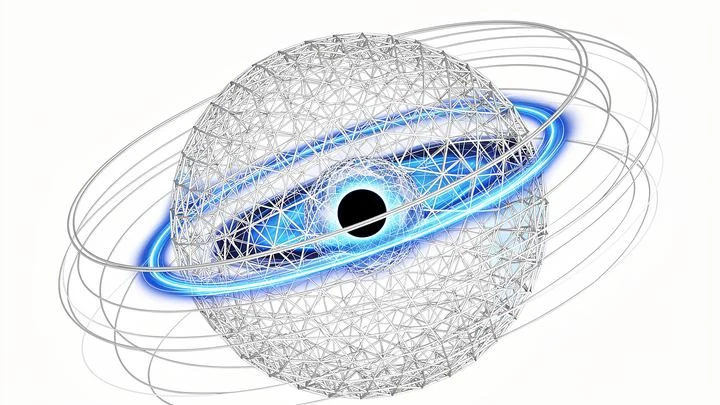
Twenty thousand years ago, the star that would become supernova 1987A put on a ring. Not one — three. The two outer ones, like lampshades, tilted relative to the equatorial ring, and the star's light, struggling through them, barely reached an observer who happened to be in the plane of the equatorial ring.
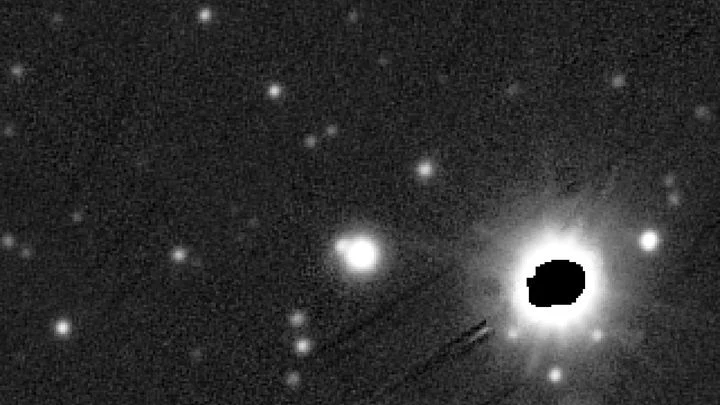
In the dense galaxy cluster Abell 2744, where gravity bends light like a lens, the James Webb Space Telescope spotted a new point of light. It appeared in images from 2023 and then began to change brightness. It was a supernova, the explosion of a dying star, but not just any kind: a Type IIP.
Cosmic rays are particles that race across our Galaxy at enormous speeds. Their energies can be millions of times higher than those of particles in the most powerful accelerator on Earth. But the higher the energy, the fewer such particles there are: the plot of their numbers shows a noticeable kink, which is called the knee.
Two stars circle each other like dancers who come together and drift apart. Over time, one swells, and its outer layers spill onto its neighbor. The star that receives foreign matter looks no different from a single star, but its surface remembers everything.
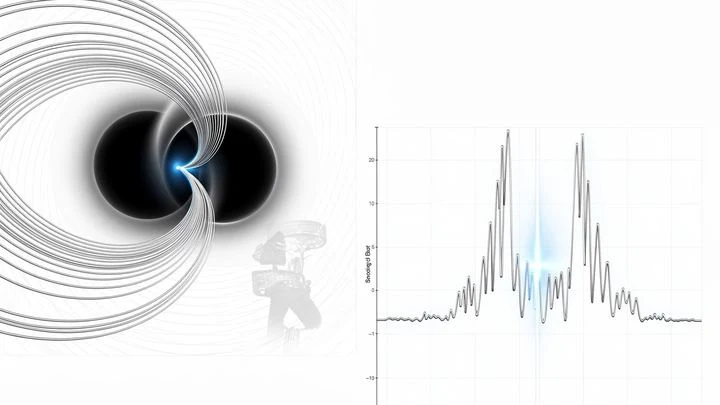
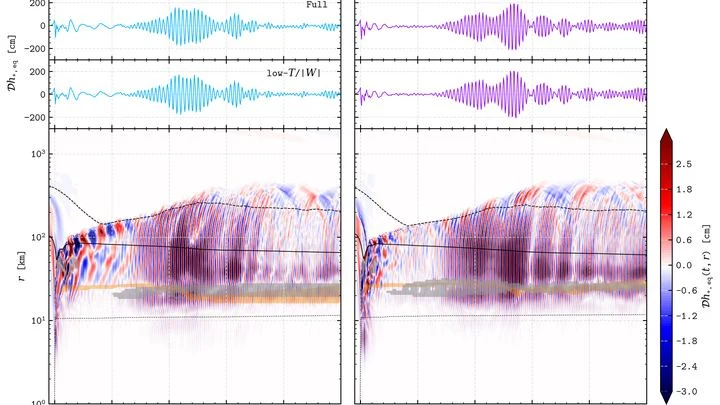
After a supernova explosion, a dense ball the size of a city remains at the center — a newborn neutron star. It is hot, compressed, and rings like a bell after being struck. These tremors, the star's oscillations, emit gravitational ripples that sensitive detectors on Earth can catch.
In the first moments after the Big Bang, matter and antimatter should have been created in equal amounts. But today, everything around us is ordinary matter, and antimatter is almost nowhere to be found. Where did it all go? The standard answer: a tiny imbalance in favor of matter wiped out almost all antimatter.
The explosion of a massive star is not just a flash: it's a blow to the surrounding gas. But until now, no one had looked at how the gas itself moves at the sites of such explosions. Now astronomers have gathered data on 33 nearby supernovae and for the first time measured the turbulence of the cold molecular gas around them.
A white dwarf is the former core of a star like the Sun, squeezed down to the size of Earth. A teaspoon of its material would weigh several tons. A neutron star is an even denser remnant: a city the size of Manhattan, but with more mass than the Sun.
The calm surface of a lake suddenly ripples — somewhere in the depths, an underwater cliff has collapsed. The water trembles almost imperceptibly, and the circles spread wider and wider until they reach a bobber near the shore.
17 supernovae from the ZTF DR2 sample lit up ahead of schedule. In the first hours and days after the explosion, they emitted more light than standard models predict. Astronomers compare this to a Bickford fuse: before the blinding flash tears across the sky, a precursor spark runs through the outer layers.
On August 6, 1181, Chinese astronomers spotted a new star in the constellation Cassiopeia. It shone for 185 days, slowly fading, and then vanished, leaving only a record in the chronicles. Today, at its location, there is a hot white dwarf — a compressed stellar core with no nuclear reactions, heated to tens of thousands of degrees.
Three milliseconds before the merger. A gargantuan black hole spinning at breakneck speed drags in a neutron star — a ball the size of a city but with 1.5 times the Sun's mass. Tidal forces stretch the star into a thread as thin as a needle and fling its matter outward.
The hunter of ancient light, the James Webb Telescope, aimed its mirrors at a tiny patch of sky and caught a strange beacon. The object, with the working name beacon_1420-$$5253_{4770}$$, flashed and faded. At first, it was logged as a candidate for the most distant galaxy, as if we were seeing it just 300 million years after the big bang.
It takes the stellar pair J05+50 nearly two months to complete one orbit around their common center. From Earth, it appears as a faint point in the constellation Hercules — 4625 parsecs away. Photometry of the binary star only captures a steady flicker of brightness, like the pulse of a giant heart.
At the centers of many galaxies, not only supermassive black holes lurk, but also vast clouds of invisible matter. If this matter consists of ultralight particles, it can gather into dense clumps — a kind of 'star' made of dark matter.
A detective story unfolded in the GWTC-5 catalog. Hundreds of signals from merging black holes, captured by the detectors of Rainer Weiss and his colleagues, held the secret to the origin of the most massive and rapidly spinning stellar-scale objects.
When JWST peered into the young universe at redshifts of 6–10, it revealed a scattering of mysterious 'little red dots' (LRDs). These objects combined features of galaxies and active nuclei, but their spectra refused to fit into familiar patterns.
Imagine a forest planted in a single day. At first glance, all trees look alike, but their cross sections tell different stories: some grew on clean soil, others on the ashes of ancient fires.
The birth of planets resembles the workings of a cosmic forge. Rocky blocks collide and fuse together. A powerful impact strikes a spark — material heats to white-hot and glows like cooling metal. Computer simulations show: the flash is visible from days to years, peaking at a tenth of the sun's light.
The galaxy NGC 1277 is like an old book that no one has opened for billions of years. It formed quickly at the dawn of the Universe and has barely changed since — no collisions with neighbors, no new layers added.
A shockwave erupts from the star's surface, and for a brief moment, a blinding flash of ultraviolet and X-rays is born. This very event, named EP260321a, was spotted by the Einstein space telescope in March 2026. The light took about 450 million years to reach Earth.
A massive star ends its life in a spectacular collapse: the core compresses into a neutron star or a black hole, while the outer layers fly off in a dazzling supernova.
The universe is full of the invisible. We know about dark matter from galaxy rotation and gravitational lensing, but its nature has eluded us for a century.
Elliptical galaxies are quiet stellar metropolises in retirement. By all rights, their light should be calm, reddish, like a sunset. But their spectra scream otherwise: in the far ultraviolet, these old-timers blaze like holiday lights. For three decades, astronomers have puzzled over this 'ultraviolet upturn' (UV upturn).
Somewhere in the galactic bulge, a massive star lies dormant, ready to trade quiet burning for collapse. Its core will exhaust its fuel, and in a fraction of a second, a neutron star or black hole will be born, releasing 10⁵⁸ neutrinos — almost all the energy of the explosion.
Eight hundred million years ago, in the main asteroid belt, a giant inkwell shattered. The parent body, over a hundred kilometers in diameter, made of primitive carbonaceous chondrites, suddenly broke apart near the J3:1 resonance with Jupiter.
The James Webb space telescope peered into an era when the Universe was less than a billion years old and discovered hundreds of strange objects there. Tiny yet dazzlingly bright, they glowed a deep red — like burning coals scattered across the black velvet of space.
The first two billion years after the Big Bang were an era when the universe resembled a boiling construction pit. Dark matter clumped the gas together, igniting the first stars. It seemed there simply wasn't enough time to assemble massive elliptical galaxies—'dormant' stellar metropolises — from this raw material.
In the silent theater of the cosmos, a star’s life plays out over billions of years. But sometimes an invisible director sneaks onto the stage — a primordial black hole.
In the heart of the Eagle Nebula, about 7000 light-years away, three giant pillars of gas and dust rise — the Pillars of Creation. Their shape is familiar to many from Hubble Space Telescope images. Now, Webb's infrared camera has allowed us to peer inside these dense cocoons where stars are born.
A figure skater pulls their arms in, and their spin suddenly accelerates. When a massive star exhausts its fuel and its core collapses, something similar happens, but on a cosmic scale. The core shrinks to a city-sized sphere, and if it is spinning rapidly, a peculiar instability can arise.
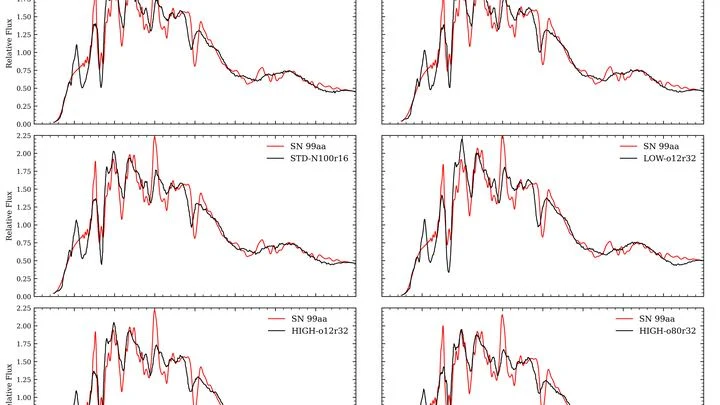
Two burned-out stars, each about the size of Earth but heavier than the Sun, spiral ever closer until one crashes into the other. The impact triggers a thermonuclear explosion, giving birth to a type Ia supernova. Such flashes serve as cosmic beacons for measuring distances across the universe. Yet the details of their origin remain hotly debated.
A pot of boiling porridge, where instead of grains there are layers of oxygen and silicon, and the fire beneath is about to go out, and the star will collapse in on itself. Until now, astrophysicist cooks have used a simplified recipe: they assumed that bubbles and eddies in the porridge obey one and the same average temperature throughout the depth.
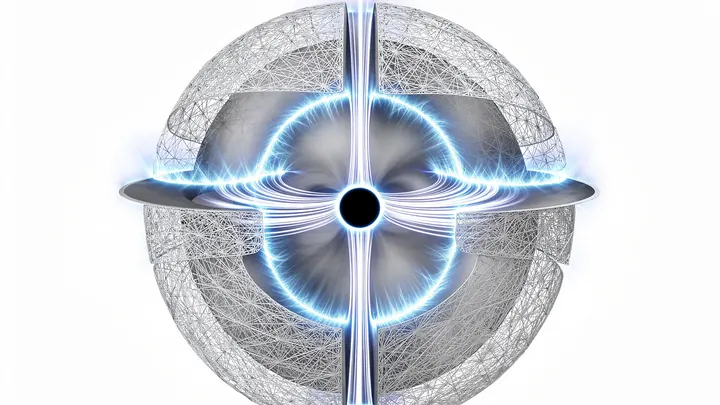
In the minutes before a massive star becomes a supernova, a hidden drama unfolds in its depths. A giant cauldron boils: matter churns, rotates, and invisible magnetic threads snap and rejoin. This moment, which has eluded direct observation, has now been recreated for the first time in three-dimensional computer models.
For a long time, a void yawned in the family of ultra-dense remnants of dead stars. Neutron stars, swift city-sized tops, rarely weigh more than two Suns. Black holes start at about five solar masses. Between them lies a 'gap' where for decades no object could be found.
A campfire that always blazes up to the same temperature — whether you toss a match into the center of a log or light several kindling sticks at the edges. That's roughly how Type Ia supernovas behave: cosmic explosions that astronomers use as rulers to measure distances across the universe.
Just after the Big Bang, clumps weighing as much as a trillion Suns and with an electric charge of colossal strength, like trillions of electrified balloons, could have drifted through space.
Two stars circle each other like dancers in a slow waltz. This dance is not eternal: the partners gradually draw closer until they collide and merge into a single entity. At that very moment, a red nova is born — a flash that lights up the sky for a few weeks, then slowly fades, enveloped in a dense cloud of dust.