A red giant is a large, cool, luminous star in a late stage of stellar evolution. It forms when a star like the Sun exhausts the hydrogen in its core and begins fusing hydrogen in a shell around the core. The outer layers expand enormously, cooling and turning red, while the core contracts and heats up. Red giants can be hundreds of times larger in diameter than the Sun but have surface temperatures of only about 3,000–4,000 K.
History
The term 'red giant' was coined in the early 20th century by astronomers like Ejnar Hertzsprung, who noticed a distinct group of cool, luminous stars on the Hertzsprung-Russell diagram.
How it works
When core hydrogen fusion ceases, the core contracts under gravity, releasing gravitational energy that heats the surrounding shell. This shell ignites hydrogen fusion, producing energy that pushes the outer layers outward. The expanded envelope cools, giving the star its red color. The star's luminosity increases dramatically because the larger surface area more than compensates for the lower temperature.
In practice
Red giants are used as distance indicators (via the tip of the red giant branch) and as laboratories for studying nucleosynthesis, as they produce elements like carbon and heavy metals.
Fun fact
When the Sun becomes a red giant in about 5 billion years, it will expand to engulf Mercury, Venus, and possibly Earth.
A little monster hides in a dwarf galaxy, and its neighbor feeds it. The satellite galaxy is slowly merging with a massive companion, and gas from the outer regions falls toward the center, where a black hole sits. By cosmic standards, it is not large: only 800 to 5000 solar masses, but its appetite is ferocious.
Two spinning tops whirl so close they nearly touch. One is scorching blue, the other dim white. Together they complete a full orbit in twenty hours. This is the pair Feige 64: a blue star with a mass of just a third of the Sun's, and a white dwarf, the cooled core of a former star, one and a half times heavier than our Sun.
The blue star seems too hot for its mass.
Galaxy NGC 5584 is a vast stellar city, where some neighborhoods are just being built while others are already marked by aging giants. To see both, astronomers used two very different flashlights. The ultraviolet telescope Swift lit up hot blue patches — stellar nurseries where massive stars have recently ignited.
A red giant in a globular cluster is a star in retirement. It has burned up the hydrogen in its core and now lives off fusion in a thin shell around a helium ash core.
Betelgeuse, the red supergiant familiar from Orion's shoulder, keeps surprising us. After the mysterious Great Dimming of 2019–2020, when the star suddenly dimmed, it didn't just recover; it changed its ways.
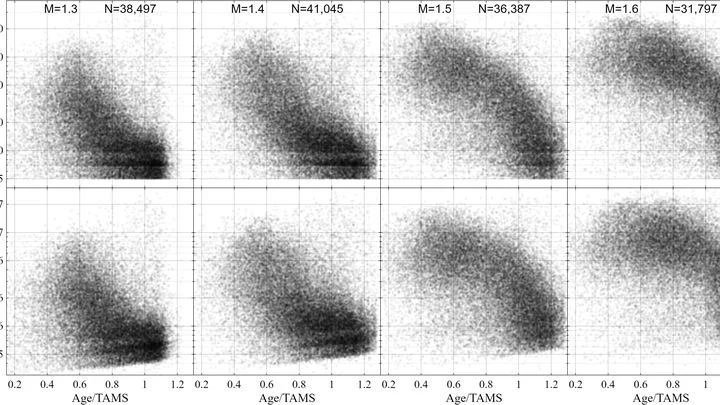
The most massive stars are like overinflated balloons: their envelope stops stretching and instead begins to furiously vent material. At a certain stage, the mass loss becomes so intense that the star stops growing in size. Astronomers see this moment as a kink in the diagram where stars are sorted by luminosity and temperature.
It takes the stellar pair J05+50 nearly two months to complete one orbit around their common center. From Earth, it appears as a faint point in the constellation Hercules — 4625 parsecs away. Photometry of the binary star only captures a steady flicker of brightness, like the pulse of a giant heart.
In a giant cosmic cradle, the Tarantula Nebula, astronomers took a close look at 122 massive stars, each at least 30 times heavier than the Sun. They measured the nitrogen abundance in their atmospheres, and the picture turned out to be unexpected.
In the Galactic bulge, where the light of billions of stars merges into a continuous glow, four cold giants passed unnoticed. You can't see them through a telescope — too far, too dim.
Massive stars are cosmic titans, living under the sign of indomitable energy. When such a star enters the B[e] supergiant phase, its radiation is so powerful that it would seemingly pulverize any molecule into atoms. The spectral lines, once systematized by Johann Balmer, blaze here with particular fury.
When two neutron stars, the ultra-dense cores of dead stars, collide, a kilonova is born: an explosion a thousand times brighter than a typical nova. This is the universe's true smelting works. In the scorching cloud racing outward at near-light speeds, a furious flux of neutrons transmutes atomic nuclei into gold, platinum, osmium.
The birth of planets resembles the workings of a cosmic forge. Rocky blocks collide and fuse together. A powerful impact strikes a spark — material heats to white-hot and glows like cooling metal. Computer simulations show: the flash is visible from days to years, peaking at a tenth of the sun's light.
In 5 billion years, the Sun, having exhausted its fuel, will start to swell, turning into a red giant. Like a balloon losing air, the star will weaken its gravitational grip, and Earth — a grain of sand on an invisible thread — will drift to a more distant orbit.
Previously, Uranus and Neptune were considered ice giants because of assumed thick layers of frozen water, methane, and ammonia. New calculations paint a different picture: deep inside them hides an ocean of hot magma, which under immense pressure has absorbed a colossal amount of hydrogen.
The galaxy NGC 1277 is like an old book that no one has opened for billions of years. It formed quickly at the dawn of the Universe and has barely changed since — no collisions with neighbors, no new layers added.
A giant baby planet is still pulling in leftover building material from its surrounding cloud. That's the scene the Hubble Space Telescope captured when it aimed its cameras at an object catalogued as SR 12 c. This companion planet orbits a young star at a wide distance — farther out than Neptune is from the Sun.
The Universe at 700 million years old was a noisy construction site, just beginning to light up. Telescopes caught a signal from that distant epoch: the galaxy REBELS-25, massive and full of stellar fuel.
A neutron star is a gravitational lens that focuses our attempts to glimpse dark matter. Through its ultra-dense matter, like exotic glass, we search for the axion — an elusive particle that could explain the hidden mass of the universe.
The first two billion years after the Big Bang were an era when the universe resembled a boiling construction pit. Dark matter clumped the gas together, igniting the first stars. It seemed there simply wasn't enough time to assemble massive elliptical galaxies—'dormant' stellar metropolises — from this raw material.
Using the JWST space telescope, astronomers conducted a chemical analysis of the centaur Chiron, an icy body from the fringes of the Solar System. It turns out its gas activity resembles a layered cake. Carbon dioxide evaporates from the surface, forming a top crust.
Two lamps in a shop window: one glows with a cool, bluish light, the other a bit warmer and yellower. That's roughly how the two types of supernovae, Ib and Ic, look when astronomers view them through a telescope.
Axions are hypothetical elementary particles introduced in 1977 by Roberto Peccei and Helen Quinn to resolve the so-called strong CP problem in the Standard Model of particle physics.
The light from two galaxies, caught by the James Webb telescope, traveled 13 billion years to us, beginning just 600 million years after the Big Bang. Breaking this light into colors (spectral analysis), astronomers saw not just distant galaxies but true lighthouses: within them blazed giant stars.
The night sky sometimes throws up riddles that take your breath away. One of them is a ring of galaxies stretching across a third of the horizon. Astronomers have named it the “Giant Ring on the Sky”: a cluster of galaxies stretched into a thin filament and closed into a circle about 400 megaparsecs in diameter.
After the Big Bang, the Universe was filled with cold gas — mostly neutral hydrogen and helium. It enveloped the cosmos like a morning fog, impenetrable to light. The Dark Ages began.
When the first galaxies ignited, their radiation, like a searchlight beam, started knocking electrons out of atoms.
In the open cluster Trumpler 5, where hundreds of stars move together, one star behaves like a teenager among elders. It pulsates — expanding and contracting, changing brightness every few hours.
Eight red giants — bloated old stars like the future Sun — are not behaving by the book. Their surfaces oscillate steadily, like a bell, but within this chime there are glitches: some tones are missing, and the rhythm breaks. Scientists suspected an invisible hand inside — a magnetic field — and tried to calculate its strength.
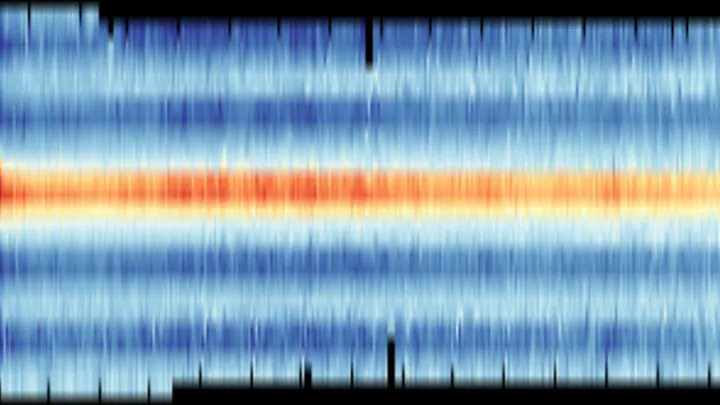
A red giant is a star that has swelled up, cooled on the outside, and become hundreds of times larger than the Sun. Inside, it's far from calm: layers of gas oscillate like a giant bell, causing its brightness to flicker slightly. Astronomers pick up these oscillations to probe what's happening deep within.
The night sky looks still, but many stars tremble like a drum after a strike. For seven straight years, the TESS satellite stared at the same patches of sky and caught this trembling in 19,151 red giants — old, bloated stars. Previously, far fewer of these 'singing' giants were known, and now the list has grown by 80%.
A pot of boiling water sits on the stove: the higher the heat, the hotter the water and the more steam escapes. Hot gas in galaxy clusters behaves much the same way. But in small galaxy groups, this "steam" leaks out faster than you'd expect from the temperature alone.
Around the star Epsilon Indi, visible to the naked eye from the Southern Hemisphere, orbits a planet the size of Jupiter. The temperature there is like a good freezer: minus 200 degrees Celsius. The James Webb Space Telescope has for the first time directly imaged it and measured the light the planet emits in the thermal range.
Three and a half parsecs from the Sun, among the dim stars of the southern sky, hides a world that astronomers have been trying to see for thirty years. Epsilon Indi Ab is a gas giant, cold as a winter night: its temperature is about 275 kelvins, just above the freezing point of water.
Oxygenic photosynthesis requires splitting water. It's kind of like a water wheel: to make it spin, you need a strong current. Light acts as the current, and light particles are the streams. For red dwarfs, the most common stars, the light is "cool" and weak — the streams barely move the wheel.
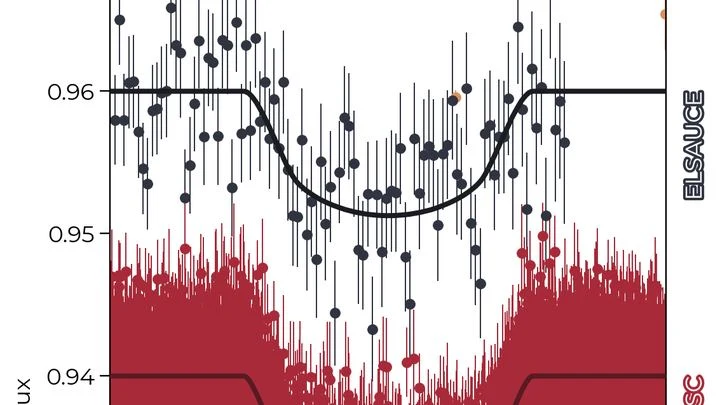
NASA's TESS space telescope monitors thousands of stars, catching the moment when a planet crosses its star's disk — the star's light dims slightly. That's how astronomers spotted two planets orbiting stars similar to our Sun. One, TOI-883 b, completes an orbit in ten days; the other, TOI-899 b, takes nearly thirteen.
Imagine a city where a skyscraper and a huge park are being built at the same time. The skyscraper grows upward, and the park expands outward. Both processes are fast and get in each other's way, but in the end they are meant to become a single whole. That's the situation in galaxy GNz7q: a black hole grows at the center while new stars burst to life around it.
In the Tarantula Nebula, where thousands of stars are born, one bright blue star is behaving strangely. It moves toward us and then away, as if something is tugging it on an invisible string. That 'something' completes an orbit every 17 days, but telescopes can't see it.
Astronomers observed the star 30 times with a spectrograph, which splits light into colors like a prism.
In the first moments after the Big Bang, the universe was nearly uniform, like smooth dough. But within a billion years, in some places the dough began to rise faster: clumps of hundreds of galaxies emerged, which astronomers call protoclusters. These are the seeds of future giant clusters, the most massive bound structures in the universe.
The Gaia space telescope has measured how fast more than a hundred thousand stars spin. It turns out that a star's rotation speed depends on its temperature. For stars cooler than 6500 degrees, the surface moves at 10–20 kilometers per second.
Light from the galaxy PAN-z14-1 began its journey when the universe was 400 million years old — a cosmic infancy. The expansion of space made it travel to us for nearly 13.5 billion years.
A red giant is like a balloon slowly letting out gas. The star swells, its outer layers weaken, and stellar wind carries mass into space. But exactly how much does a star lose? This is a crucial question: the answer determines what kind of remnant it will leave behind — a white dwarf, a neutron star, or a black hole.