Simple

Supernovae Point to a Changing Dark Energy ⚡ экспресс

Original: "Strong Progenitor Age-bias in Supernova Cosmology. II. Alignment with DESI BAO and Signs of a Non-Accelerating Universe"
arXiv:2510.13121 · 2025-10-15 · CC BY 4.0 · ⏱ 1 min · Cosmology
Accounting for the age of supernova progenitor stars reveals that dark energy is likely not constant, but changes over time.
Abstract

Type Ia supernovae are the key markers for measuring cosmic distances. But new research reveals: over time, these beacons ‘age’ and shine less brightly, like bulbs losing their glow. This shifts our picture of the universe’s expansion—perhaps it’s no longer speeding up, but slowing down. What if dark energy isn’t forever?

Links in the knowledge graph 1

Astronomers use Type Ia supernovae as candles. Their brightness was thought to be unchanging. The discovery of the Universe’s acceleration using them brought a Nobel Prize to Riess, Perlmutter, and Schmidt. But measurements of the parent stars’ ages revealed: the older, the dimmer the explosion (5.5 sigma). The farther we look, the brighter supernovae appear — this distorts the picture of the Universe’s expansion. It’s like old candles giving off less light, and we misjudge distances.

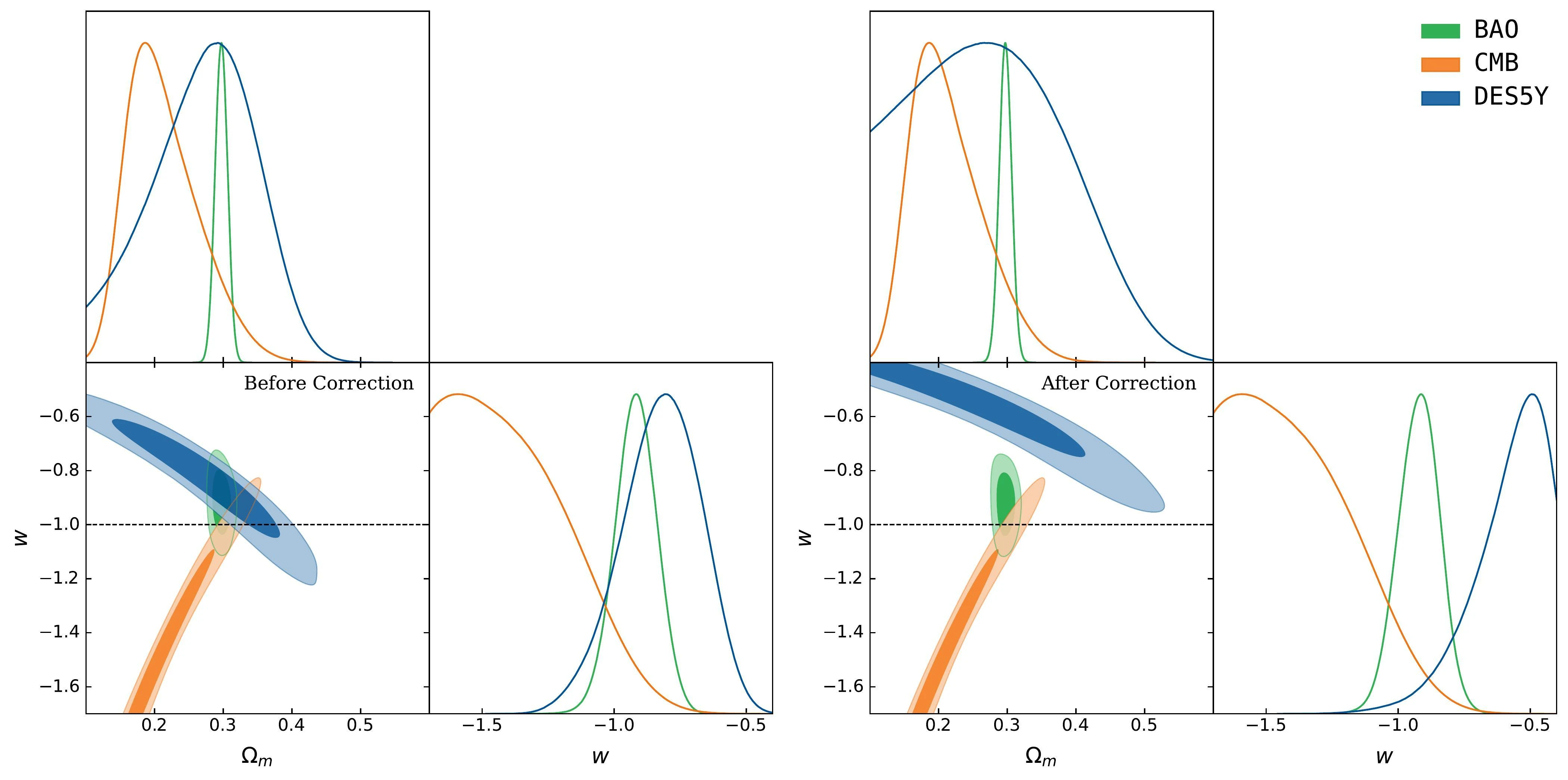
Accounting for age changes everything: the data fits better into a model of changing dark energy, not the standard cosmological model.

Adding to the analysis the ‘echoes’ of the early Universe (baryon acoustic oscillations) and the cosmic microwave background, the contradiction with a constant dark energy intensifies to a staggering 9 sigma. The most unexpected outcome: the Universe’s acceleration may have already stopped.

🎯 Type Ia supernovae are born when a white dwarf pulls matter from a companion star and, reaching a critical mass, explodes. Despite the ‘Ia’ label, they have nothing to do with stellar classes — it’s a historical classification based on spectra.

Scientists
Alan GuthAndrei LindeGeorges LemaîtreJames PeeblesAdam RiessBrian Schmidt
Tags
dark energy supernova expansion of the universe Standard Model
Laws
Friedmann equationsHubble's lawNoether's theoremspin–statistics theoremFermi's golden ruleChandrasekhar limit
Original: arXiv:2510.13121 · CC BY 4.0 · bridge42worlds