Neural Network Predicts Warm and Cold Ocean Years Two Years Ahead ✛
Every spring, El Niño forecasts lose their edge, like an interpreter who gets distracted by every rustle in the room and turns a one-hour meeting into a two-hour one. Scientists call this the spring predictability barrier. The new program learns to strip noise from ocean temperature maps layer by layer, much as a restorer removes soot from an old painting.
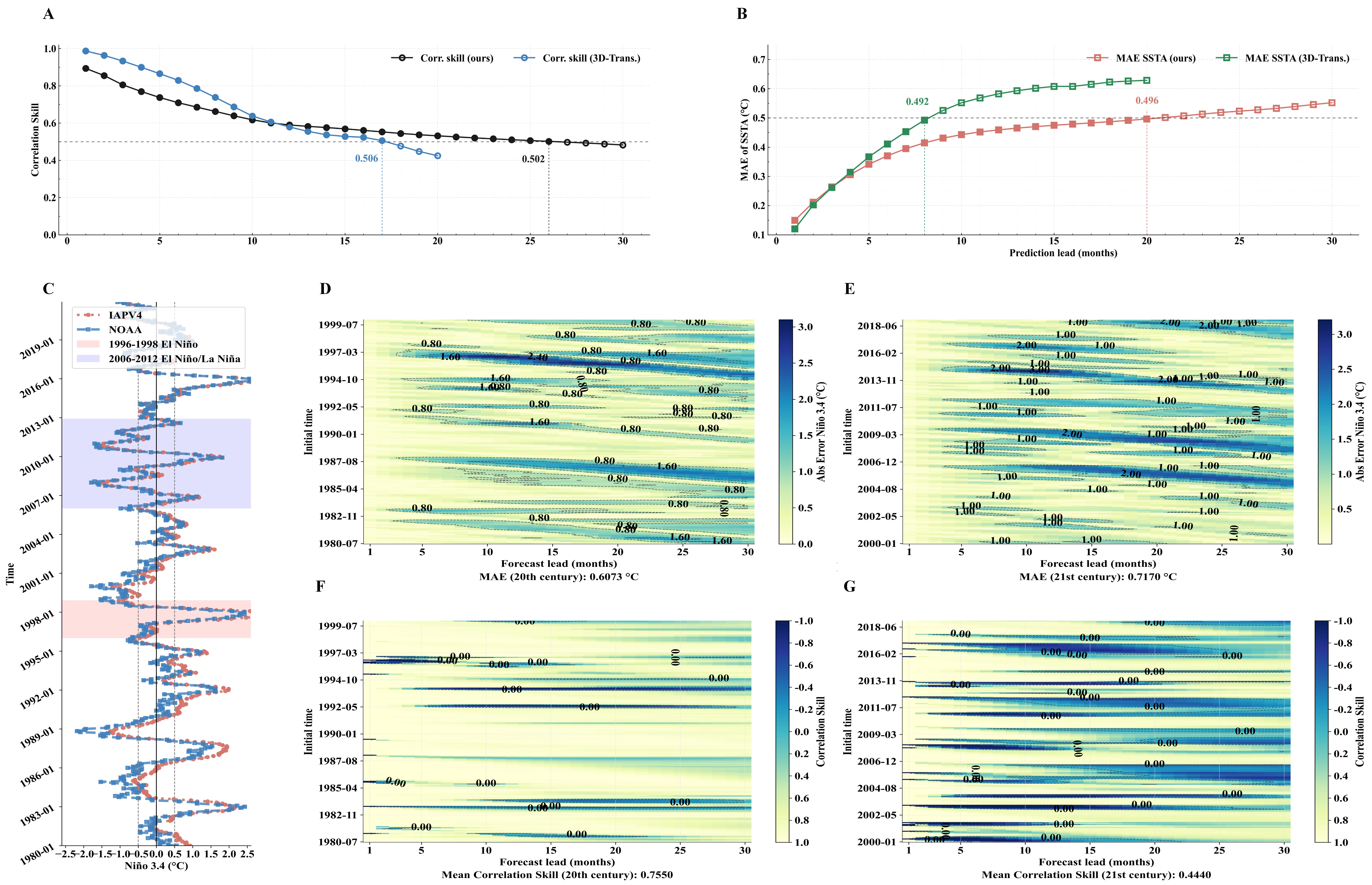
It turns out that a program trained only on real data from 1940 to 1999 predicts ocean temperature 14 months ahead with good accuracy, and in another experiment, 26 months ahead. It correctly captured the super El Niño of 2015 and the triple-dip La Niña of 2020–2022 with an error of only ±0.3 °C. The most intriguing part: when scientists examined how the program removes noise, they found that this process is described by the same equation that governs the oscillation of warm and cold water in the ocean. The neural network, on its own and without hints, learned the physics of El Niño.
Such a tool could now be used in climate forecast centers to provide early warnings about warm and cold ocean years and the associated droughts or floods.
The model itself, without any hints, found the 22-month El Niño cycle, even though it was given no physics equations, only 60 years of ocean temperature maps.
The idea of a neural network that internally reproduces a physical law evokes Isaac Asimov's 'Psychohistory': a statistical apparatus predicts the behavior of a complex system without knowing all the details, yet capturing its deep dynamics.