Neural Network Denoises the Ocean and Predicts El Niño Two Years Ahead ✛
Every spring, El Niño forecasts lose their edge, like a translator who gets distracted by every rustle in the room and turns a one-hour meeting into a two-hour one. Scientists call this the spring predictability barrier: in March and April, models that confidently predicted a warm phase in the Pacific back in January start making mistakes twice as often. This new study takes a different approach: instead of trying to shout over the noise, it teaches a neural network to strip it away layer by layer, like a restorer removing soot from an old painting.
The authors fed the model the last six months of sea surface temperatures in the tropical Pacific and asked it to produce a probability distribution for the next month. Then they added the predicted month to the history and repeated the process up to 30 times, so the forecast slid forward like a person crossing a swamp, testing each tussock before shifting their weight onto it. They trained on the IAP v4 reanalysis from 1940 to 1999 and validated on the independent period 2000–2023. They also compared two variants: one pretrained on the CMIP6 ensemble of climate models, and one without.
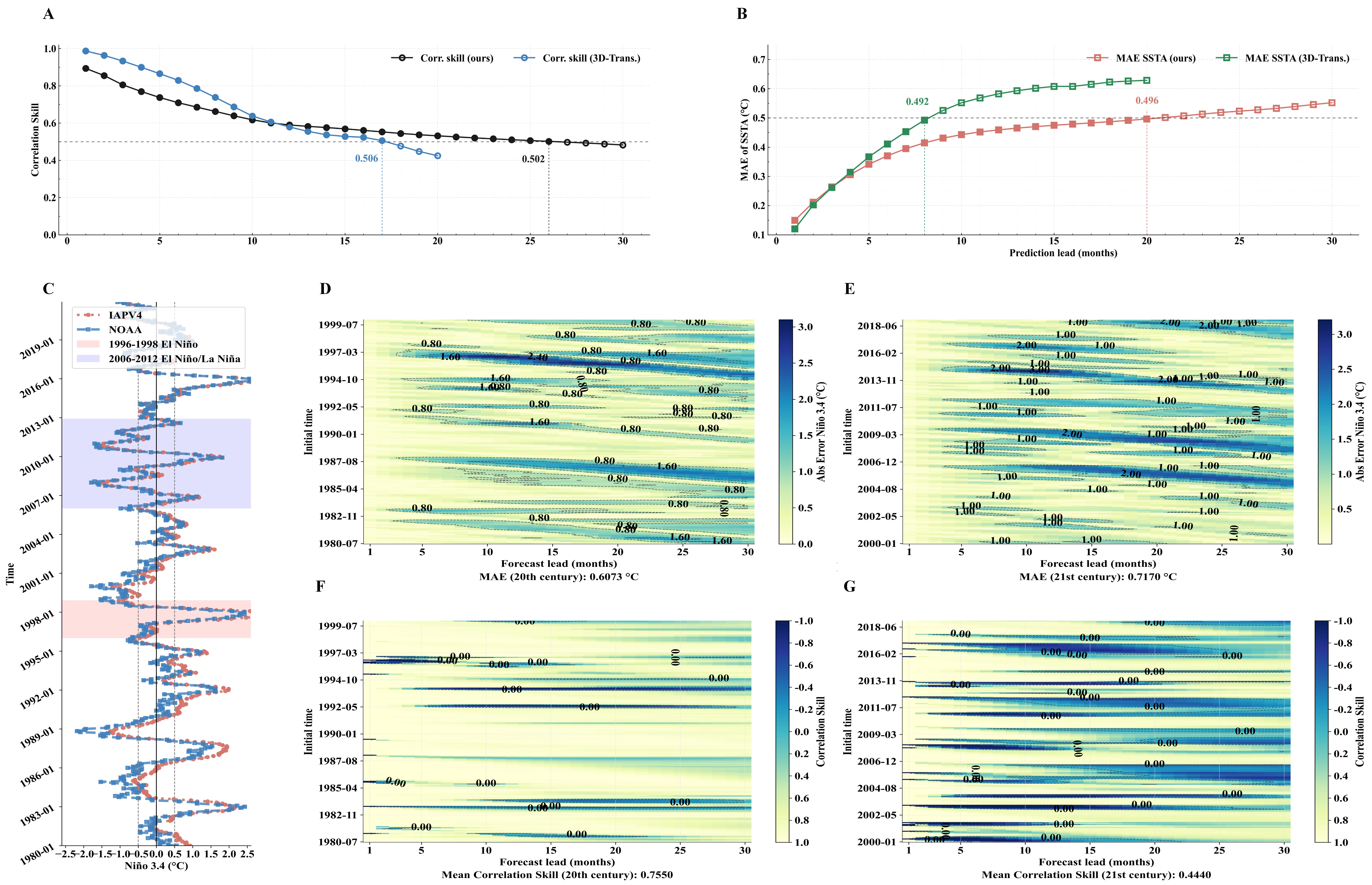
The result surprised them: the model without CMIP6 pretraining maintains a Niño3.4 correlation above 0.5 for 14 months, while the CMIP6 version drops below that level after just 7 months. In an earlier experiment using data from 1980 to 2021, the correlation stayed above 0.5 for up to 26 months, and the mean absolute temperature error over 30 months was 0.66 °C. For comparison, leading dynamical models have errors exceeding 0.7 °C at 6–9 month leads. The model reproduced the 2015 super El Niño and the 2020–2022 triple-dip La Niña with index errors within ±0.3 °C.
The biggest physical surprise came when the authors analyzed how the model removes noise at each step: they found that this process is mathematically equivalent to the Van der Pol equation. That equation describes self-sustaining oscillations with nonlinear damping, which is exactly the heat recharge–discharge cycle that generates El Niño and La Niña. The nonlinear damping and oscillation frequency parameters extracted from the neural network match the observed 22-month ENSO cycle. The network didn't just memorize data; on its own, without hints, it reproduced the physics of climate variability.
Before this work, it was unclear whether one could simultaneously get a probabilistic El Niño forecast beyond a year and a physically interpretable model. Now it's clear: a diffusion model gives reliable Niño3.4 forecasts for 14–26 months and, within its reverse process, reproduces the Van der Pol equation. Such a tool could be used in operational centers for probabilistic El Niño forecasting and early warning of the spring predictability barrier, when forecast accuracy drops sharply every spring. The neural network is no longer a black box but a window into ocean mechanics.
The model itself, without any hints, found the 22-month El Niño cycle, even though it was given no physics equations, only 60 years of ocean temperature maps.
The idea of a neural network that internally reproduces a physical law evokes Isaac Asimov's 'Psychohistory': a statistical apparatus predicts the behavior of a complex system without knowing all the details, yet capturing its deep dynamics.