Neural network regression is a machine learning technique where an artificial neural network is trained to predict a continuous numerical output from input features. In physics, it is increasingly used as a statistical estimator for complex relationships, such as the equation of state (EoS) of matter — the function linking pressure, temperature, and volume. Instead of relying on analytical formulas, a neural network learns the EoS directly from experimental or simulation data, capturing nonlinearities that are hard to model by hand.
History
Neural networks were conceptualized in the 1940s, but their use in physics for regression became widespread in the 2010s with the rise of deep learning and powerful GPUs. Specific applications to equations of state emerged in nuclear physics and astrophysics around that time.
How it works
A neural network consists of layers of interconnected 'neurons' (mathematical functions). During training, the network adjusts its internal weights to minimize the difference between its predictions and known data points (e.g., from nuclear experiments or simulations). Once trained, it can interpolate or extrapolate to predict the EoS for new conditions. The network's flexibility allows it to approximate any smooth function, given enough data and neurons.
In practice
Used to model equations of state for neutron stars, nuclear matter, and materials under extreme conditions, where traditional analytical forms are inadequate.
Fun fact
A neural network with just one hidden layer can approximate any continuous function on a compact domain — a result known as the universal approximation theorem.
Imagine a simultaneous interpreter in a room where two people are speaking: they must keep up with both meaning and intonation, but if the speech is too fast, only a paraphrase remains. That's roughly how scientists feel as the stream of gravitational waves from black hole and neutron star mergers grows, while precise signal calculations lag behind.
Two photographers shoot the same mountain. One takes a hundred shots from the summit and only a couple from the base; the other does the opposite. If you try to align their images, the algorithm might decide that the summit in one photo matches the summit in the other simply because there are many similar points there, not because it's the same spot. Sampling density throws it off.
The merger of two neutron stars is not just a collision. Even before they touch, they deform each other through tidal forces, and this deformation depends on how 'soft' or 'stiff' the matter inside is. Stiff matter resists more; soft matter changes shape more easily.
A cosmic "caliper" will soon measure a neutron star to within a hundred meters. For an object a couple dozen kilometers across, that's like measuring the thickness of a human hair from a kilometer away.
A neutron star is the remnant of an exploded supernova.
In 1998, mathematician David Boyd noticed something strange. He was studying the Mahler measure of polynomials, a quantity that gauges the "complexity" of their roots, and found that for a family of curves, it always equals a special rational number times the derivative of an L-function.
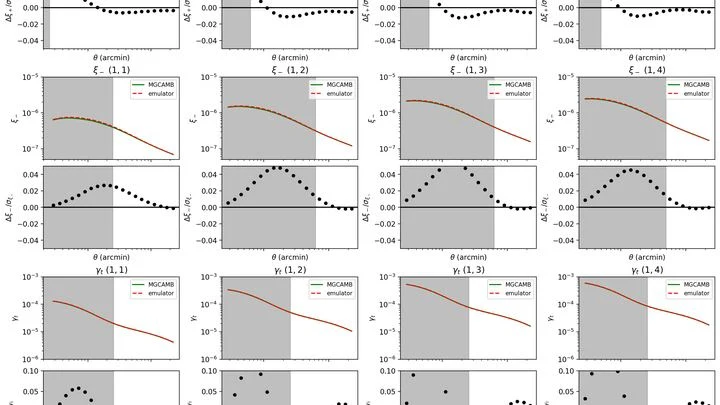
In the vast cosmic ocean, dark matter gathers into clumps and filaments, like plankton in currents. But if gravity doesn't work exactly as Einstein said, these patterns change — barely noticeably, like ripples from an invisible wind. You can spot such ripples by comparing sky maps with computer simulations.
One hundred milliseconds. In that time, after a lightning strike or a short circuit, the power system either returns to normal operation or loses stability. A new-generation Neural Network Oscillations learns to sense this moment, like an experienced tightrope walker anticipating a gust of wind.
Communicating with a satellite is like trying to hear a whisper in a storm: the signal drowns in noise. Engineers have created an AI algorithm that runs directly on the satellite and, with minimal power consumption, detects distortions more accurately than previous methods.
Many natural processes are described by differential equations, but scientists often have only fragmentary data — a sort of torn map. The new computational method works like a cartographer who reconstructs a complete map of the terrain from a few landmarks.
In a soup pot, you only need two thermometers to gauge the temperature everywhere — if you know heat travels in circles from the bottom. Science works the same way: from a handful of measurements, you want to reconstruct the full heat picture.
The system captures the gist of heat flow, compressing it into a handful of governing numbers.
Traditionally, machine learning algorithms operate in a static environment, like water flowing along a pre-cut channel without changing its shape. The new method flips this paradigm: it lets an agent simultaneously master actions and deliberately modify the very environment it inhabits.
Neutron stars are the last clumps of visible matter before collapsing into a black hole. In their interiors, matter is squeezed to trillion-fold densities. Here, nuclear forces and gravity weave into an exotic substance inaccessible to any earthly particle accelerator.
Complex machinery, from drones to surgical robots, sometimes behaves like a wild mustang: full of disorder and whims, where the slightest touch triggers a storm. Instead of rote memorization of formulas, the new method observes the system like a horse breaker.
Gravitational signals from dying massive stars are whispers reaching us from the most violent laboratories in the Universe. Einstein predicted these gravitational waves over a century ago, but only today, with detectors like LIGO, are we beginning to hear them.
At a weather station in Brazos County, Texas, rain is recorded on magnetic tape: every day, four years straight. Nine hundred millimeters in a good season, a hundred in a bad one. Then the tape falls silent. Drought creeps in without a sound — the slow fading of the earth's pulse. The standard SPI-3 index only catches on a month or two later, once the moisture is already gone.
A black hole is not a frozen void, but a living magnetic engine. Its 'heart'—the accretion disk, pulsates: inhale, matter spirals into the funnel, exhale — magnetic reconnection tears the field lines, and plasma shoots away from the horizon.
Designing machines is like cooking: you need to know exactly where the 'dough' will tear. Old computer simulations check every point on a part for hours, like measuring the entire pot to make sure the handle doesn't fall off.
The atomic nucleus rarely sits still: it often trembles, rotates, or pulses like a plucked string. Each such motion is an excited state, and describing it usually requires extremely complex calculations. Now neural networks come to the rescue: they shape the nucleus the way a musician identifies a note in a chord by ear.
Two ultra-dense stars spiral around each other and eventually collide. This dance lasts only moments, but it sends powerful ripples through space — gravitational waves. After the merger, a rapidly spinning blob remains, ringing like a bell, and that ring carries information about what the stars were made of.
Imagine a factory where hundreds of tiny assembly lines run nonstop. Each line is a molecular motor that converts chemical fuel into motion. To make the motor go faster or in the right direction, an engineer tweaks the settings — the shape of parts, the strength of interactions.
A uranium nucleus is like a tight wallet snapped shut on two halves. To make it burst and release energy (that is, to make the nucleus split) you have to climb over an energy barrier. The height of this threshold determines whether a substance is stable or ready to fall apart at any moment.
A neural network learning something new is like a traveler in mountainous terrain. Each piece of learned knowledge is a depression in the landscape into which the traveler rolls and gets stuck. To escape and reach a new basin, energy is needed. But as the traveler gains experience, the walls of their pit become steeper, and each subsequent climb requires more effort.
When a massive star dies and collapses into a supernova, a neutron star is born — a city-sized sphere with the Sun's mass. Its matter is so compressed that a teaspoon weighs more than Mount Everest. Physicists are trying to learn the "recipe" of this matter — the equation of state that explains how matter behaves under extreme pressure.
Turbulent water flowing through a pipe and the swing of a pendulum may seem worlds apart. But they share something fundamental: both follow their own laws of motion, which can be described by numbers. A neural network trained on just one such 'dance of numbers' suddenly starts to understand another — without a single extra example.
An antibody is a protein that catches viruses and bacteria. When an enemy enters the body, immune cells start trying out different antibody variants, as if testing different keys against a lock. Beneficial changes are kept, harmful ones are discarded. Over a few weeks, this process yields an antibody that fits its target perfectly.
Every thought leaves a trace — a faint electrical blip on the scalp. A device with dozens of wires, resembling a swim cap, catches these traces and turns them into wavy lines. From those lines, you can guess what a person feels even if they stay silent. In a new study, three computer programs competed to see which could read such lines most accurately and determine whether the mood was bad, neutral, or good.
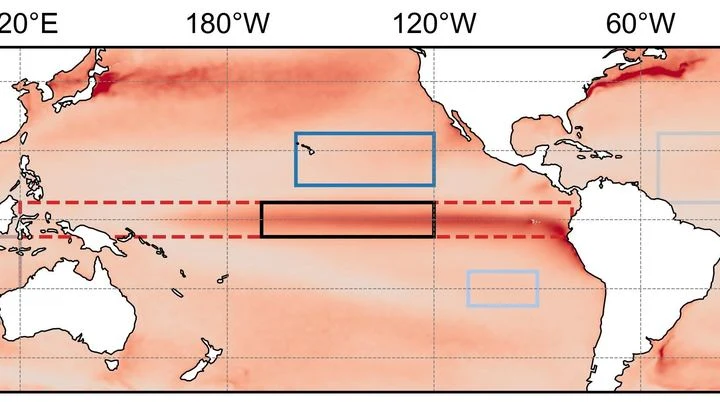
The Pacific Ocean breathes slowly and deeply. Every few years, its warm surface waters shift eastward toward the coast of South America, and then Peru gets drenched while Australia goes up in flames. A year or two later, the water retreats, and the picture flips. This breathing is called El Niño, and until now its rhythm could only be guessed a couple of steps ahead.
When a top quark is born in a particle detector, it immediately decays into a shower of other particles. Catching a hint of new physics in that shower is like hearing a whisper at a rock concert. You need not just a good microphone, but the ability to subtract the roar of the amplifiers and the hum of the crowd.
Fine-tuning a neural network is like trying to alter a black hole without touching its event horizon: you change only a tiny fraction of parameters. Researchers looked inside and saw stunning patterns — strong links between pieces of the model, akin to quantum entanglement.
In every handful of fertile soil, there are bacteria that do something no factory can: they take nitrogen straight from the air and turn it into fertilizer. The secret lies in the enzyme nitrogenase, and its working core, a cluster of iron and molybdenum atoms, looks like a tiny factory floor.
Chemists have long tried to understand how this factory works from the inside.
A neutron star is a sphere the size of a city, but it weighs as much as one and a half Suns. Inside such a sphere, matter is so compressed that a teaspoon of it would weigh billions of tons. But physicists don't fully know what this matter is made of.
Inside a neutron star, matter is compressed to unimaginable densities. Previously, scientists speculated about its exact makeup, cycling through possible equations linking pressure and density. The new method tosses out guesswork: it directly ties the measurable mass and radius to the internal structure.
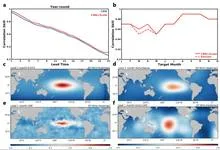
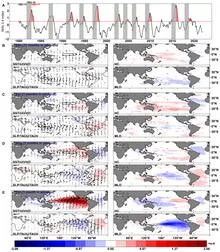
The tropical Pacific Ocean heats and cools like a giant battery, and its rhythm affects weather from India to Canada. This rhythm is called El Niño–Southern Oscillation, or ENSO for short. Forecasting it months ahead is like predicting when a pot will boil without knowing the strength of the flame.
Every spring, El Niño forecasts lose their edge, like a translator who gets distracted by every rustle in the room and turns a one-hour meeting into a two-hour one. Scientists call this the spring predictability barrier: in March and April, models that confidently predicted a warm phase in the Pacific back in January start making mistakes twice as often.
The collision of two neutron stars is a strike heard across the universe. Gravitational wave detectors pick up the ripples in spacetime, but the most interesting sound begins after the impact: the merger remnant, a rapidly spinning hypermassive neutron star, continues to vibrate, emitting waves for a few more…
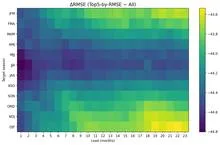
A team of forty forecasters prepares an El Niño forecast two years ahead. Each works with the same model but slightly different initial conditions and settings, so their outputs diverge. Typically, forecasting centers average all forty opinions, assuming each member is equally useful.
In a room with 80 advisors, each shouts their own opinion, and if you simply listen to everyone and take the average, you get mush. So it is with El Niño forecasts: a model produces 80 possible futures, but not all are equally useful. Some err less often, others more, and still others talk about something else entirely.
Imagine a translator in a noisy hall, trying to catch a speech through the buzz of voices. The usual approach is to memorize a set of phrases and slot them into templates. But when the noise cranks up, the template falls apart.
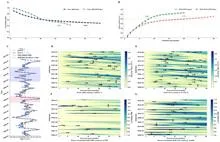
Imagine a translator sitting in on a conversation between two parties: the ocean and the atmosphere. Usually, the translator conveys the meaning with a six-month delay, and in spring it loses the thread entirely. The new model, called CTEFNet, translates up to two years ahead and, on top of that, explains which remark turned the tide.
An interpreter at negotiations hears only the words already spoken, yet still guesses the next phrase. This is how the new El Niño forecasting method works: it doesn't peek into the future but relies solely on the past, like an honest listener.