process

equatorial wave propagation

The movement of waves along the equator, crucial for ocean-atmosphere coupling and ENSO dynamics.
122 related articles

Description

Understanding equatorial wave propagation is essential for interpreting ocean observations, such as sea level and temperature data from buoys and satellites, because these waves produce characteristic signals that can be tracked. It also explains why ENSO events have a predictable sequence: the appearance of a Kelvin wave in the west often precedes an El Niño by several months, offering a lead time for forecasts.

History

The theoretical foundation for equatorial waves was laid by Japanese meteorologist Taroh Matsuno in 1966, who derived the solutions for wave motions in a shallow-water model on an equatorial beta-plane. His work was later applied to the ocean by Klaus Wyrtki and others in the 1970s, linking these waves to observed sea level changes during El Niño.

How it works

The physics relies on the balance between the Coriolis force and pressure gradients. Near the equator, the Coriolis parameter (which measures the deflecting force) is small and changes sign, allowing waves to propagate without being deflected away. Kelvin waves are special because they have no north-south velocity component and are trapped to the equator, moving only eastward. Rossby waves, on the other hand, have a more complex structure and move westward, with their speed depending on their wavelength. In the ocean, these waves travel along the thermocline, causing it to deepen or shoal as they pass. The speed of a first-mode baroclinic Kelvin wave in the Pacific is about 2.5 meters per second, meaning it takes roughly two months to cross the basin—a delay that sets the timescale for ENSO oscillations.

In practice

Equatorial wave theory is used in ocean data assimilation for ENSO prediction, where observed sea level and temperature data are interpreted in terms of Kelvin and Rossby waves to initialize forecast models.

Fun fact

Equatorial Kelvin waves in the ocean travel at speeds comparable to a fast bicycle—about 2.5 meters per second—yet they carry enough energy to alter sea surface temperatures across an entire ocean basin.

Concept graph →

Related articles · 122

High Energy2026-07-312 minarXiv:2607.29273express
Black Hole Echo: What the Horizon Sounds Like
When two black holes merge, ripples spread across the fabric of spacetime — gravitational waves. But what if one of them isn't a run-of-the-mill black hole but something else — an exotic compact object?
physics.data-an2026-07-111 minarXiv:2607.11935express
When Climate Sends an Early Signal
Every month, satellites measure temperature and humidity over different parts of the planet. Over 24 years, thousands of such paired measurements have accumulated. Normally, temperature and humidity change in concert: when it warms, the air holds more water; when it cools, it releases it. But before a sharp climate shift, this coordination breaks down.
Galaxies2026-07-063 minarXiv:2607.05502
The Mystery of Fragile Satellites: Dark Matter Under Tidal Assault
Dwarf galaxies orbiting the Milky Way look as if they’ve survived a gravitational storm. Their stellar bodies are stretched, scattered by tidal tails, and heated from within.
How a Neural Network Learns Climate from Sparse Data
A student who has spent years solving problems from other people's textbooks suddenly receives three notebooks with real ocean observations. There are few problems, but they have already seen hundreds of similar ones, and now a couple of examples suffice to catch the new teacher's style.
A Warm Current Against El Niño
In the Pacific Ocean, there is a warm current that flows eastward against all the others. It is called the North Equatorial Countercurrent, or NECC. In normal years, this band of warm water, a few hundred kilometers wide, quietly carries heat from Indonesia toward the Americas.
math.NA2026-06-083 minarXiv:2606.09369
The Nineteen Notes That Make Up El Niño
An orchestra plays in a dark hall, and the listener hears only a hum: hundreds of instruments blend into a dense noise in which no melody can be discerned. That is roughly what spectra extracted from climate data by methods like the Koopman operator look like: hundreds of components, each with its own frequency, and it is unclear which ones are true musicians and which are the rattling of chairs.
Exoplanets2026-05-092 minarXiv:2605.09052express
How to See Beneath Enceladus's Ice
Enceladus is a tiny moon of Saturn, covered in a thick crust of ice. Beneath it sloshes a salty ocean, and deep down, a hot, porous core may be at work, like a sponge soaked with water and heat. But how do you see through tens of kilometers of ice? No need to drill: you can use an electromagnetic "echo." A person with a metal detector walks along a beach.
Fluid Dynamics2026-04-121 minarXiv:2604.10594express
Resistance Inside a Spinning Sphere
Deep inside Earth lies a solid iron core about the size of the Moon. It floats in liquid metal and sways slightly, like a pit in a peach when you shake the fruit. Such oscillations are called Slichter modes: the core shifts both along the planet's axis and perpendicular to it. Three forces act together to damp this motion.
Predicting El Niño Six Months Ahead
Two observers watch the Pacific Ocean. One studies surface heat maps, the other listens to the rhythm of temperature and heat stored in the water column. On their own, each notices only part of the picture, but together they can sense the approach of El Niño months before the warm current alters weather across the planet.
The Ocean as a Draft: Diffusion Model Reveals All Possible Temperatures
In 2023, the ocean off the coast of Peru warmed so much that fishermen came back empty-handed, while meteorologists argued over the strength of the upcoming El Niño. The sea surface temperature map they were looking at was the only one available, but how much could they trust it?
The Ocean Whispers Early: Neural Network Hears the Atlantic Winter Three Months Ahead
The ocean does not shout about its intentions. It whispers: a warm patch off the coast of Peru, a cold tongue near Hudson Bay, a barely perceptible shift in a current. The atmosphere does not respond immediately, and by winter Europe may get either mild slush or Siberian frosts.
The El Niño Pendulum: How Warming First Amplifies, Then Damps It
Every few years, the Pacific Ocean off Peru warms so abruptly that fish disappear and rains flood the desert. This phenomenon is called El Niño, and it acts like a pendulum that swings the planet's climate. But when the planet itself warms, the pendulum behaves strangely: first its swing widens, then it suddenly fades.
Gamelan Hears El Niño: How Javanese Scales Turn Climate Chaos into Sound
The bronze plates of a gamelan do not sound according to a single tuning standard: each orchestra on Java keeps its own tuning, and two neighboring ensembles may play the same melody in slightly different intervals.
El Niño 2026: Two Barometers, One Forecast
Two barometers hang on the wall. One reads clear, the other says partly cloudy. Which weather do you trust? That is roughly the question facing a group of climate scientists when two independent methods predicted different futures for the Pacific Ocean in 2026.
Geophysics2026-01-311 minarXiv:2602.00421express
Wind Changes the Voice of an Explosion
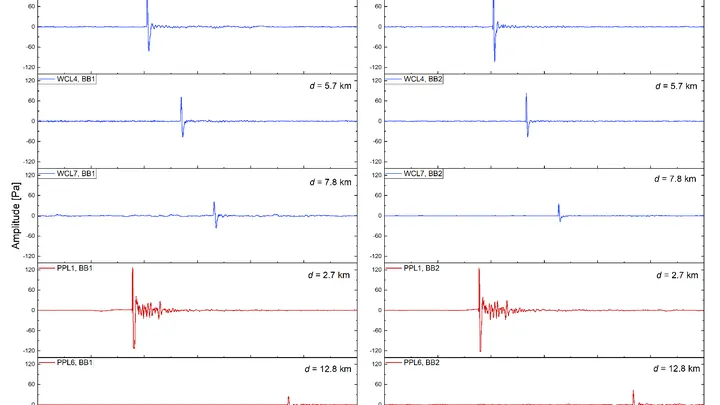
The same explosion can sound different: it all depends on which way the wind is blowing. In 2024, researchers set off charges equivalent to ten tons of TNT twice and recorded the sound with a network of 31 microphones spread over a radius of 23 kilometers. The source was identical, but the acoustic pictures turned out to be quite different.
El Niño Can Be Predicted a Year and a Half in Advance
The Pacific Ocean breathes slowly and deeply. Every few years, its warm surface waters shift eastward toward the coast of South America, and then Peru gets drenched while Australia goes up in flames. A year or two later, the water retreats, and the picture flips. This breathing is called El Niño, and until now its rhythm could only be guessed a couple of steps ahead.
The Neural Network's Treasure Map: Where El Niño Hides Its Predictability
The tropical Pacific Ocean heats and cools like a giant battery, and its rhythm affects weather from India to Canada. This rhythm is called El Niño–Southern Oscillation, or ENSO for short. Forecasting it months ahead is like predicting when a pot will boil without knowing the strength of the flame.
The Noise That Rocks the Pacific Swing
The Pacific Ocean is like a giant swing: warm water piles up in the west, then slides toward the east, and the temperature off the coast of South America jumps. Such warm years are called El Niño, and cold ones La Niña. But the swing doesn't move on its own: it's pushed by the wind.
An Orchestra Without a Conductor: How Ensembles of Neural Networks Learn to Hear Their Own Ignorance
An orchestra of a hundred musicians plays without a conductor. As long as the score is familiar, each player confidently follows their part, and together they sound harmonious. But when the composer changes the rhythm, discord creeps in: some instruments keep playing the old tune, others try to adapt, and a few fall silent.
Climate Norms Under Pressure from Trends
A camera on a tripod shoots the same landscape for decades. If you don't touch the lens, the images get hazy: the landscape changes, but the focus stays put. That's roughly how climate norms work. According to World Meteorological Organization rules, they are calculated as the average over the last 30 years.
Neural Network Denoises the Ocean and Predicts El Niño Two Years Ahead
Every spring, El Niño forecasts lose their edge, like a translator who gets distracted by every rustle in the room and turns a one-hour meeting into a two-hour one. Scientists call this the spring predictability barrier: in March and April, models that confidently predicted a warm phase in the Pacific back in January start making mistakes twice as often.
Selecting the Best El Niño Predictors from a Model Ensemble
A team of forty forecasters prepares an El Niño forecast two years ahead. Each works with the same model but slightly different initial conditions and settings, so their outputs diverge. Typically, forecasting centers average all forty opinions, assuming each member is equally useful.
Three Voices of the Pacific: How a Neural Network Learns to Hear Each One Separately
The ocean hums like a crowded hall: in one corner, voices argue about decades; in another, about years; in a third, about the changing seasons. To pick apart these voices, climatologists used to rely on filters they tuned themselves, letting through only slow waves or only fast ones. But the Pacific plays by its own rules: a warm patch off the coast of Peru can be a brief spike or part of a long-term rearrangement.
A Council of Elders Instead of a Popular Vote: How to Pick the Best El Niño Forecasts
In a room with 80 advisors, each shouts their own opinion, and if you simply listen to everyone and take the average, you get mush. So it is with El Niño forecasts: a model produces 80 possible futures, but not all are equally useful. Some err less often, others more, and still others talk about something else entirely.
The Ocean That Learned the Grammar of the Wind
A translator that learned the grammar of the wind, not just the vocabulary. The wind blows over the Pacific, and the water responds with waves, currents, and upwellings of cold depths. The KIST-Ocean neural network was taught not just to memorize how the ocean looked yesterday, but to understand why it will become what it is tomorrow.
Rain Relay: How Rare Runners Shape South American Weather
An invisible relay race runs through Earth's tropics: a wave of heavy rain and winds, which meteorologists call the Madden–Julian Oscillation, travels eastward at about five meters per second. Most runners tire quickly, but rare marathoners carry the torch all the way across the Pacific.
A Bridge Between Typhoon and Current: How El Niño Is Born
The tropical Pacific Ocean lives in two rhythms. The first is fast: a wave of thunderstorms born over the Indian Ocean races eastward and dies out off the coast of the Americas within a month or two. The second is slow: every few years, the ocean surface warms enough to alter weather across the entire planet. That is El Niño. Between these rhythms lies a bridge, and building it took climatologists decades.
A Pendulum Rocked by Gusts of Wind
Picture a pendulum hanging in a room with drafts. Sometimes a gust pushes it harder, sometimes softer. If the pendulum barely loses energy, it will swing long and steady. But if friction is strong, each push quickly fades, and the motion becomes jerky: a sharp swing, then a long sway. That's exactly how the tropical Pacific behaves when the heat of El Niño gives way to the cold of La Niña.
El Niño: Fading Out or Self-Sustaining?
The Pacific Ocean breathes. Every few years, its warm western "lung" exhales eastward, and from Peru to Indonesia, rains, droughts, and hurricanes shift. This breath is called El Niño–Southern Oscillation, or ENSO.
Neural Network Understands the Ocean Like an Interpreter
An interpreter in a conference room hears not just words but intonations, pauses, and gestures. From these cues, they anticipate where the conversation will turn. The Pacific climate speaks the language of wind, heat, and currents, and PTSTnet listens like an experienced simultaneous interpreter, grasping the grammar of ocean and atmosphere.
The Two-Core El Niño Model: An Orchestra Where the Soloist Sets the Tempo
A warm patch off the coast of Peru does not appear every year, but when it does, deserts are drenched with rain and Australia is plagued by wildfires. This is El Niño, a phenomenon that climate models struggle to reproduce. Simple models do well at estimating how often it occurs but lose spatial details.
A Translator That Hears the Ocean a Year Before the Event
Imagine a translator sitting in on a conversation between two parties: the ocean and the atmosphere. Usually, the translator conveys the meaning with a six-month delay, and in spring it loses the thread entirely. The new model, called CTEFNet, translates up to two years ahead and, on top of that, explains which remark turned the tide.
Council of Sages: How Entropy Predicts El Niño Two Years Ahead
In the hall, fifty sages confer, each observing the ocean in their own way. One listens to surface temperature, another to the wind, a third to how heat hides in the depths. Their judgments often contradict each other, but there is an elder who knows which of them to trust more.
Network catches the monsoon beyond the horizon
In 2015, downpours in Chennai turned streets into rivers overnight. The city was caught unprepared: seasonal models offered only a vague warning. Yet the monsoon is not a whim of the sky; it is the pulse of a vast machine linking oceans and continents.
A Two-Year Horizon for El Niño: A Filter That Doesn't Peek into the Future
An interpreter at negotiations hears only the words already spoken, yet still guesses the next phrase. This is how the new El Niño forecasting method works: it doesn't peek into the future but relies solely on the past, like an honest listener.
The Pacific Ocean Sends a Signal: No El Niño in 2025
The Pacific Ocean is a giant network of nerve endings that warns of an impending attack a year in advance. In 2023–2024, El Niño, the warm phase of the Pacific climate oscillation, pushed global temperatures to record highs. Now, two independent methods, like two doctors examining the same symptoms, agree: no new attack in 2025.
Navigator and Cabin Boy: How a Hybrid Model Learns to Predict El Niño from the Ocean's Short Memory
An experienced navigator steers the ship by a well-tested chart, but in unfamiliar waters the chart lies. A cabin boy who has watched the navigator err for years learns to anticipate where the chart will fail. Together they plot a course more accurately than either could alone.
A Bridge Between Ocean and Atmosphere Rhythms
The tropical Pacific breathes in two rhythms. One lasts several years: the water off the coast of Peru warms and cools, which fishermen call El Niño. The second rhythm is fast: every month or two, a giant cloud wave is born over the warm waters of the Indian and Pacific Oceans, creeping eastward at a runner's pace and dying out near South America.
Ocean Seesaw Dance: How El Niño and AMO Steer Hurricanes
The ocean breathes, and hurricanes swing on its breath like on a seesaw. Over the past seventy years, hundreds of tropical cyclones have crossed the North Atlantic, and not all of them behaved alike. Some decades brought a barrage of destructive storms to coastlines; others brought calm.
eess.SY2024-06-202 minarXiv:2406.14474
The Ocean Conducts Blackouts: How La Niña Steers the US Power Grid
The Pacific Ocean behaves like a conductor setting the tempo for outages in the American power grid. When the ocean shifts into its cold phase, known as La Niña, lights start going out more often across the US. Researchers traced this connection over 24 years and confirmed that the ocean really does drive the weather, and the weather batters wires and transformers.