Diffusion model predicts El Niño two years ahead ✛
Context
El Niño and La Niña (together ENSO) remain the main source of interannual climate variability, but forecasting them beyond a year hits the so-called spring predictability barrier: every spring, model accuracy drops sharply. Numerical models depend on parameterizations, while ordinary neural networks give a single deterministic answer and show no uncertainty. Neighboring papers in the archive take similar paths: some use neural networks to predict drought from past data, others embed physical laws into training, and still others search for echoes in the machine learning labyrinth. This paper stands apart because it is the first to apply diffusion models, which explicitly generate an ensemble of possible scenarios, to long-term ENSO forecasting.
Methods
The authors took a diffusion model that learns to turn random noise into a meaningful temperature field by removing noise step by step. The input was the last six months of sea surface temperature in the tropical Pacific, and the output was a probability distribution for the next month. To extend the forecast, the model slid through time: the predicted month was added to the history and the procedure repeated up to 30 times. Training used the IAP v4 reanalysis from 1940 to 1999, with validation on the independent 2000–2023 period. They also compared two variants: one with pretraining on the CMIP6 climate model ensemble and one without.
Results
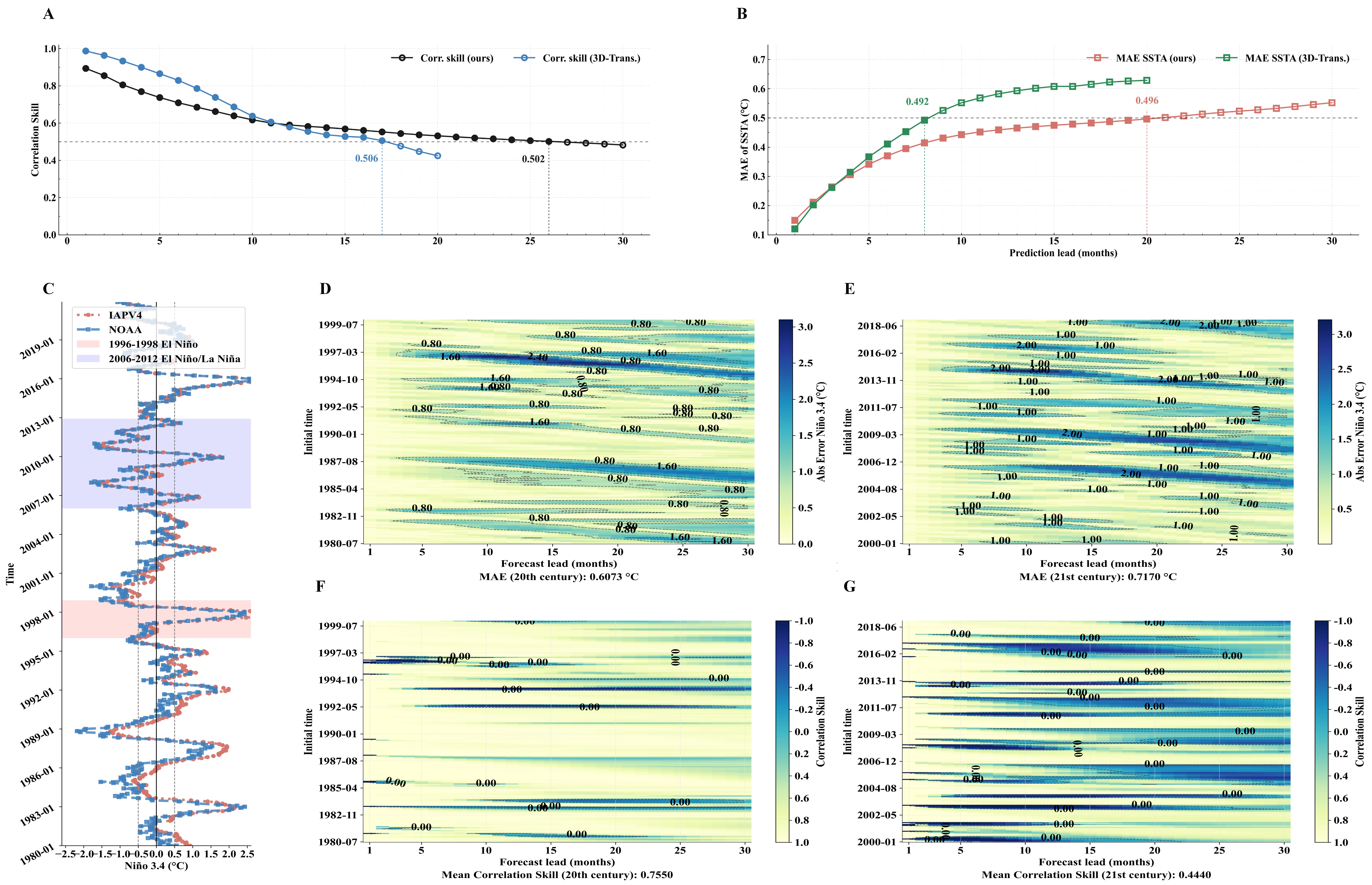
The model without CMIP6 pretraining maintains a Niño3.4 index correlation above 0.5 for 14 months, whereas the CMIP6 version drops below that level after just 7 months. In an earlier experiment on 1980–2021 data, the correlation stayed above 0.5 for up to 26 months, and the mean absolute temperature error over 30 months was 0.66 °C. For comparison, leading dynamical models have errors exceeding 0.7 °C at 6–9 month horizons. The model reproduced the 2015 super El Niño and the 2020–2022 triple-dip La Niña with index errors within ±0.3 °C. The main physical result: the reverse diffusion process (noise removal) is almost perfectly described by the Van der Pol equation, with a coefficient of determination R² = 0.99. The nonlinear damping and oscillation frequency parameters extracted from the neural network match the observed 22-month ENSO cycle.
Implications
This work differs from neighboring studies in that it does not just predict the index; it shows that the mathematical machinery of the classical recharge-discharge oscillator emerges spontaneously inside the diffusion model. Neighbors either embed physics into the loss function or seek interpretation after the fact, but here physics turns out to be built into the very structure of the reverse process. This is the first time a diffusion model for ENSO provides both a probabilistic forecast and an analytically verifiable link to deterministic dynamics. Such a result turns the neural network from a black box into a tool for testing hypotheses about the mechanisms of climate variability.
Future development
The method can be transferred to other chaotic systems where uncertainty matters: monsoons, ice cover, atmospheric circulation regimes. The authors propose adding asymmetry between El Niño and La Niña to the modeled probability density, which the classical oscillator lacks. Another direction is expanding the input from surface temperature to subsurface temperature and salinity, so the model can better distinguish El Niño types. In the long run, this approach could become a template for forecasting extreme events in a changing climate.
Impact
The results matter for operational climate forecast centers that need not just point estimates but also probabilities of extreme events. The method is also useful for insurance, agriculture, and water resource management, where decisions depend on forecast horizons of several months.
Next steps
Test the model on independent data from other reanalyses, such as ERA5 or OISST. Investigate how the physical interpretation changes when the forecast horizon extends beyond 30 months.
Key open problems
The work directly addresses the unresolved spring predictability barrier: the model detects an early signal of predictability loss in February, before the barrier itself. This provides a quantitative tool for studying which physical processes cause the collapse of forecast skill every spring.
The knowledge machine's view
This section is addressed to the author of the paper and their colleagues. Neighbouring works were found by meaning-based search across our archive, not by word overlap. We do not review: we show the field around the work.
What the work does
The study applies a diffusion model to forecast the Niño3.4 index up to 26 months ahead, training it only on the IAP v4 reanalysis. It shows that the reverse diffusion process is equivalent to the Van der Pol equation with R²=0.99, providing a physical interpretation of the neural network forecast.
Where its strength is
The key achievement is not merely probabilistic ENSO forecasting, but the discovery of charge–discharge oscillator dynamics embedded in the diffusion process, linking the generative model to classical ENSO theory.
Where it could go next
- It might be interesting to compare the interpretability of the diffusion model with approaches that embed physical laws into training, as in the work on drought forecasting based on reading weather backward.based on: How a neural network, reading weather backwards, warns of drought months in advance arXiv:2607.00331
- A related study uses a neural network to predict El Niño 1.5 years ahead; comparing forecast horizons and ensemble methods could help identify which architectures better overcome the spring barrier.based on: El Niño Can Be Predicted a Year and a Half in Advance arXiv:2601.12251
- The archive contains an example of using diffusion models for weather forecasting on a single GPU; transferring their sampling acceleration or ensemble generation techniques could benefit operational ENSO forecasting.based on: Weather forecast on a single GPU arXiv:2603.21284
Worth trying
- Test whether the equivalence to the Van der Pol equation holds when training on other reanalyses (e.g., OISST) or when including additional variables.
- Use the diffusion model to generate scenarios of extreme ENSO events and assess how well it reproduces the tails of the index distribution.
- Test accelerated sampling techniques for diffusion models to reduce computational costs in operational forecasting.
Why this may matter
If diffusion models systematically yield physically interpretable reverse processes, this could pave the way for a new class of generative models for climate forecasting, where uncertainty and dynamics are analytically connected.
Nearby works in our archive
- El Niño Can Be Predicted a Year and a Half in Advancesimilarity 0.58
- Neural Network Reads the Future of Plasmasimilarity 0.49
- How a neural network, reading weather backwards, warns of drought months in advancesimilarity 0.49
- Gravitational Waves Reveal the Missing Link in Cosmic Evolutionsimilarity 0.48
- Weather forecast on a single GPUsimilarity 0.48
- How a neural network tells black holes from neutron starssimilarity 0.48
The archive is sparse around this work: the closest review is only 0.58, against a usual 0.64. It looks like few have drilled nearby.
The model itself, without any hints, found the 22-month El Niño cycle, even though it was given no physics equations, only 60 years of ocean temperature maps.
The idea of a neural network that internally reproduces a physical law evokes Isaac Asimov's 'Psychohistory': a statistical apparatus predicts the behavior of a complex system without knowing all the details, yet capturing its deep dynamics.
Key numbers
- Reliable forecast horizon: 26 months (correlation >0.5)
- Mean temperature error over 30 months: 0.66 °C
- Coefficient of determination R² for the Van der Pol equation: 0.99
- Dominant ENSO oscillation period: 22 months
- Niño3.4 index error for the triple-dip La Niña: ±0.3 °C