Diffusion models are a generative approach that transforms Gaussian noise into ordered data, such as a photo of a cat. The process resembles restoring a mosaic from memory: you have only a rough sketch, but you remember what similar works looked like, and you gradually recreate the pattern—from fuzzy patches to fine lines. The model contains a 'representation' of the world, learned from millions of examples, and thus can generate plausible new images. The key difference from other generative networks is iterativity: the picture is born not instantly but through a chain of small improvements.
History
The method's roots go back to works on thermodynamics and statisticalphysics (e.g., the works of Langevin), but the modern embodiment was proposed in 2015 by Jascha Sohl-Dickstein as a stochastic generative model based on non-equilibrium thermodynamics. The breakthrough came after the 2020 publication of the paper 'Denoising Diffusion Probabilistic Models,' which demonstrated outstanding results on image synthesis tasks. Further improvements (accelerated sampling, conditional guidance) led to the creation of systems like DALL-E 2, Imagen, Stable Diffusion, which revolutionized the field of AI creativity.
How it works
Forward process: to the original image x0, small amounts of Gaussian noise are added over T steps, obtaining a sequence x1, x2, ..., xT, where xT is practically indistinguishable from white noise. The transition at each step: q(xt|xt-1) = N(xt; sqrt(1-βt)·xt-1, βtI), where βt is the variance schedule. Reverse process: a neural network εθ(xt, t) learns to predict the noise added at step t, minimizing E[||ε - εθ(xt, t)||²]. During generation, one starts from xT ~ N(0, I) and iteratively applies xt-1 = (1/√(αt))·(xt - (1-αt)/√(1-ᾱt)·εθ(xt, t)) + σt·z, where z is noise. To speed up sampling, DDIM (Denoising Diffusion Implicit Models) with step skipping is used. Conditional models augment the input with information about text, class, etc., guiding the reverse process.
In practice
Generating photographs from text descriptions, improving telescope images, designing new materials.
Fun fact
Although diffusion seems slow, modern versions create an image in just half a second on a powerful graphics chip.
Light that never reaches the camera still leaves its mark on it. That's how the new imaging method works: you illuminate the object with one color, and the picture is assembled from another. Inside the crystal, light waves mix, and information about the invisible transfers to a visible beam.
In the experiment, they used a silver thiogallate crystal.
Under an electron microscope, a protein looks like a series of blurry shadows — hundreds of thousands of images of the same molecule, but from different angles and with heavy noise. Previously, from these shadows, one first assembled a volumetric 'haze'—a map of how electric charge is distributed inside the protein.
Catching light one particle at a time is like hearing a whisper in a roaring factory. An electron-multiplying camera (EMCCD) can do exactly that: it turns a single photon hitting a pixel into an avalanche of electrons that can be measured. These cameras are mounted on telescopes to spot a barely visible planet next to a dazzling star.
A low-dose X-ray image looks like a view through a fogged-up window: outlines are there, but details drown in a hazy veil. Doctors need such images during radiation therapy — to aim the beam precisely at the tumor and spare healthy tissue. But saving on radiation comes at the cost of noise, streaks, and artifacts that obscure what matters.
A clot grows like a snowball rolling down a mountain: small at first, it picks up new layers, and predicting when it will turn into an avalanche is tricky. In the blood, a long chain of reactions, the coagulation cascade, unfolds, where one substance activates another, and the clot gains mass.
A neural network predicts the future of a system — say, how plasma will swirl in a magnetic field or how a face in a video will change. Errors are inevitable, and the further it looks ahead, the more they accumulate. Checking against the correct answer during operation is impossible: it simply doesn't exist.
The brain doesn't just react to the world: it's constantly guessing what will happen next. This principle is called predictive coding: neurons compare expectations with reality and update their internal picture when an error occurs. But how such a complex system could be wired into the living tissue of the cortex remained unclear.
A basin of wet sand. You press in one corner, and water starts moving. But how exactly? Instead of an even circle, it might spread in tongues, linger in some spots, and rush through others. Underground, the same thing happens: oil, water, or gas migrate through rocks not by the textbook, but following the chaos of fractures and heterogeneities.
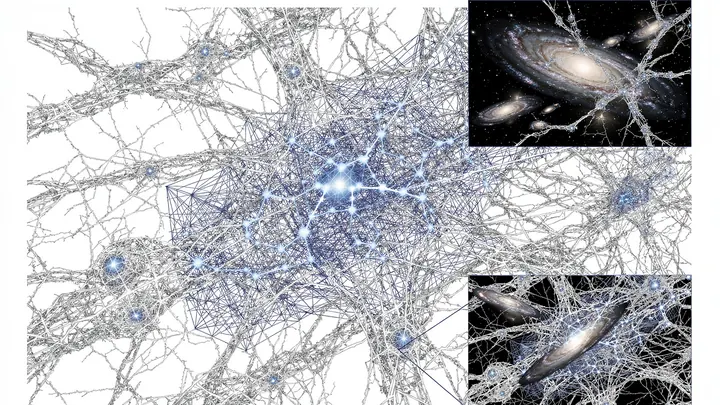
The cosmos resembles silk fabric with threads of the dark web showing through. We only glimpse tiny swatches of the real tapestry — through telescopes, in actual galaxy catalogs. To separate the fundamental signal from astrophysical noise in the cosmic pattern, statistical analysis demands thousands of plausible sketches — synthetic sky maps.
A night river is dotted with tiny sparks. This isn't plankton: it's functional pollen-sensors, millimeter-sized devices that swim on their own and measure the water's chemistry.
Each particle is a tiny lab. Inside, two reagents meet: one triggers a glow upon contact with a pollutant, and the second, a colored filter, blocks out interference.
To capture every detail of a statue's shape, you could break it into millions of tiny cubes and describe each one — slow, heavy, and your computer's memory would groan at the seams. That's how 3D medical scans are usually handled: a CT or MRI is a huge array of such cubes (voxels), and to create or improve an image, the machine has to plow through all of them.
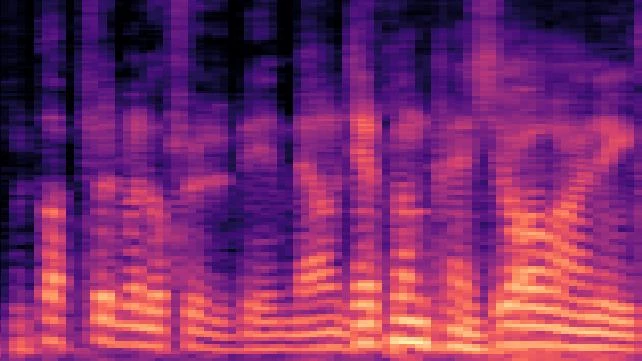
WanSong creates music like a sculptor carving a statue: it starts with noise, akin to the roar of a waterfall, and gradually chisels away the excess until pure notes and voices emerge. This method, diffusion, turns chaos into order, like ink dispersing in water, only in reverse. The model doesn’t stitch sounds together from fragments; it births a complete song in one go.
Unlike regular cameras, event-based ones only record moments when light becomes brighter or dimmer. They don't produce snapshots; instead, they send an endless stream of such flashes. Scientists turned this stream into a sharp picture of the Earth while flying over it on a satellite. Each flash is like a piece of a mosaic; together they form a still image.
The data from a single CT scan is comparable to several feature-length films. TCAM-Diff bypasses this bottleneck: the program compresses the 3D scene into three shadow projections — like a sculptor reconstructing a solid statue from silhouettes on three walls.
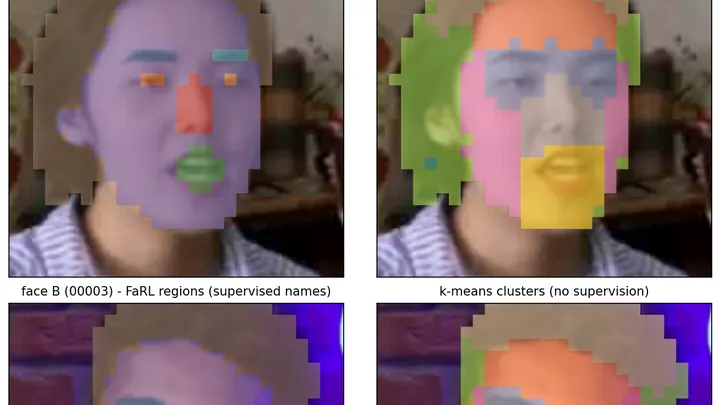
Trained on ordinary images, the DINOv3 model unexpectedly began to see faces as a spectrum: on its own, without hints, it isolates the eye, nose, and mouth regions. Like an invisible spectroscope, it breaks down a portrait into parts, just as a prism splits light into colors.
Across 200 videos, feature labeling accuracy reached 83% (random guessing is 23%).
In a noisy room, a person picks out a desired voice thanks to two ears capturing the difference in sound arrival. A computer with several microphones does the same: it gets spatial cues — where each voice is coming from.
Previously, these cues were used to focus on one direction, like a flashlight beam.
A neural network that generates sounds from text is like a kitchen where dozens of chefs prepare each 'dish.' Many just get in the way — sending false signals and wasting resources.
Gravitational microlensing is a fascinating cosmic effect predicted by Einstein and developed by Zwicky. A massive body passing between us and a distant star bends its light like a lens, creating characteristic magnifications and distortions.
A protein in a cell is not a frozen sculpture. It is constantly in motion: bending, breathing, jittering. This motion, its dynamics, determines how the protein works. But peering directly into the dance is hard, and computer simulations often demand enormous computing power.
A new approach, named DynaMode, views protein motion as a musical piece.
Light from distant galaxies travels to us for billions of years, but along the way it gets bent and twisted by the invisible web of dark matter. This effect, predicted by Albert Einstein within general relativity, is called gravitational lensing.
A student who has spent years solving problems from other people's textbooks suddenly receives three notebooks with real ocean observations. There are few problems, but they have already seen hundreds of similar ones, and now a couple of examples suffice to catch the new teacher's style.
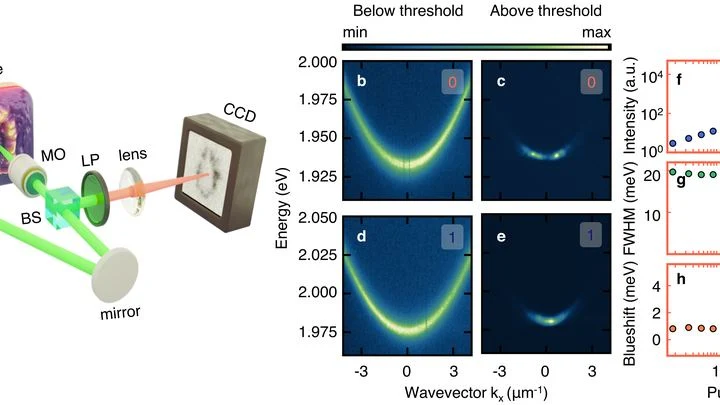
Generative neural networks that create images typically rely on digital randomness. But a team of researchers built a system where randomness is born not in code, but in a tiny optical cavity filled with an organic dye.
A photocatalyst is a powder that, when placed in water under light, splits it into bubbles of hydrogen and oxygen. The most popular material for this is titanium dioxide, the white pigment in paints and toothpaste. But a pure crystal works sluggishly: it absorbs only ultraviolet light, and such rays are scarce in the solar spectrum.
Through the ripples on the water, pebbles at the bottom of a pool look shifted and warped. In a similar way, the gravity of invisible dark matter bends the light of distant galaxies — a phenomenon known as weak lensing.
In a grand courtroom, a meeting is in session. Hundreds of translator-neurons simultaneously hear fragments of phrases, and must piece them into a single coherent picture. This is exactly how large brain networks turn scattered signals from the eyes into a unified object image.
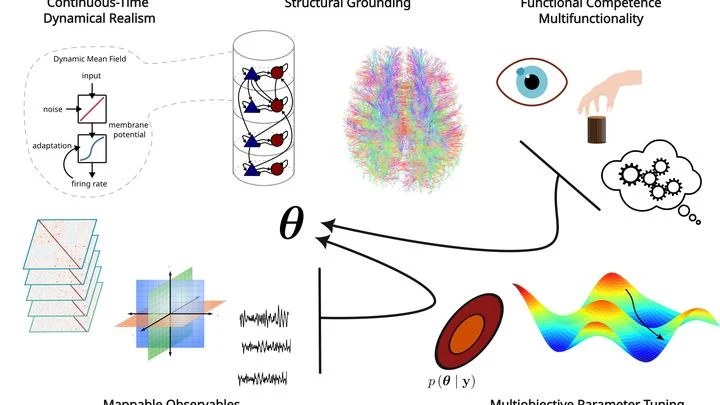
Engineers are building a car. Some assemble an exact replica of the engine, every piston and spark plug, but the car doesn't move: there's no steering wheel or wheels. Others build a fast self-driving go-kart, but its engine is made of playdough and doesn't resemble a real one. This is roughly the situation in brain science.
An artist paints a portrait stroke by stroke, and then someone offers them a flash camera — one click, and it's done. That's roughly the shift from multi-step models to one-step models in generating images of galaxies.
Typical neural networks for image synthesis work like a watercolorist: they apply a layer, blur it, add details.
A mosaic of large colored tiles. Each tile is the average precipitation over an entire month for an area the size of a small country. For a general understanding, the picture is fine, but if you need to know whether a downpour hit a specific city yesterday, it's useless.
Any light measurement runs into a fundamental limit: photons hit the camera sensor unevenly. This natural ripple (shot noise) blurs fine details, like trying to pick out a quiet instrument in an orchestra through the noise of the hall.
A drop of ink in a glass of water spreads quickly and evenly. But if the water is squeezed between tightly packed spheres, the ink cloud crawls slowly and erratically: it dodges obstacles and gets stuck in narrow necks. Water molecules in living tissue move in much the same way.
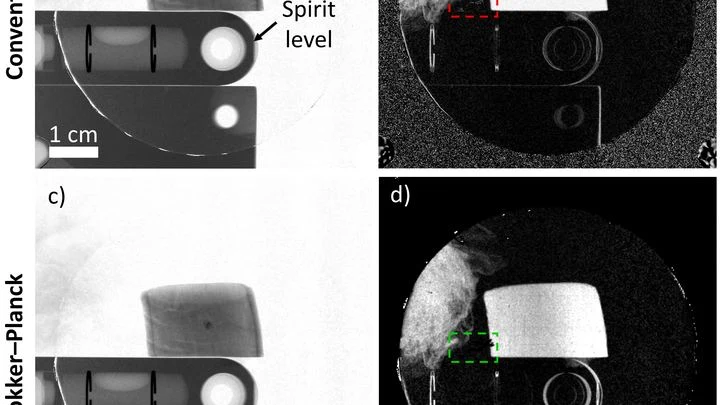
An X-ray machine with gratings takes not one but three pictures at once: a regular image, a map of beam deflections invisible to the eye, and an image of tiny structures that scatter light. Together, they help spot, for example, emphysema or pulmonary fibrosis. But there's a catch: to separate these three layers, you need a clever mathematical trick.
Imagine a river that doesn't flow in an open channel but through the inside of a sponge, with its currents shifting from place to place. That's a good way to think about the brain's glymphatic system: a network of ultra-fine channels around blood vessels, through which cerebrospinal fluid seeps into the tissue and washes away the waste that has piled up during the day.
You taste a fruit smoothie through two different straws. One lets through only the big chunks, the other only the liquid. Individually, the sensations are misleading, but together they give you the key: here, it seems, is banana, and here, strawberry.
Light passing through a turbid medium like milk or living tissue scatters in all directions. Reconstructing where light was absorbed more strongly is like guessing the shape of a fallen object from a puddle on the asphalt. Optical tomography solves this problem, but usually requires large computational resources.
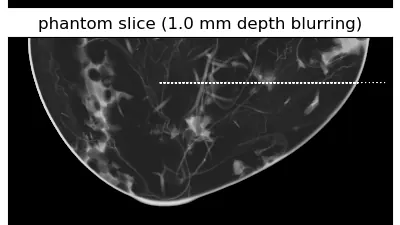
The X-ray machine moves around the breast in an arc, taking several images from different angles. From these flat frames, the computer assembles a 3D picture, like putting together a mosaic from pieces. But if the mosaic pieces are crumpled or smudged, the picture turns out blurry. In tomography, the role of "crumples" is played by noise and imperfections in the imaging.
Training an accurate aerodynamic model is like culinary art: first, a chef masters hundreds of recipes to grasp the general principles, then easily perfects a specific dish. Engineers created AeroTransformer and fed it 30,000 different wing shapes — a whole galaxy of culinary ideas galaxy.
An ordinary camera captures light reflected from objects and builds a picture from it. But if the object is hidden behind an obstacle or does not reflect light, radio waves come to the rescue: they pass through walls and fog, and a computer reconstructs the image from scattered signals.
A laser that usually produces a steady beam starts to tremble near its threshold, like a string about to sound. This trembling is not a defect but quantum noise: atoms inside the laser emit light randomly, without any external cause.
Water in a river flows around rocks, air bends around an airplane wing: these motions are described by equations that are hard to solve even on a powerful computer. Neural networks can approximate such solutions, but they often err when data is collected at only a few points or is noisy.
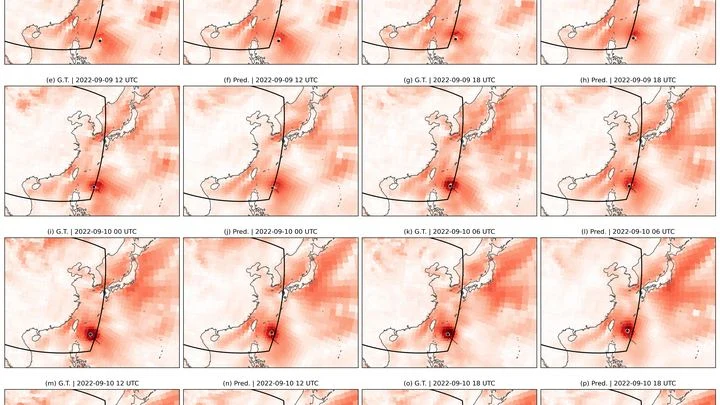
The atmosphere is a chaotic system, and a detailed global forecast requires monstrous computing power. StretchCast sidesteps this by working like the human eye: it creates 'sharp vision' over a selected region with an ultra-fine grid, while seeing the rest of the world blurry, but sharp enough to capture global connections.