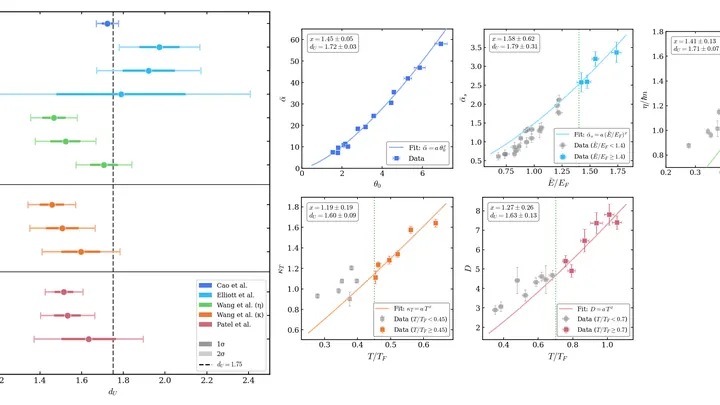
Universality is the phenomenon where completely different physical systems behave in exactly the same way near a critical point, such as a phase transition. For example, a magnet losing its magnetization at its Curie temperature and a liquid turning into a gas at its critical point show the same mathematical behavior, despite having utterly different microscopic constituents. This means that the details of the particles or forces don't matter — only the symmetry and dimensionality of the system do.
History
The idea of universality emerged in the 1960s and 1970s, culminating in Wilson's renormalization group theory, for which he won the 1982 Nobel Prize in Physics. Earlier, the observation that different fluids have the same critical exponents was a hint, but the deep explanation came later.
How it works
Near a critical point, correlations between particles extend over long distances, and the system's behavior is governed by fluctuations at all scales. This leads to 'scale invariance' — the system looks the same when zoomed in or out. The mathematical framework of the renormalization group, developed by Kenneth Wilson in the 1970s, explains why this happens: as you coarse-grain the system, the microscopic details 'wash out,' and only a few parameters (like dimensionality) survive. These universal properties are described by critical exponents, which are the same for entire classes of systems.
In practice
Universality allows physicists to study one system (like a simple magnet) and apply the results to another (like a quark-gluon plasma), saving enormous computational effort. It also underpins the design of quantum simulators.
Fun fact
The same universalexponents appear in the clustering of galaxies, the behavior of stock market crashes, and the way a forest fire spreads — all are examples of critical phenomena.
Imagine an interferometer as a giant ear listening to the radio whisper of a distant galaxy. Three antennas spread across continents capture the signal, and the difference in their phases combines into a quantity that is immune to atmospheric jitter. This quantity is called the closure phase.
A handful of coins drops onto a table — heads and tails land wherever they please. The same goes for an instantaneous snapshot of a quantum chain: in some places a particle is present, in others it is not. But behind the disorder lurks a precise angle.
In this work, a chain of particles closed into a ring was considered. It was divided into four arcs: two were measured, two were left untouched.
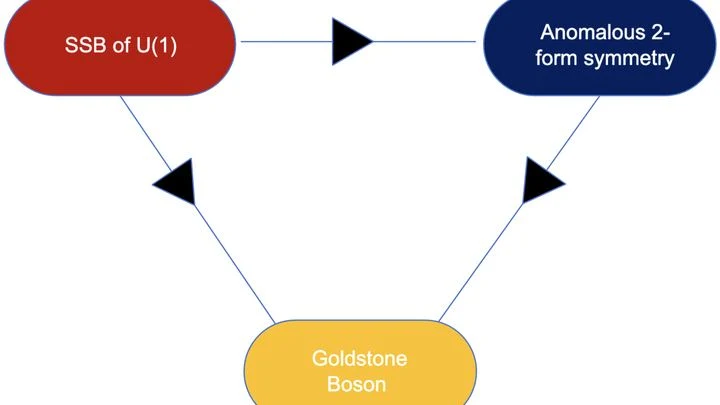
In some quantum theories, symmetries intertwine in an unusual way, as if a lock had two keys, but turning one slightly shifted the other. Such intertwined symmetries are called 2-groups. One is an ordinary symmetry acting on point particles (0-form), and the other is a 'linear' symmetry (1-form) governing extended objects like strings or lines.
A snowflake grows, an oil slick spreads, a crowd moves — each case has its own equations. But the end result is often the same: shape, speed, and pattern follow a simple scheme that repeats across scales. This is universality — when a common law hides behind the details.
The classical Mpemba paradox — hot water freezes faster than cold — has teased scientists for centuries. Only recently has nonequilibrium statistical mechanics explained it: it’s all about boundary conditions; the system seems to seek an excuse to “hit the wall” and speed up cooling.
In an orchestra, one musician plays so quietly that their sound is almost inaudible in the overall chorus. In the quantum world, such 'quiet' states are called dark: their energy barely escapes, like light in a darkened room. But if there are many musicians, their mutual influence can unexpectedly awaken even the most silent one.
A lightning strike splits the sky in a fraction of a second, leaving a branched trail. At the same moment, in a tiny superconducting crystal cooled to near absolute zero, an avalanche of magnetic field rushes through — thin fingers of magnetization piercing the material.
A stone falls into a pond, and ripples spread across the water. But if the stone is very small and the water is not quite ordinary, the ripples pass right through it, as if it weren't there.
A stone drops into a pond. Ripples spread, fade, and soon the surface is smooth again. But what if the pond has no shores, no bottom, and no characteristic ripple size? That is the world, a scale-free world, where quantum systems live when surrounded by an environment that picks out no particular length or energy.
A snowdrift grows by strict rules: falling snowflakes form bumps, those attract more snow, and the bumps amplify. The same mathematics describes city growth, patterns on bark, ripples on water, and clusters of cosmic dust. Physicists call this uniformity universality.
A neutron star is the ultra-dense remnant of a supernova explosion, whose existence was predicted by Fritz Zwicky back in the 1930s. Later, Jocelyn Bell Burnell detected them as pulsars — rotating sources of strictly periodic radio signals.
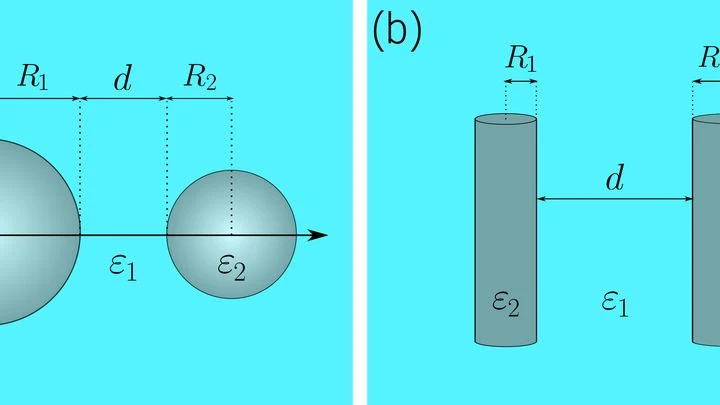
In a glass of salty water, even if it sits perfectly still, something is always happening. Tiny salt particles, ions, float and collide, sending ripples through the water. These ripples are invisible, but they create a force that attracts or repels nearby objects.
Previously, it was thought that this force only acts over very short distances, as if it quickly fades out.
Paraglider, hang glider, and glider — three different wings, but in the sky they behave the same. Pilots catch invisible warm air currents, rise on them, then glide to the next. Such flight is like a game of hopscotch: a jump upward, then a glide forward, and again a search for a place to jump.
Scientists analyzed thousands of real routes and found a common law.
Matter is like a house. In some rooms, there is the strict order of a crystal, where every atom is in its place. In others, the chaos of superfluid helium, where atoms forget about their neighbors.
Cosmic rays are charged particles that fly to us from the depths of the Galaxy. If you plot how many particles arrive at each energy, the line runs smooth, then suddenly drops sharply.