Warm Ocean, Few Hurricanes: The 2025 Season as an Orchestra Without a Conductor ✛
The orchestra assembled, the instruments were tuned, but there was barely any music: that's what the 2025 Atlantic hurricane season looked like. The ocean was the fifth warmest on record, and a weak La Niña usually adds strength to storms. But instead of a continuous concert, we got isolated thunderous chords: three Category 5 hurricanes, with silence in between.
Why was the orchestra silent? There was no conductor. The role of conductor for tropical cyclones is played by several atmospheric waves, and in 2025 they rarely stepped in at the right moment. The West African monsoon, which usually supplies the 'raw material' for hurricanes, was weak. An upper-tropospheric cyclone (a cold vortex at about 12 kilometers altitude) lingered over the Atlantic and sheared the tops off developing storms, like scissors snipping sprouts.
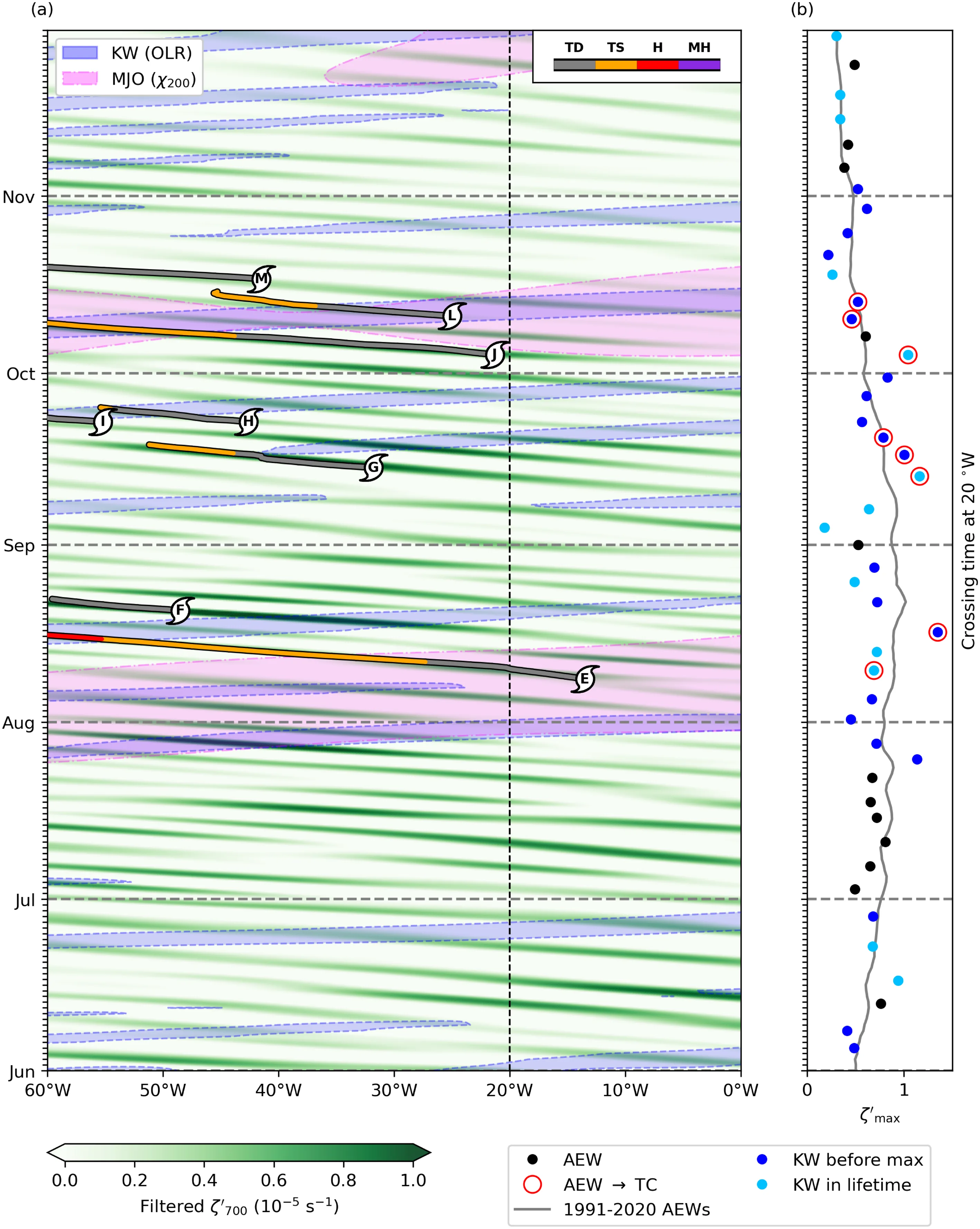
The Madden–Julian oscillation (another large-scale convection wave that circles the globe in 30–60 days) also rarely fell into a favorable phase: just 25 days for the season, the second lowest since 1991. As a result, African easterly waves (atmospheric disturbances born over Africa that drift across the ocean) were weaker than usual. Only a few of them grew into full-fledged hurricanes.
Previously, it was thought that a warm ocean and a weak El Niño almost guaranteed an active season. Now it's clear that less conspicuous players become decisive: the monsoon, the upper-tropospheric cyclone, and intraseasonal waves. This is the first real-data test of the hypothesis that Kelvin waves can 'push' African waves toward becoming hurricanes.
The music did play, after all: Hurricane Melissa produced a wind gust of 252 miles per hour (405 km/h) measured by a dropsonde, a new world record. An orchestra without a conductor can deliver thunderous notes; they're just rare. The 2025 season showed that the total number of hurricanes can decline, but when they do arrive, they hit harder.
In Hurricane Melissa, a dropsonde recorded a wind gust of 252 miles per hour (405 km/h), a new world record for a gust measured inside a tropical cyclone.