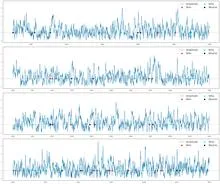
A marine heatwave is a period of unusually warm ocean water in a specific region, lasting from days to months. Unlike a single warm day, it's a sustained event that can disrupt marine ecosystems, shift fish populations, and affect weather patterns. These events are the ocean's equivalent of atmospheric heatwaves, but because water has a much higher heat capacity, they store and release enormous amounts of energy, making them significant for both marine life and coastal climates.
History
The term gained prominence in the early 2000s, but the phenomenon was recognized earlier; the 2011 Western Australia event and the 2013–2016 'Blob' in the Northeast Pacific brought it to wide scientific and public attention.
How it works
Marine heatwaves typically form when persistent high-pressure weather systems reduce cloud cover and wind, allowing more sunlight to heat the ocean surface and limiting mixing with cooler, deeper water. They can also be driven by ocean currents that advect warm water into a region. The event is defined statistically: when sea surface temperatures exceed a local threshold (often the 90th percentile) for at least five consecutive days, it qualifies as a marine heatwave.
In practice
Marine heatwave forecasts help fisheries managers, aquaculture operators, and conservation agencies prepare for ecosystem stress, such as coral bleaching or shifts in commercial fish stocks.
Fun fact
The 2013–2016 Northeast Pacific marine heatwave, nicknamed 'The Blob,' covered an area roughly the size of the continental United States and persisted for over two years.
Picture a guitar string stretched between two frets. When you pluck it, a standing wave forms: some points on the string oscillate strongly, while others, the nodes, remain almost still. The chromosphere, a layer of the solar atmosphere sandwiched between the photosphere and the corona, behaves in much the same way.
A spotlight with an adjustable beam width sweeps along the shore. Its light is the long ocean waves that are born in the surf zone and spread in both directions: toward the beach and out to the open sea. Previously, this spotlight was considered a point source, but the actual breaking zone, where short waves break, has a finite width, and it changes as the wave front advances and retreats.
Swimming season opens when the water feels tolerable. But everyone has their own threshold: one person shivers at twenty degrees, another swims comfortably at fifteen. Scientists decided to figure out where this difference comes from.
They compared a swimmer's body to a house trying to keep heat in while a cold wind blows outside.
In the solar corona, it rains from time to time — only not water, but plasma. The hot gas cools, clumps into blobs, and rushes downward along magnetic loops, like drops running down invisible gutters.
Imagine water as a ballroom, where each molecule is a dancer, constantly forming fleeting partnerships. These hydrogen bonds give rise to local patterns: some resemble a stiff waltz — an ordered network with cavities (low-density structure), others a wild jitterbug, where partners crowd into chaotic dense clusters.
Inside planets and stars, in rotating oceans of plasma, turbulent flows, Coriolis forces, and magnetic tension collide. The central question is how the energy of this chaos crystallizes into a stable magnetic framework that can last billions of years.
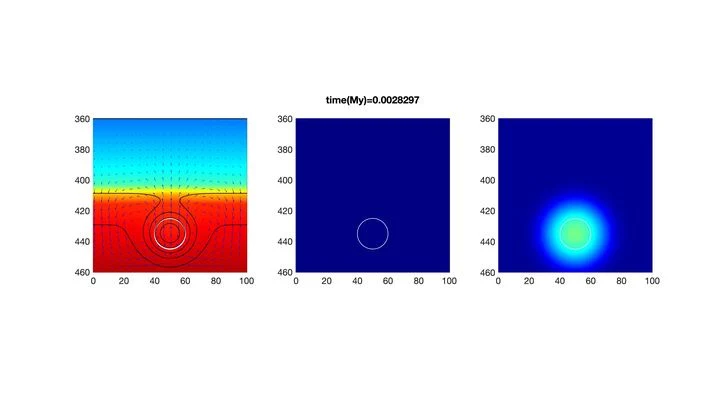
In the deep oceans of icy moons, water is not still. Warm plumes rise from the rocky seafloor, but the planet's rotation twists them into long, slanted rolls stretched along the rotation axis. Previously, this process could not be included in global models: it was too complex.
The Mpemba effect is surprising: hot water sometimes freezes faster than cold. Scientists built a simple model: a bead in a thick, honey-like medium, on a landscape with two dips and a wall at the edge. The bead moves viscously, unable to hop over the central bump.
Mars is an icy desert with an average temperature of minus 60. To warm it without biology, scientists propose three approaches with a single idea: create a thick heat-trapping blanket.
First, deploy transparent film-blankets over bases. They let sunlight in but keep heat from escaping, allowing us to harvest water from the soil and grow plants.
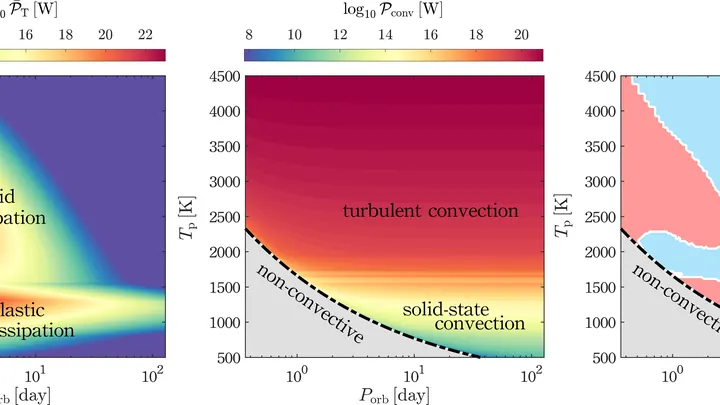
The James Webb Space Telescope is gazing more and more at exoplanets — worlds orbiting alien stars. Some of them are scorching rocky spheres, tidally locked with one side forever facing their star. There, rock melts into oceans of liquid lava. How does this lava move?
Water is the only common liquid that doesn't immediately contract when cooled. Ice melts, and water becomes denser, but only up to 4 degrees Celsius. Beyond that, with further cooling, it expands again. This quirk explains why fish survive in freezing ponds: the densest water sinks to the bottom, while a lighter cold layer stays on top and turns into ice.
When servers in a data center run at full tilt, they get as hot as a forgotten iron. That heat goes to waste, and cooling them eats up even more energy. Engineers in Germany have proposed putting that heat to work: let it drive liquid through thin tubes all by itself, with no motors or pumps.
Their device looks like a flat box with an asymmetric bottom.
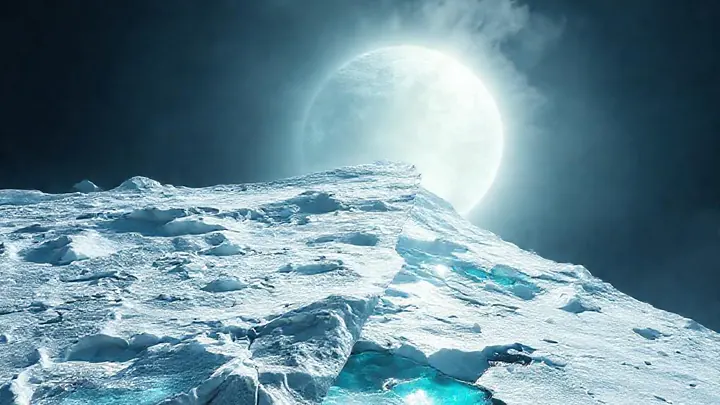
Beneath Enceladus's icy crust churns an ocean, acting like a perfect heat pump. It pushes heat from the equator to the poles, spending a thousand times less energy than it transports — like a perpetual motion machine built into the moon. The secret lies in salt.
Above the Sun's surface hang long ribbons of glowing gas — streamers. They look like giant harps stretched across the corona. When a wave runs along such a ribbon, it trembles and bends like a string after being plucked.
For a long time, it was thought that only a very fast ejection of material, one traveling at more than 500 kilometers per second, could launch such a wave.
In summer, the Arabian Sea breathes like a pair of bellows: one moment it pumps heat, the next it exhales moisture over a billion people. But sometimes this breathing stumbles, and the water off the coasts of India and Pakistan runs a few degrees hotter than usual.
Thousands of kilometers of fiber-optic cables lie on the ocean floor. They carry internet traffic, but the cables themselves sense the slightest vibrations in the water and the seabed. If you listen closely to such a cable, you can hear a blue whale singing or the ground trembling thousands of kilometers away.
An ordinary heat engine is like a mill between the hot and cold banks of a river: the greater the drop, the stronger the current. Here, the drop is tiny, just one or two degrees, but water can still turn the wheel. The secret is that water is made to boil not by heating but by a sudden drop in pressure, so steam bursts out even from barely warm liquid.
Ahead of the bow shock that Earth creates in the solar wind, giant bubbles of rarefied gas sometimes appear. Inside them, particle density drops by factors, and electric fields start to tremble like a plucked string.
The Sun's surface boils like water in a pot. Hot gas rises, cools, and sinks: that's convection. Magnetic fields churn around, tearing and reconnecting. In this frenzy, spicules are born: narrow plasma jets that shoot thousands of kilometers upward.
For exoplanets that always face their star with one side, the night side is doomed to eternal cold. But mountains can turn things around. Surface irregularities shake up the ocean of air, steering moisture flows across the day-night boundary. Once in the dark, water freezes into clouds, and clouds act like a blanket: they trap heat and keep the world from cooling down.
Deep beneath us, hundreds of kilometers down, lies a layer that can absorb water like a sponge. The minerals there, wadsleyite and ringwoodite, can hold up to 1–2% water by weight within their crystal lattices.
The Sun regularly produces explosions that hurl huge clouds of charged particles into space. Such a cloud travels toward Earth and can knock out satellites, disrupt radio communications, and even leave cities without electricity.
Rogue planets, ejected from star systems, may harbor life on their moons. A moon of such a planet can preserve heat and liquid water for billions of years. The whole secret lies in a reliable "blanket" and an internal "stove."
The stove is tidal forces: they squeeze and stretch the moon's interior, heating it up like kneading clay.
Glaciers don't just darken from soot. Their surfaces host tiny algae that, as temperatures rise, bloom and turn the ice dark. Dark ice absorbs more sunlight, melts faster, and further warms the planet. It's like how a black t-shirt in the sun gets hotter than a white one.
The second player in overheating is forests.
For a long time, the climate of ancient Mars remained a mystery: the beds of dried-up rivers spoke of water, but models couldn't explain how it got there — after all, 4 billion years ago the Sun shone 30% dimmer. New research shows that the planet swayed, as if on a swing, between long glaciations and short wet epochs.
An exoplanet — a planet outside our solar system — follows a slightly elongated orbit. With each revolution, it swings closer to its parent star and then farther away.
The Sun is slowly brightening, and in hundreds of millions of years its heat would become lethal for Earth. Fortunately, the built-in planetary thermostat — the carbon cycle — when overheating triggers rocks to absorb carbon dioxide faster, cooling the climate.
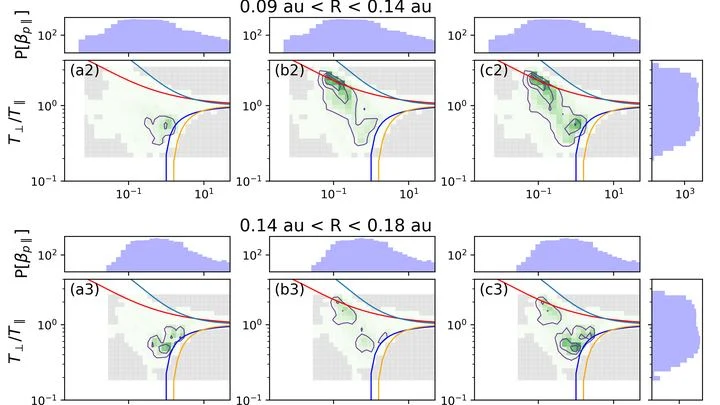
The solar wind isn't a calm stream but a bubbling soup of charged particles. Diving close to the Sun, the Parker probe picked up two types of stirring waves. Left-handed ones, like a whisk in a chef's hand, whip up the material when the temperature differs along and across the flow.
The orchestra assembled, the instruments were tuned, but there was barely any music: that's what the 2025 Atlantic hurricane season looked like. The ocean was the fifth warmest on record, and a weak La Niña usually adds strength to storms. But instead of a continuous concert, we got isolated thunderous chords: three Category 5 hurricanes, with silence in between.
Why was the orchestra silent?
Lunar rocks brought a puzzle: their age is 4.35 billion years, but the Moon itself should have appeared 150 million years earlier. The missing time is hidden in tidal heating. When the Moon hung closer to Earth, Earth's gravity acted like tireless hands: it constantly kneaded and bent the satellite.
The planet's gravity rhythmically squeezes and kneads the moon like dough: from this constant 'kneading', the interior heats up, and oceans of water can persist under the icy crust for ages.
In the Galaxy, there are plenty of rogue planets, thrown out by supernova explosions.
After the Moon's birth, Earth resembled a sizzling lump of dough: a continuous liquid magma and a dense shroud of gases. The Moon acted like a giant spoon, constantly kneading this lump with its gravity. Friction generated heat, delaying cooling.
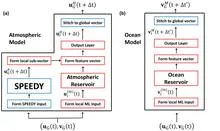
An orchestra of two musicians plays from the same score, but each hears only their own line. The atmosphere and ocean in a climate model resemble such a duet: they exchange heat and moisture every few hours, yet until recently their neural network counterparts could not keep a common rhythm.
In summer, the South China Sea can show a strange pattern: the water in the north warms while the south cools at the same time. A year later, it's the opposite. This isn't random; it's a steady seesaw that the ocean rocks every summer.
An invisible relay race runs through Earth's tropics: a wave of heavy rain and winds, which meteorologists call the Madden–Julian Oscillation, travels eastward at about five meters per second. Most runners tire quickly, but rare marathoners carry the torch all the way across the Pacific.
A translator at a high-stakes negotiation doesn't just render words quickly; they make sure the meaning doesn't get lost. CAMulator does the same: it takes the complex climate model CAM6 and translates it into the language of a neural network that runs hundreds of times faster, without losing the physical essence.
A translator at an important negotiation starts by simply repeating words, but gradually begins to anticipate what the counterpart will say. The new weather model works similarly: physics provides the framework, and machine learning learns from errors and fills in the gaps.
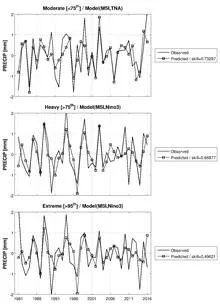
Every year, over the semi-arid belt south of the Sahara, the sky stages the same play: gentle rains that nourish millet, and violent downpours that wash away villages. Until recently, both acts were attributed to a single conductor: ocean surface temperature. But if you listen closely, each rain has its own control panel.
A fisherman in Queensland notices that in some years snapper are harder to catch, even though the nets and boat are the same. The reason hides not in the catch itself but in the water temperature several months earlier, when the fry were just hatching. A warm current arrived not for the whole year but only for a few weeks, and that short episode decided the fate of an entire fish generation.
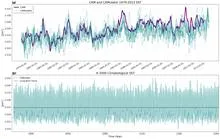
A doctor who has followed the same patient for years learns to predict flare-ups from subtle signs: a slight pallor, labored breathing, restless sleep. The ocean is just such a complex patient, only instead of a thermometer it has thousands of buoys and satellites, and instead of a medical history, seventy years of daily measurements.