Ghost Mode in a Sphere: Mathematics Without Physics express
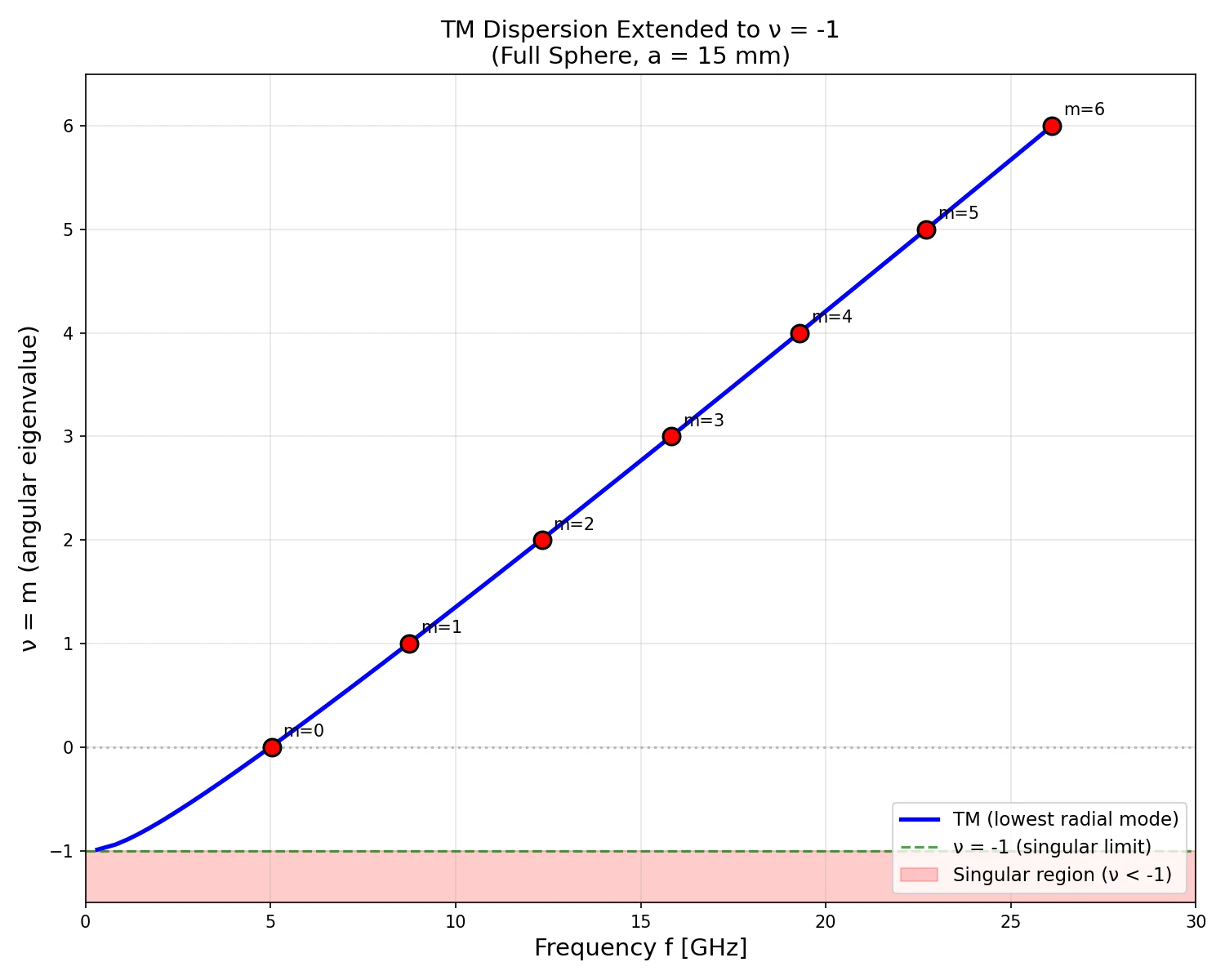
A metal sphere is a trap for light waves. Bouncing off the walls, they combine into frozen oscillations — like crests on a pond, frozen in time. For each such pattern (mode), Maxwell's equations prescribe a strict frequency. But if you extend the calculations to zero frequency, a glitch occurs: the fields disappear, yet the potential — something like a blueprint of the wave — remains. Physicists call this a ghost mode: it gives birth to neither light nor radio waves.
You can't ignore the phantom — it participates in the count of all possible waves inside the sphere. If you miss it, when heated, a miscount of entropy (a measure of thermal chaos) will yield a noticeable error in the radiation. It was precisely such discrepancies in the early 20th century that prevented classical physics from explaining the spectrum of a heated body — and forced Max Planck to introduce quanta, giving birth to quantum theory. Today, accurate accounting of all "almost-modes" saves us from errors when building resonators for quantum computers and spectroscopy instruments (analyzing light by its colors).
Original abstract
as written by the authors arXiv:2512.20123
The transverse magnetic (TM) modes of a spherical cavity satisfy a dispersion relation connecting the angular eigenvalue $$ u$$ to the resonant frequency through zeros of the spherical Bessel function derivative. Analytic continuation of this dispersion relation to $$ u = -1$$ yields a formal zero-frequency endpoint where $$j_{-1}(x) = \cos x / x$$ admits the root $$x = 0$$. We examine this limit in detail, showing that while the mathematics is well-defined, the endpoint does not correspond to a physical electromagnetic mode. The positivity of the angular Sturm-Liouville operator restricts physical eigenvalues to $$ u \geq 0$$, placing $$ u = -1$$ outside the admissible spectrum. We demonstrate that all electromagnetic field components vanish in this limit, even though the underlying Debye potential $$\Pi = \cos(kr)/kr$$ remains non-trivial and exhibits a monopole-type singularity at the origin. This distinction between potential and field reflects the kernel structure of the curl-curl operator for spherically symmetric configurations. The analysis clarifies the boundary between propagating electromagnetic modes and static field configurations in spherical geometry, connecting the formal endpoint to longstanding questions about mode counting in cavity quantization.
Counting electromagnetic modes in a cavity is the very problem that led to the birth of quantum physics, when classical theory failed to explain blackbody radiation.
A ghost potential without a field is like 'null-space' from science fiction: a void holding hidden energy.