concept

thermal chaos

The random motion of particles due to temperature, obscuring small effects.
16 related articles

Description

Thermal chaos refers to the random, jittery motion of particles in a system due to its temperature. This microscopic agitation is a fundamental aspect of thermodynamics and statistical mechanics, and it often obscures or masks small, subtle effects that one might want to measure. In physics experiments, thermal chaos is a ubiquitous source of noise that must be carefully accounted for or minimized, often by cooling the system to very low temperatures.

History

The concept of thermal motion has been understood since the development of kinetic theory in the 19th century, with contributions from James Clerk Maxwell and Ludwig Boltzmann. The term 'thermal noise' was later formalized in the context of electrical circuits by John B. Johnson and Harry Nyquist in the 1920s.

How it works

At any temperature above absolute zero, particles possess kinetic energy that causes them to move and collide randomly. This motion is described by statistical mechanics, where the distribution of velocities follows the Maxwell-Boltzmann distribution. The random fluctuations in position and momentum of particles create a background 'noise' that can interfere with sensitive measurements, such as detecting weak signals or observing quantum effects. In many experiments, reducing thermal chaos by cooling the system is essential to reveal the underlying physics.

In practice

Thermal chaos is a key consideration in the design of sensitive instruments like gravitational wave detectors, where it limits sensitivity, and in quantum computing, where it causes decoherence. It is also the basis for technologies like bolometers, which measure radiation by detecting temperature-induced changes in resistance.

Fun fact

Thermal chaos is the reason why the sky is blue: the random motion of air molecules scatters sunlight more strongly at shorter wavelengths, a phenomenon known as Rayleigh scattering.


Concept graph →

Related articles · 16

HEP Phenomenology2026-08-062 minarXiv:2608.05538express
Dark Matter from Thermal Noise
In the first moments after the Big Bang, the universe resembled a boiling cauldron. According to one hypothesis, dark matter, the invisible substance that holds galaxies together, could have been born there.
Thermal Split: How Uneven Heating Divides a Mixture
In a glass of water, oil gathers into droplets: that's equilibrium separation dictated by chemistry. But there are systems where order arises not from rest but from a constant flow of energy.
Materials2026-07-191 minarXiv:2607.17434express
Mirrors of Detectors: The Dance of Defects in Glass
Glass lenses and mirrors appear perfectly smooth and still. But beneath the surface, a hidden life teems. Atoms in an amorphous material (a substance without a crystalline lattice) are packed haphazardly, and this disorder creates a complex energy landscape, like a mountainous region with countless hills and valleys.
Quantum Physics2026-07-081 minarXiv:2607.07801express
Noise as the Architect of Quantum Order
In the microscopic world, noise, random fluctuations, usually destroys fragile quantum states, much like ripples on water break the reflection in a puddle. However, in some systems, collective, coordinated noise from many particles produces the opposite effect: a stable unidirectional flow emerges.
General Relativity2026-06-122 minarXiv:2606.14815express
Quantum Corrections to a Black Hole in a Dark Web
A black hole is not just a cosmic vacuum cleaner. It is a region with such strong gravity that even light cannot escape it. But place it in a perfect fluid of dark matter and add a cloud of strings, thin filaments stretched across all of space, and the picture gets more complicated.
HEP Theory2026-05-282 minarXiv:2605.29923express
How a Black Hole's Photon Ring Reveals Its Chaos
A light beam approaches a black hole not head-on, but at a glancing angle. If the angle is just right, the light neither falls in nor escapes: it starts looping around, like a figure skater circling the rim of a funnel. This narrow track is the photon ring. It acts like a lens, repeatedly reflecting the image of everything that falls into the hole.
Phantom Chords of Gravity: Boson Stars as Keepers of Quantum Memory
Every isolated quantum system inevitably moves toward thermal equilibrium — a state where all details of the past are erased. It’s like an orchestra: instead of a symphony, it starts playing white noise — random but statistically predictable notes.
Squeezed Light Catches Gravitational Waves
Gravitational wave detectors are microphones listening to the trembling of space. But their own noise drowns out weak signals. To hear more, physicists add special "squeezed" light to the instrument: it reduces quantum noise, like noise cancellation in headphones.
Biological Physics2026-04-042 minarXiv:2604.03538express
Fluid Dynamics2026-03-151 minarXiv:2603.14237express
How a sharp jolt flips a system over
A quiet tube with a heated grid inside. The voltage on the grid is suddenly raised, and the tube starts to hum, sustaining itself. This is not a malfunction but a transition to another stable state, like a ball rolling over a hill into a neighboring hollow.
Materials2026-03-121 minarXiv:2603.11539express
Ice Is Slippery Because of Heat
Ice slips away from under a skate blade like a bar of soap in wet hands. For a hundred years, scientists argued about where this slipperiness comes from. Some said there is already a thin layer of water on top: it acts as a lubricant. Others countered that water only appears when you start moving, due to friction.
Memory in Vibrating Sand
A handful of sand on a vibrating table is like a crowd on a dance floor that still holds the rhythm of the old song for a second after the DJ has switched to a new one. Scientists made a thin layer of grains bounce on a vertically shaking platform and abruptly changed the shaking intensity.
Statistical Mech2026-02-162 minarXiv:2602.15185express
Complexity on the Edge of Order and Chaos
A magnetic film divided into tiny arrow-shaped cells behaves like a crowd in a square. While it's cold, all arrows point in the same direction — perfect order. Heat the film, and the arrows start darting around like pedestrians who have lost their purpose. Somewhere between these extremes, there is a moment when the system stops being uniform but hasn't yet dissolved into random noise.
Chaotic Dynamics2026-02-072 minarXiv:2602.07660express
How to Tell Chaos from Order by a Particle's Trail
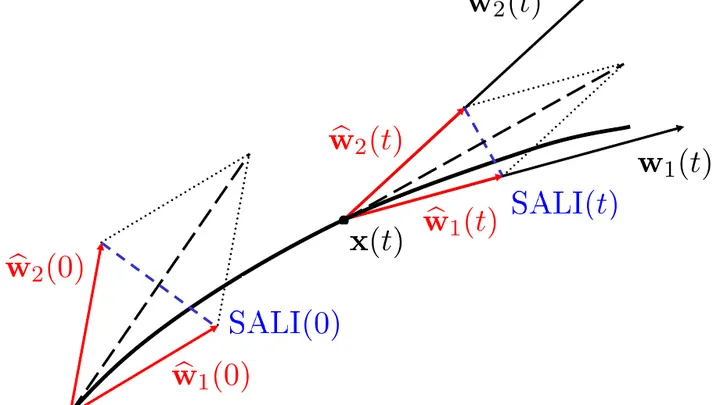
Drop a stone into a calm pond — the ripples spread evenly. Drop it into a churning stream — the water swirls unpredictably. Scientists have long wrestled with a similar question: how can you tell from a single particle's path whether its motion is chaotic? Previously, this meant comparing the particle's path with neighboring ones, which is complicated and time-consuming.
Quantum Gases2026-01-191 minarXiv:2601.13226express
Light Atoms Get Stuck in a Dense Gas
Toss a handful of peas into a pot of semolina porridge — the peas quickly sink, pushing the grains aside. But if you make the porridge very thick and sticky, the peas get stuck. That's roughly how light lithium atoms behaved in a cloud of heavy potassium atoms at temperatures just a few millionths of a degree above absolute zero.
Noise That Works for Us
An old aviation instrument sometimes sticks: the needle catches on the scale and doesn't move, even though the plane is already changing altitude. Engineers found a simple solution: add a slight vibration. The shaking doesn't hinder; on the contrary, it helps the needle break free and show the truth.