One membrane – two mysteries of the Universe express
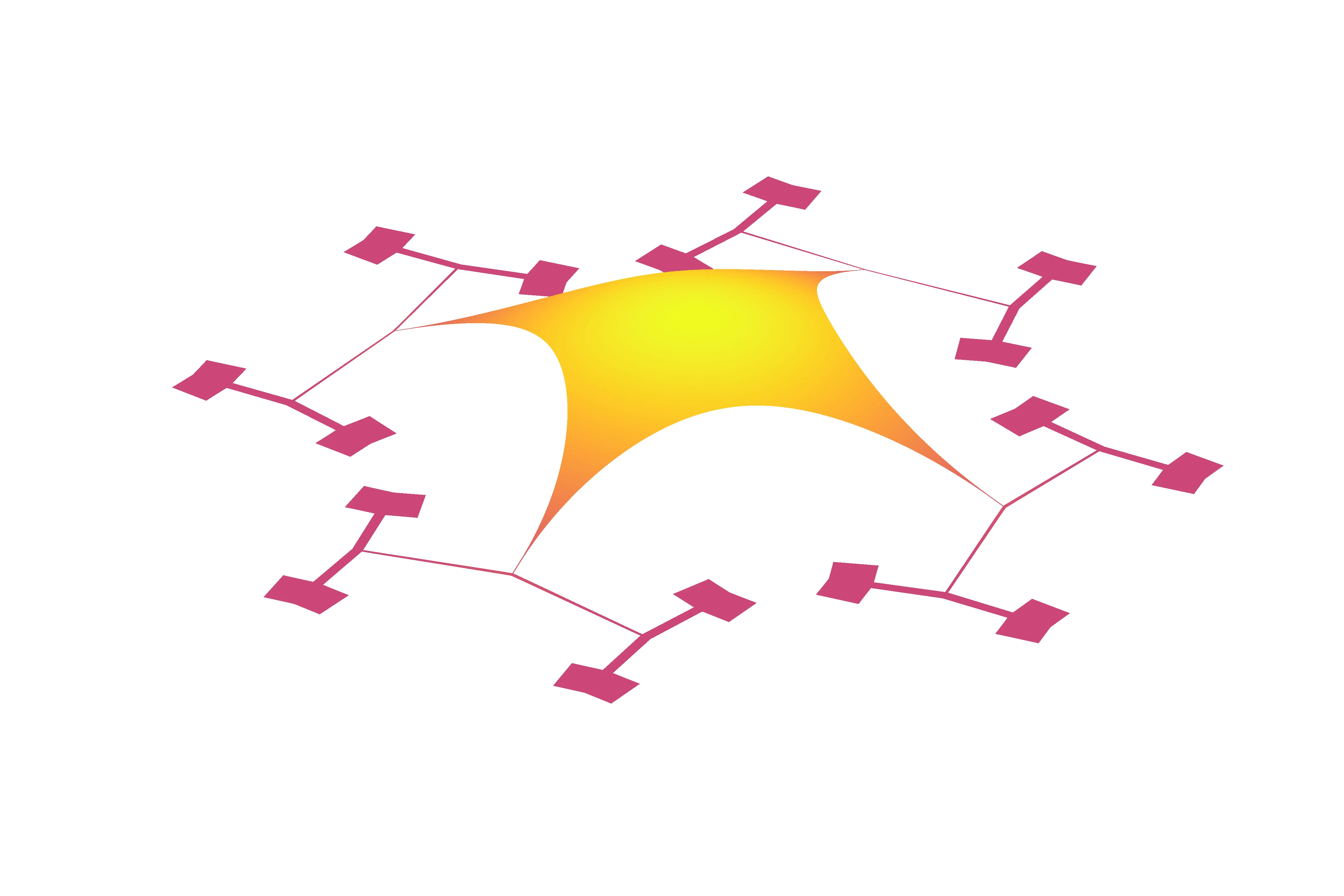
Imagine a membrane stretched like the skin of a drum. It picks up two signals at once: gravitational waves — the trembling of space itself — and elusive particles of dark matter. The membrane is placed between mirrors, and light presses on it like a finger on a string, keeping it under constant tension. When a gravitational wave arrives, the distance between mirrors barely changes, and the membrane starts to vibrate. By adjusting the light pressure, the membrane's frequency can be tuned nearly two-fold — this way one set of membranes hears the whole range from a low hum to a high whistle.
To search for dark matter, a small plate of a different material is suspended next to the membrane. Invisible particles push them with different forces — like wind that playfully shakes a light leaf but barely touches a stone. The microscopic discrepancy in the motion of these objects reveals the presence of dark matter, even if it lies beyond the Standard Model — the familiar set of known particles.
Sensitivity is astonishing: the device detects oscillations whose amplitude is a thousand times smaller than the size of a proton. One membrane simultaneously listens to the hum of black holes and sniffs the breeze of dark wind — a rare case where a single experiment tackles two of the greatest mysteries.
Original abstract
as written by the authors arXiv:2601.02576v1
We present a proposal for a nanomechanical membrane resonator integrated into a moderate-finesse ($$\mathcal{F}\sim 10$$) optical cavity as a versatile platform for detecting high-frequency gravitational waves and vector dark matter. Gravitational-wave sensitivity arises from cavity-length modulation, which resonantly drives membrane motion via the radiation-pressure force. This force also enables in situ tuning of the membrane's resonance frequency by nearly a factor of two, allowing a frequency coverage from 0.5 to 40 kHz using six membranes. The detector achieves a peak strain sensitivity of $$2\times 10^{-23}/\sqrt{\text{Hz}}$$ at 40 kHz. Using a silicon membrane positioned near a gallium-arsenide input mirror additionally provides sensitivity to vector dark matter via differential acceleration from their differing atomic-to-mass number ratios. The projected reach surpasses the existing limits in the range of $$2\times 10^{-12}$$ to $$2\times 10^{-10}$$ $$\text{eV}/c^2$$ for a one-year measurement. Consequently, the proposed detector offers a unified approach to searching for physics beyond the Standard Model, probing both high-frequency gravitational waves and vector dark matter.
The detector is so sensitive it would catch a displacement of the membrane by a billionth of an atom — such ripples are born from the merger of black holes in a distant galaxy.
In the movie Interstellar, spacetime curvature allowed the heroes to travel through time. The new detector searches for the same oscillations, only on a stellar scale and incredibly quiet.