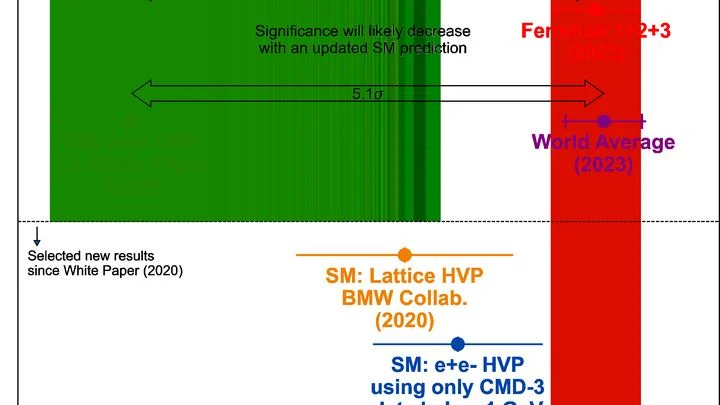
Fermilab is a major particle physics laboratory in the United States, specializing in high-energy particle accelerators and precision measurements of fundamental particles. It is best known for discovering the top quark and for its long-running Tevatron collider, which probed matter at the smallest scales. In recent years, the lab has become central to the study of the muon, a heavier cousin of the electron, through the Muon g-2 experiment, which measures the muon's magnetic moment with extraordinary precision.
History
Fermilab was founded in 1967 and named after physicist Enrico Fermi. The Muon g-2 experiment began taking data there in 2018, following earlier measurements at Brookhaven National Laboratory.
How it works
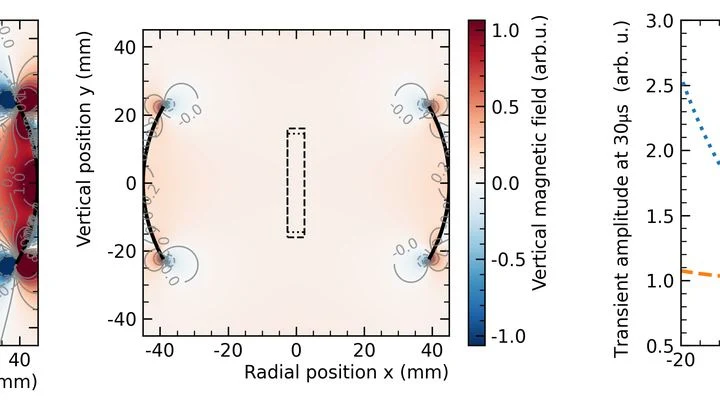
The lab operates large particle accelerators that smash protons into targets or other protons, creating showers of particles that are then studied by massive detectors. For the muon g-2 experiment, a beam of muons is injected into a storage ring with a highly uniform magnetic field; the muons circulate for thousands of laps, and their precession (the wobble of their spin) is measured. The rate of precession reveals the magnetic moment, which can be compared to theoretical predictions to test the Standard Model of particle physics.
In practice
Fermilab's accelerator technology and detector expertise are used in medical imaging, materials science, and the development of superconducting magnets for future colliders.
Fun fact
The Muon g-2 storage ring at Fermilab was originally built for the Brookhaven experiment and was transported 3,200 miles by road and sea to its new home in Illinois.
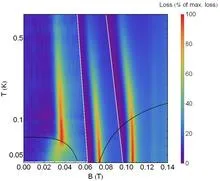
Tuning a radio receiver to a station that changes frequency as you cross a phase boundary: that is how you might picture the challenge facing the researchers. In the metal YbRh2Si2, electrons behave as "heavy" particles: their effective mass is hundreds of times that of a free electron.
The hanmilite crystal, resembling a layered cake of copper and boron, behaves like a ladder: the copper spins are arranged in two parallel rails connected by rungs.
A magnet weighing just a few grains of sand hovers in midair with no support. It doesn't touch the walls, doesn't rub against bearings — it just hangs in a magnetic trap like a speck of dust in a sunbeam. Researchers have turned this tiny object into an ultra-sensitive compass: the device detects changes in the magnetic field of 23 femtotesla.
In southern India, in the city of Madurai, from 2018 to 2022, an unusual 'catcher' of cosmic particles stood — the mini-ICAL prototype, weighing 85 tons. It is a 600-times scaled-down version of the future neutrino detector (those elusive ghost particles) that will be built deep underground.
The 21-kilometer ring near Protvino was once planned to accelerate protons. Today, the same tunnel could host a very different machine — a muon collider. The muon is a heavy cousin of the electron, and that's its strength. On a curve, an electron radiates like a searchlight, losing precious energy. A muon radiates a billion times less.
In the pitch darkness of a vacuum chamber, a tiny magnet floats. It touches no walls and loses almost no energy — an ideal sentinel, ready to catch the faintest nudge. Such a sentinel is exactly what you need for axion hunting. These particles are prime suspects in the case of the Universe's hidden mass, which we call dark matter.
Nearly a decade and a half ago, the Fermi gamma-ray telescope spotted mysterious "bubbles" — giant plasma blobs, as if inflated by invisible lungs, towering tens of thousands of light-years from the Galactic center.
A spinning top rotates, but its axis remains invisible. That's roughly how a muon behaves — a heavy cousin of the electron. Its spin (intrinsic rotation) changes direction, and the only way to infer this is by how the muon decays. In a new experiment, scientists tracked the spins of about 10 billion muons using data from the Muon g-2 facility at Fermilab.
In a giant ring of magnets outside Chicago, muons whirled like figure skaters on an ice rink. But instead of music, there's a magnetic field, and instead of spinning, there's a barely perceptible wobble of the spin. Physicists call this wobble the anomalous magnetic moment.
Every second, about a hundred invisible particles, muons, pass through your body. They are born high in the sky when cosmic rays collide with air atoms, raining down on Earth. These particles are so penetrating that they can pass through a multi-story building, but they slightly change direction when they encounter dense material, such as lead or uranium.
Electrons and muons are tiny magnets. Their magnetism is slightly more than two (in special units), and this 'excess fraction' (anomalous magnetic moment) arises from constant ripples in the vacuum: particle pairs momentarily pop into existence and vanish.
Deep inside the detector at the Large Hadron Collider, protons collide, and for a fleeting moment something heavy is born. It instantly shatters into two Higgs bosons — particles that, like nesting dolls, each hide two pairs of b-quarks.
In a dark room, a glass bead the size of a dust grain hangs on a laser beam. Beneath it are two mirrors: one aluminum, one silver. If axions (light, invisible particles that could make up the mysterious dark matter) whiz by, they exchange with the mirror atoms, and the bead shifts ever so slightly.
A giant cloud of gas and dust, so cold that its warmth barely flickers, just a few degrees above absolute zero. This is TMC-1 in the constellation Taurus, one of the darkest and densest cradles of molecules in our Galaxy. In recent years, it has become a true treasure trove for astrochemists: the number of substances found there has more than doubled.
The Higgs boson is like a conductor that gives mass to all other particles. Without it, electrons would be massless and atoms would fall apart. But how does the conductor interact with itself? That is the key question a future muon collider aims to answer.
Colliding two lead nuclei at the Large Hadron Collider is like throwing two hefty bags of marbles at each other. Usually, the marbles scatter in all directions, but sometimes one bag passes so close that the marbles don't collide: they just exchange glances.
In giant accelerators, particles zip through detectors in billionths of a second, and telling one from another requires a stopwatch of incredible precision. The new µRWELL-PICOSEC detector acts as such a stopwatch: it captures the moment a particle passes with a precision of 48 picoseconds: that's 48 trillionths of a second.
Protons accelerated to enormous energies slam into a thick metal plate, like bullets into armor. Inside the metal, a J/ψ particle is born for an instant, which immediately decays into two muons — light relatives of the electron. These muons fly out of the target, and detectors catch their tracks.
The scientists compared the number of caught muons with predictions from a computer model.
A ring road around the Sun, where the traffic is not cars but clumps of matter. The diameter of this road is measured in light-years: it encircles our planetary system at its outer edge, in the Oort Cloud, where the star's weak gravity still holds sway.
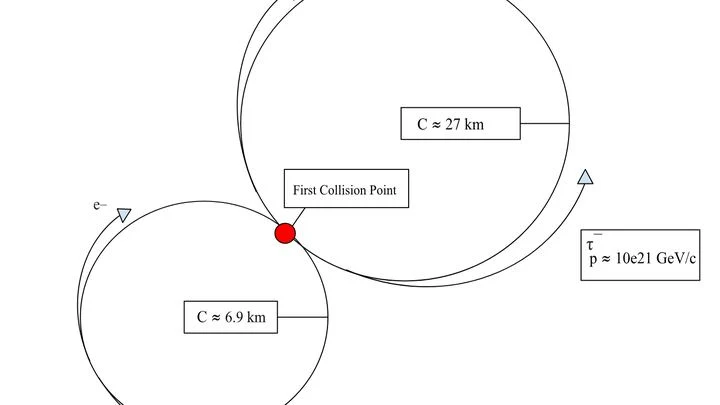
In an underground ring 27 kilometers in circumference, protons are accelerated to nearly the speed of light and smashed head-on. At the collision point, conditions briefly recreate those of the first trillionth of a second after the birth of the universe.
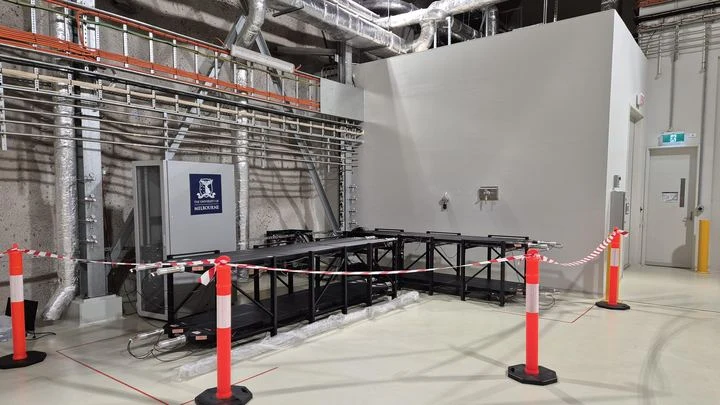
Deep underground, in a former gold mine in Australia, stands a laboratory where silence is broken only by rare flashes of light. These flashes are the traces of cosmic particles that punch through hundreds of meters of rock. Eight plastic panels, resembling large glowing sheets, catch these particles.
Physicists trapped a cloud of lithium atoms between mirrors. Light bounces inside, like in an echo chamber, forcing the atoms to emit synchronously — resulting in superradiance, akin to a choir where voices merge into a single thunder. Like a stadium chanting in unison: each whisper turns into a deafening rhythm. The secret is density.
In collisions of heavy nuclei, a fireball of thousands of particles is born. Among them are pions and kaons, two kinds of light particles that look very much alike. To understand what happens in this fireball, physicists need to know exactly how many of each particle flew out.
A single antiproton, trapped and cooled to near absolute zero, behaves like a tuning fork that needs a very precise strike to produce a clean note. Catching that 'note' directly is nearly impossible — the signal is too weak.
At the Large Hadron Collider, by accelerating particles to nearly light speeds, top quarks are created — the heaviest building blocks of the Standard Model. They live for vanishingly small fractions of a second but manage to exhibit complex quantum connections.
Inside the Large Hadron Collider, protons are accelerated to nearly the speed of light and smashed head-on. At the collision point, a burst of energy is born for an instant, from which new particles can emerge. One of the heaviest is the top quark.
The top quark is the heaviest known building block of matter, but theory predicts a stealthy twin, the T-quark, which could be several times heavier. To coax it into the open, physicists collide protons with muons — the electron's unstable relatives.
In an underground hall at Fermilab, a huge tank holds liquid argon — a transparent fluid at minus 186 degrees. When an invisible neutrino flies into the tank, it occasionally strikes an argon nucleus, and a short track of charged particles flashes.
The muon is a heavy cousin of the electron that lives for just two millionths of a second. In a magnetic field, it spins like a top, but slightly faster than formulas predict. Twenty years ago, this 'slightly faster' was noticed at Brookhaven, and physicists have been arguing ever since: either the instruments were wrong, or unknown particles are hiding in the vacuum.
Dark matter is five times more massive than ordinary matter, yet it emits no light. Its nature remains unknown. One candidate is the ultra-light axion particle. Axions could pierce right through the planet, barely noticing atoms.
Two spinning tops are set off simultaneously in opposite directions. If one spins left, the other always spins right — no matter how far apart they fly. That's roughly how quantum entanglement works, except instead of tops, we have top quarks, the heaviest known particles.
Imagine a membrane stretched like the skin of a drum. It picks up two signals at once: gravitational waves — the trembling of space itself — and elusive particles of dark matter. The membrane is placed between mirrors, and light presses on it like a finger on a string, keeping it under constant tension.
Two electrons in a narrow tube don't want to be close. Both carry a negative charge and push each other apart, like two magnets with like poles facing. If the tube is very thin, they can't move sideways, so they line up one behind the other. Physicists call this Wigner localization: the particles take fixed positions, like beads on a taut string.
The muon is a tiny spinning top, twirling in the turbulent sea of the vacuum. Its magnetic axis points slightly away from what the Standard Model predicts. The deviation is just a couple of parts per million, but for physicists, it's a full-blown mystery.
The vacuum is not a dead calm.