In experimental physics, a membrane is a thin, flexible surface that can be stretched taut and used as a sensitive detector element. When a physical disturbance—such as a passing gravitational wave, a vibration, or a pressure change—interacts with the membrane, it causes the surface to deform or oscillate. These tiny mechanical movements can then be measured with high precision, often using laser interferometry or capacitive sensing, to infer the properties of the disturbance.
History
Membranes have been used in acoustics and pressure sensors for over a century, but their application as precision detector elements in fundamental physics experiments became prominent in the late 20th century, particularly in the development of resonant-mass gravitational wave detectors and in optomechanical experiments.
How it works
The membrane is typically made of a material with low mechanical loss, such as silicon nitride or a metallic film, and is suspended under tension. When an external force acts on it, the membrane's displacement is proportional to the force's amplitude. By reflecting a laser beam off the membrane and measuring the interference pattern, or by detecting changes in capacitance between the membrane and a nearby electrode, researchers can translate the mechanical motion into an electrical signal. The key is that the membrane's low mass and high tension make it extremely responsive to tiny forces, while its design minimizes thermal noise.
In practice
Membranes are used in gravitational wave detectors, atomic force microscopes, and micro-electromechanical systems (MEMS) such as pressure sensors and microphones.
Fun fact
In some optomechanical experiments, membranes are cooled to near absolute zero so that their quantum mechanical ground state can be observed, making them macroscopic objects that behave according to quantum rules.
Blood vessel cells were seeded onto a transparent film just 700 nanometers thick — a hundred times thinner than a human hair. Flat electrodes are hidden beneath the film. They send a weak alternating current and listen as the resistance changes.
Back in the 1960s, physicist Joseph Weber tried to catch gravitational waves using aluminum cylinders: they were supposed to tremble like tuning forks from the ripples of spacetime.
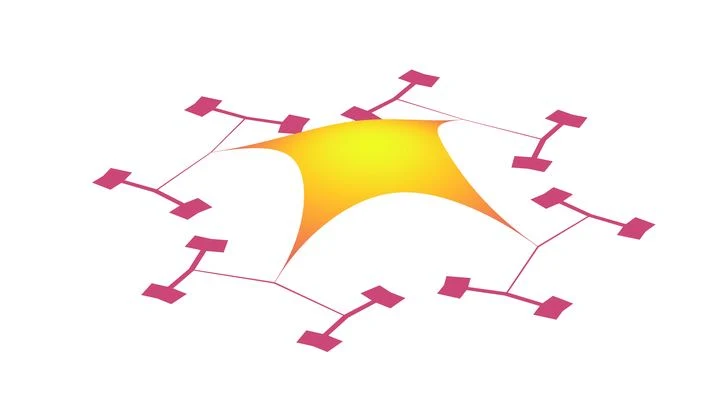
Imagine a membrane stretched like the skin of a drum. It picks up two signals at once: gravitational waves — the trembling of space itself — and elusive particles of dark matter. The membrane is placed between mirrors, and light presses on it like a finger on a string, keeping it under constant tension.