A resonant cavity is a hollow metal structure engineered to confine electromagnetic fields at specific frequencies, much like an acoustic guitar body amplifies certain sound notes. In physics, it is a precision tool for storing and detecting photons, and it plays a central role in experiments searching for dark matter candidates such as axions. When an axion converts into a photon inside a strong magnetic field, the cavity resonates at the photon's frequency, amplifying an otherwise impossibly faint signal.
History
The concept of electromagnetic resonators dates back to the late 19th century with Heinrich Hertz's experiments, but the modern use of resonant cavities for particle detection was developed in the mid-20th century, notably in particle accelerators. The application to axion detection was proposed by Pierre Sikivie in 1983.
How it works
The cavity's walls are highly conductive, typically copper or superconducting material, and its dimensions are tuned so that standing electromagnetic waves form at particular resonant frequencies. In axion detectors, a powerful magnet fills the cavity, and if an axion interacts with the magnetic field, it can convert into a photon whose frequency matches the cavity's resonance. The cavity then accumulates this signal over time, making it detectable with sensitive receivers.
In practice
Resonant cavities are used in particle accelerators to accelerate charged particles, in microwave ovens to heat food, and in axion dark matter detectors like ADMX.
Fun fact
The same resonant cavity technology used to detect hypothetical axions is also being explored to detect high-frequency gravitational waves, as the titles in the corpus suggest.
Picture a radio receiver with a single tuning knob that moves all of its internal coils at once, like one living organism. That is exactly how a new instrument for the search for the axion works, a particle that may fill galaxies with invisible mass. Inside a copper cylinder the height of a coffee can sit rods of aluminum oxide.
In the basement of the laboratory, an 8 tesla magnet hums. Inside it, like a bell in a bell tower, hangs a hollow copper cylinder tuned to a single note. If an axion, a dark matter particle, flies by, the cylinder responds with a faint ring. The trouble is that ordinary copper muffles this ring: at high frequencies, current flows only through a thin skin of the metal, and losses grow.
In the first moments after the Big Bang, the universe expanded at an incredible rate — a phase known as inflation. Even the vacuum was restless back then: quantum jitters shook the fields like wind rustling through a wheat field.
Imagine a green beam that, passing through an ingenious optical setup, twists into a three-dimensional funnel of light — an optical vortex. At its heart, like in the eye of a hurricane, the intensity drops to zero. It is there that photons disappear.
Picture the early Universe as an unimaginably large bell. Inflation — the era of rapid expansion, dreamed up by Alan Guth, strikes it, sending a wave rippling across the fabric of spacetime.
In the pitch darkness of a vacuum chamber, a tiny magnet floats. It touches no walls and loses almost no energy — an ideal sentinel, ready to catch the faintest nudge. Such a sentinel is exactly what you need for axion hunting. These particles are prime suspects in the case of the Universe's hidden mass, which we call dark matter.
A well-coordinated orchestra of electrons in a superconductor is easily thrown off rhythm. Thermal jolts destroy the fragile order, and resistance returns. For decades, scientists have sought ways to strengthen this ensemble — mostly by changing the material's composition or compressing it to unimaginable pressures.
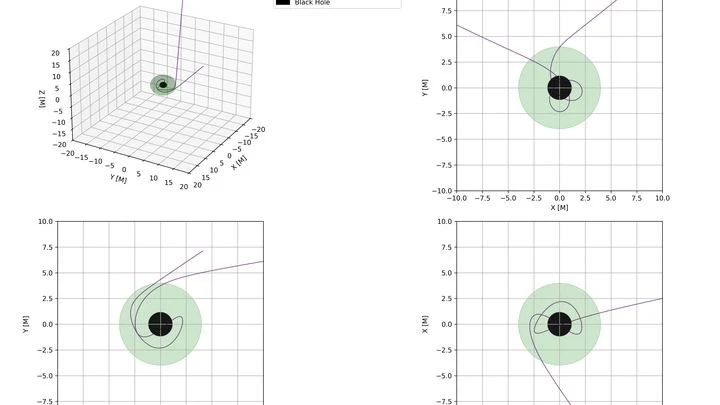
Light passing by a black hole falls into a gravitational trap: its trajectory curves and the particle bounces along a nearly closed orbit, like a pinball.
In the first moments after the Big Bang, the universe was a boiling cauldron. But then, according to a new hypothesis, it suddenly cooled dramatically — far more than previously thought. In this icy world, dark matter particles, like tiny pendulums, froze and did not begin their oscillations.
Dark matter has eluded direct observation so far, even though its gravity holds galaxies together. One hypothesis: it’s made of axions — ultra-light particles predicted by theory.
A freshly polished niobium surface shines like a mirror. But within minutes, a dull oxide film, invisible to the eye, forms on it. For a superconducting qubit, this film is like sand in an hourglass: it causes the quantum state to decay prematurely.
In 2015, two giant facilities in the United States caught the shiver of space — a gravitational wave from the collision of black holes. Since then, such signals have been caught regularly, but the detectors themselves are enormous: their arms stretch for kilometers.
A gas bubble in water sings loudly — this is Minnaert resonance: the heavy liquid prevents the bubble from compressing quickly, forcing it to vibrate. In air, there's no such effect: air is too light. But if you dress the bubble in a soft silicone shell, like rubber, it plays the role of the water mass. You get an 'elasto-bubble'.
The crystal CeB6 is like a box with a secret: inside it, electrons can occupy four nearly identical positions, like four chairs around a table. While no one is watching, the electron seems to sit on all four at once. Physicists call this hidden state quadrupolar, and it affects magnetic properties, but it is hard to see directly.
Sound in a solid is waves of compression and rarefaction rippling through atoms, like ripples across a spring mattress. If you place obstacles with just the right spacing, waves at certain frequencies can't pass: they bounce back. Such a periodic structure is called a phononic crystal, and it works for sound the way a multilayer mirror works for light.
A qubit, the computational unit of a quantum computer, lives for fractions of a millisecond before forgetting its state. One culprit is a tiny contact inside it: two layers of aluminum sandwiching a layer of aluminum oxide just a couple of nanometers thick.
At the bottom of lunar craters, where sunlight never reaches, an eternal cold reigns — about minus 240 degrees Celsius. In these icy pockets, known as permanently shadowed regions, plans are underway to install a mirror resonator made of monolithic silicon.
In its infancy, the universe was a hot, plasma-like mixture of particles. Microseconds after the Big Bang, as it cooled, the temperature fluctuated slightly.
A laser pulse enters a tiny cavity made of a transparent crystal. Inside, light bounces between mirrors, and occasionally one photon splits into a pair: one goes one way, the other goes another. One becomes the signal, and the other acts as a 'bell' announcing that a single photon is ready.
Magnetic materials can store oscillatory energy, like a tuning fork that keeps ringing after being struck. When such a material is placed in a microwave cavity, its oscillations (magnons) start interacting with light (photons).
A pot on the stove rings when the water boils. An empty copper cup can also "ring"—at radio frequencies — if a dark matter particle is born inside it. These particles are called axions, and according to one hypothesis, they fill the entire galaxy as an invisible cloud.
Gravitational waves are ripples in spacetime curvature that imperceptibly stretch and squeeze everything around. But the Moon, like a bell, catches these waves: as a gravitational wave passes through it, it makes our satellite vibrate.
A quantum computer is like an orchestra where every musician plays their part, but sometimes hits a wrong note. Errors accumulate, and you need someone to quickly fix the sound. In quantum memory, cooling plays the role of that tuner: it removes leftover photons — particles of light that remain after calculations.
Dark matter doesn't emit or reflect light, yet its gravity holds galaxies together. What it's made of is a mystery. One leading candidate is the axion, an ultra-light particle. Searching for axions is like listening for a very faint radio signal, but the receiver's own noise gets in the way.
Deep inside an underground laboratory, a room-sized detector waits for an event that might happen once in a hundred million billion years. That event is neutrinoless double beta decay — a process that would break one of physics' fundamental laws. To catch it, you need perfect silence: not a single stray radioactive atom in the detector's materials.
Imagine a membrane stretched like the skin of a drum. It picks up two signals at once: gravitational waves — the trembling of space itself — and elusive particles of dark matter. The membrane is placed between mirrors, and light presses on it like a finger on a string, keeping it under constant tension.
The Moon is not just a rocky sphere, but a giant bell. Passing through it, gravitational waves cause it to vibrate almost imperceptibly. This tremor was predicted by Einstein, and Weber was the first to try to hear it with Earth-based detectors.
A century ago, magnetic observatories recorded only the slow breathing of Earth's core. Today, their data have become hunting grounds for particle physics. At the Eskdalemuir Observatory in northern England, fluctuations of the magnetic field are recorded every hundredth of a second.
Deep inside a cryostat, beneath layers of superconducting coils, lies a stack of hundreds of semiconductor layers. Each layer is just a few nanometers thick: gallium arsenide, then aluminum gallium arsenide. The electrons within these layers are confined to a plane, like ants on a sheet of paper.