A globular cluster that looks like an open cluster express
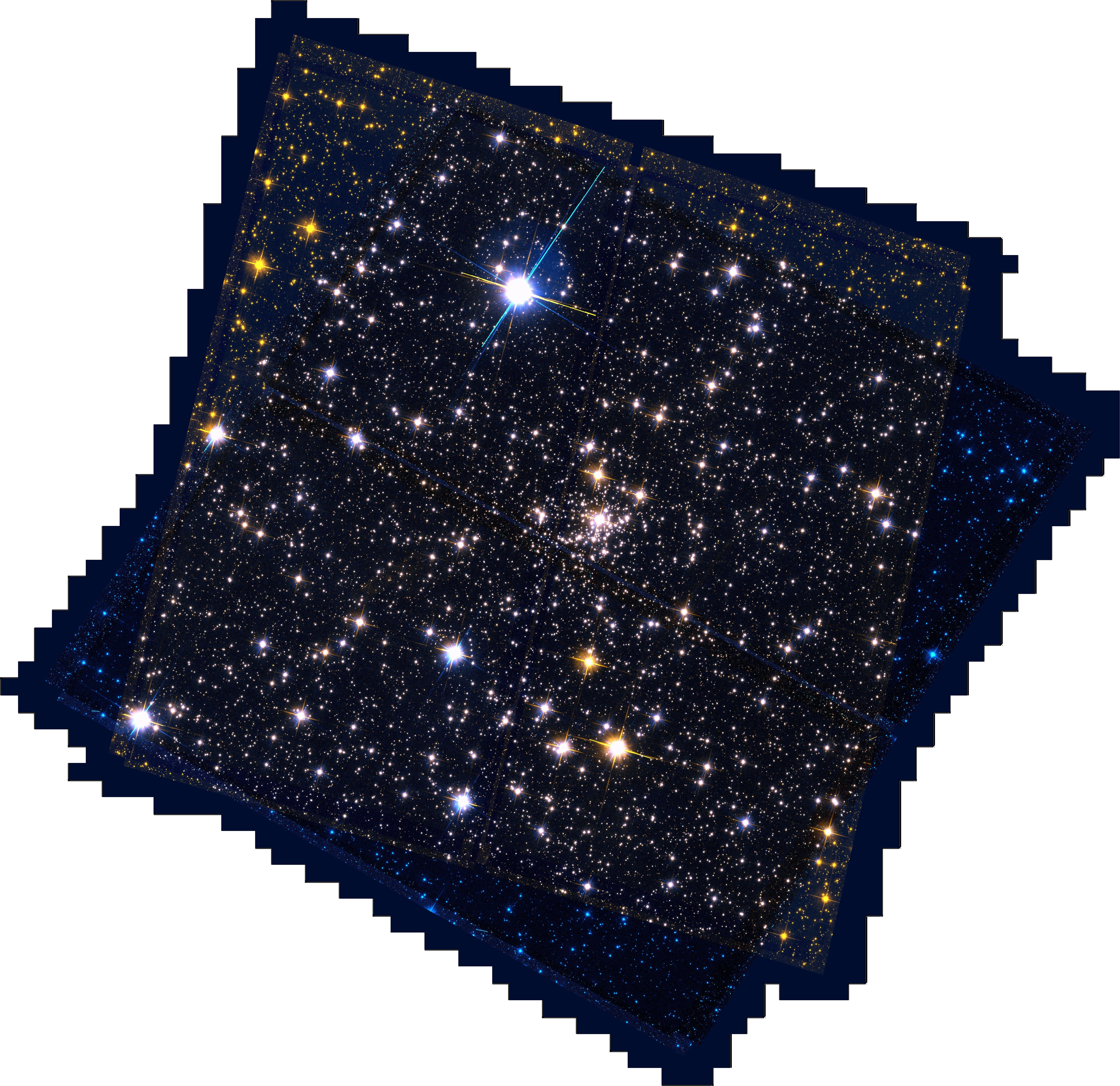
In the crowded center of the Milky Way, individual stars are hard to pick out, but that's exactly where Patchick 126 hides — a faint cluster that has long resisted confident classification. Astronomers pointed the infrared spectrograph IGRINS and the Hubble Space Telescope at it to study its chemistry and age in detail for the first time.
Spectra of four red giants showed that the cluster's stars are rich in elements heavier than helium — iron, silicon, calcium, and titanium. It's like finding an unexpectedly salty, spicy broth in a pot of soup: the gas from which these stars were cooked was already well seasoned by earlier generations of stars. The average metallicity of [Fe/H] = -0.30 means Patchick 126 is richer in metals than most globular clusters, but poorer than typical open clusters in the disk.
Using Hubble images, the astronomers built a color-magnitude diagram — a kind of family portrait of the stars showing who is at which life stage. Comparing it with models, they determined the age: 11.9 billion years, with an uncertainty of just 0.3–0.4 billion years. That makes it a very old object, nearly as old as the Universe itself.
So Patchick 126 is a bridge between two worlds: it has the age and chemistry of a globular cluster, but the orbit and low mass of an old open cluster. Objects like this help us understand how our Galaxy formed and where the boundary lies between different types of stellar groupings.
Patchick 126 lies 7.8 kiloparsecs from the Sun, and its light is heavily reddened by dust: the reddening E(B-V) = 1.08—like viewing the cluster through a very dirty window.
In Isaac Asimov's novel "The Gods Themselves," star clusters with unusual orbits challenge conventional classifications — much like Patchick 126 blurs the line between open and globular clusters.