A magnet's surface as a switch express
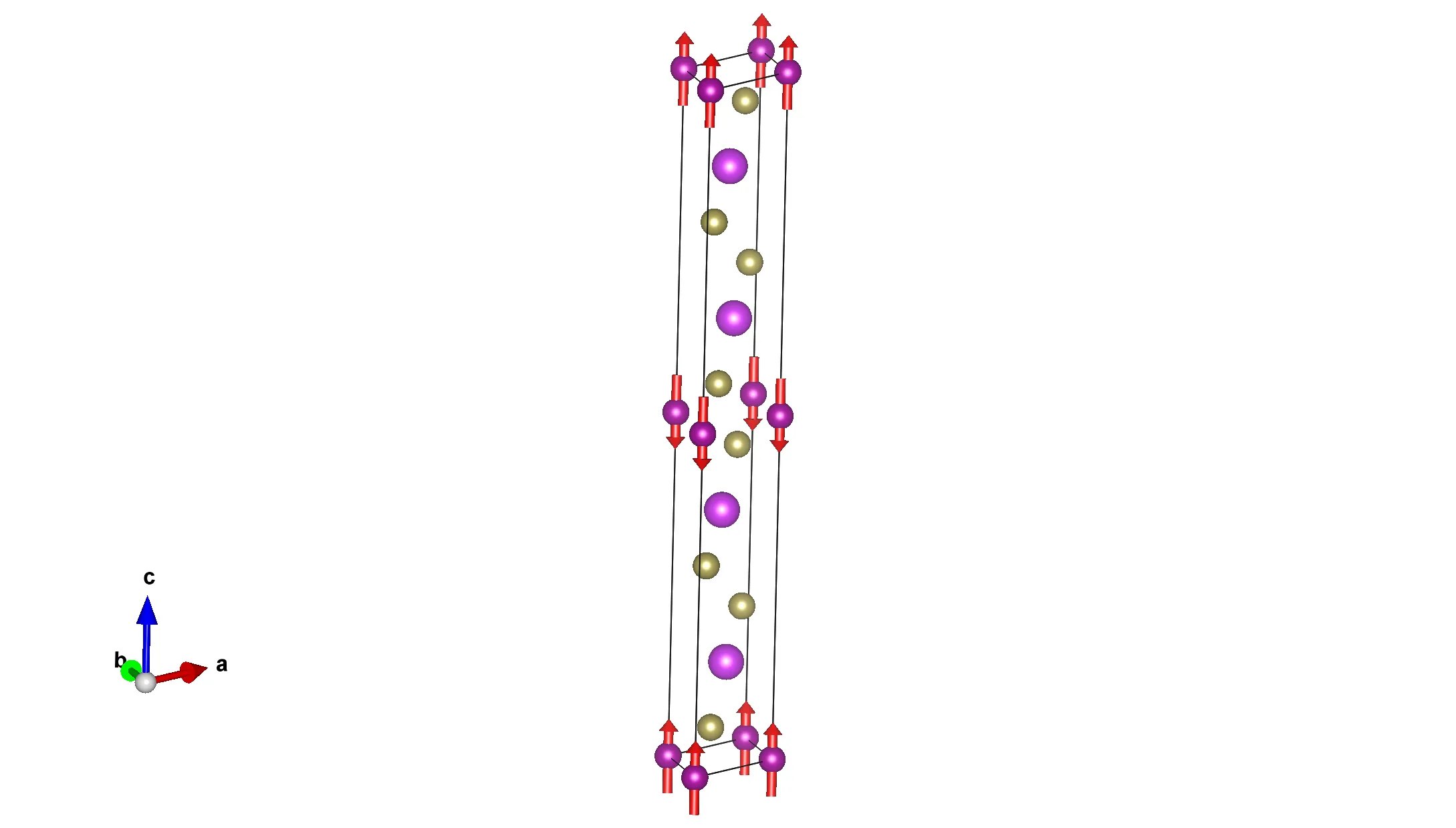
A compass needle always points north because inside the material, all the atomic magnets are aligned in one direction. But there are materials where neighboring atoms face opposite ways, like rows of soldiers turned to face each other. Such materials are called antiferromagnets. They are hard to switch: an ordinary magnetic field can't flip all the 'soldiers' at once, since half of them are already facing the right way and the other half are facing the wrong way.
Researchers studied what happens on the surface of an antiferromagnet. It turns out that at the very edge, atoms behave differently: their bonds with neighbors are weaker, and they respond more easily to an external field. If the top and bottom surfaces of the material are structured differently, then as the field is slowly changed, you can make the 'soldiers' on the surface turn the right way, and then that change propagates into the bulk. In this way, domains, regions with the same magnetization direction, switch without any extra devices.
This mechanism explains the puzzling behavior of the van der Waals antiferromagnet MnBi2Te4, where hysteresis was observed — the response depends on which way the field was changed. Now it's clear that surface atoms play the key role. This means antiferromagnets can be controlled much more simply than previously thought, just with a magnetic field, without complex electrical circuits. This opens the door to new devices for storing and processing information.
Original abstract
as written by the authors arXiv:2601.06646
Antiferromagnets (AFMs) hold promise for applications in digital logic. However, switching AFM domains is challenging, as magnetic fields do not couple to the bulk antiferromagnetic order parameter. Here we show that magnetic-field-driven switching of AFM domains can in many cases be enabled by a generic reduction of magnetic exchange at surfaces. We use statistical mechanics and Monte Carlo simulations to demonstrate that an inequivalence in magnetic exchange between top and bottom surface moments, combined with the enhanced magnetic susceptibility of surface spins, can enable deterministic selection of antiferromagnetic domains depending on the magnetic-field ramping direction. We further show that this mechanism provides a natural interpretation for experimental observations of hysteresis in magneto-optical response of the van der Waals AFM $$\mathrm{MnBi_2Te_4}$$. Our findings highlight the critical role of surface spins in responses of antiferromagnets to magnetic fields. Furthermore, our results suggest that antiferromagnetic domain selection via purely magnetic means may be a more common and experimentally accessible phenomenon than previously assumed.
Antiferromagnets don't produce an external magnetic field, so their domains don't interfere with each other: you can pack them very densely, like books on a shelf, and make memory of ultra-high capacity.