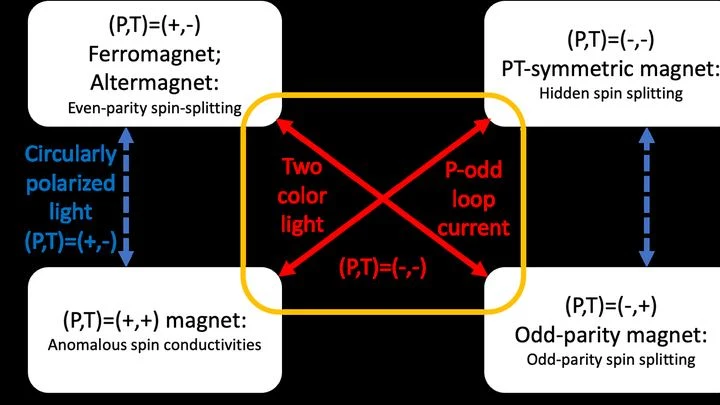
Altermagnetism is a newly identified class of magnetic order in crystals where magnetic moments on neighboring atoms point in opposite directions, just like in an antiferromagnet, but the crystal structure is arranged so that the electronic bands are spin-split, much like in a ferromagnet. This combination gives altermagnets the best of both worlds: they have no net magnetization (so they don't disturb neighboring magnets) but they can host spin-polarized currents and other phenomena previously thought to require ferromagnetism. This makes them a promising platform for spintronics — electronics that uses electron spin rather than charge.
History
The concept of altermagnetism was first proposed in 2022 by a team led by Libor Šmejkal and Jairo Sinova at Johannes Gutenberg University Mainz, who coined the term to describe this distinct magnetic phase. The idea was quickly confirmed experimentally in 2024.
How it works
In a conventional antiferromagnet, the two oppositely-oriented magnetic sublattices are related by a symmetry that maps one onto the other, making the electronic states for spin-up and spin-down identical. In an altermagnet, the crystal structure is such that this symmetry is broken — the sublattices are related by a rotation, not an inversion. This allows the electronic bands for spin-up and spin-down to be shifted in momentum space, creating a spin-split band structure without any net magnetization. The result is that electrons with different spins can have different energies and velocities, enabling spin-dependent transport.
In practice
Altermagnets are being explored for next-generation spintronic devices, such as ultra-fast magnetic memory and spin-based transistors, because they combine the stability of antiferromagnets with the spin-manipulation capabilities of ferromagnets.
Fun fact
The name 'altermagnetism' comes from the Latin 'alternare' (to alternate), but the key insight is that the alternating moments are arranged in a way that breaks a fundamental symmetry, which is why it was overlooked for so long.
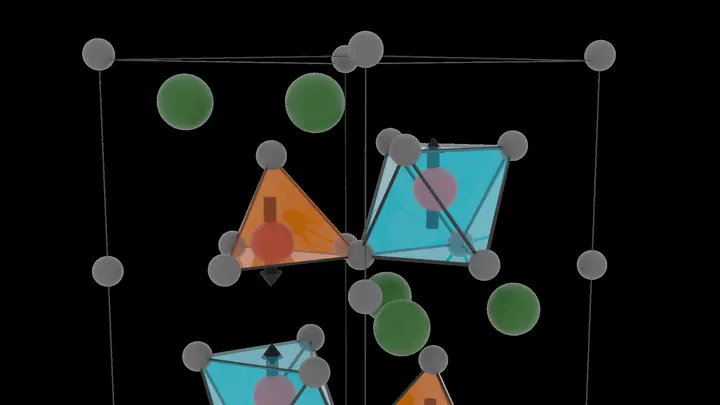
A frozen orchestra where musicians swap seats when the conductor, magnetism, sets a new score. In a spinel crystal, iron and magnesium atoms sit in two types of seats: some surrounded by four neighbors, others by six. At room temperature, they barely stir, but cool the material to 5 K and a mass migration begins.
In some crystals, electrons are not spread uniformly but arrange themselves into a strict checkerboard: one cell has more electrons, the neighboring cell has fewer. Such a pattern is called charge order, and for a long time it was considered something frozen, like a pattern on frosty glass.
Two caravans travel toward each other along a narrow road. One is wide and slow, carrying a load of density. The other, a string of light carts carrying current, slips between the first. Thus, in a magnetron discharge, two structures rotating in opposite directions coexist: the density spoke and the current filaments.
In a thin layer of liquid crystal, molecules usually lie like matches in a box — aligned in one direction but randomly oriented: some point up, others down. To make all the matches point the same way, you need a special molecular architecture. Scientists have found a chemical trick that does this almost automatically.
Earth's magnetic field is not constant: it trembles from the solar wind, from distant thunderstorms, and from the subway running nearby. To notice these tremors, you need an instrument that doesn't tremble itself. Physicists have built such an instrument from ytterbium atoms cooled to nearly absolute zero.
A highway where opposing flows are separated not just onto different sides, but onto two independent roads: each with its own entrance and exit. Something similar happens to electrons in a new type of topological insulator described by the authors of the study.
The crystal Mn₂Mo₃O₈ resembles a tiny city where manganese atoms are arranged in strict order: their magnetic moments (tiny internal arrows) point alternately up and down. This state is called collinear altermagnetism.
Moiré patterns are familiar to everyone. Two combs with different spacing, placed on top of each other, show dark fringes. Something similar has emerged in time. Physicists took a cloud of Rydberg atoms, particles with unusually large electron orbits, and illuminated it with two lasers.
In 2022, physicists described a new type of magnetism — alternagnetism. In it, electrons with different spin directions are split in energy depending on their direction of motion, like runners who speed up on one track and slow down on another. But spin is not the only degree of freedom particles have.
A parquet floor where every other plank is turned the opposite way looks symmetric. But if you run your hand over it, in one direction your fingers glide along the grain, and in the other they catch. That's roughly how the new type of magnetism studied in the crystal AgCrP2S6 works.
A guitar string keeps vibrating even after the musician lets it go, and that vibration changes the sound the listener hears. Magnetic moments in a crystal behave much the same way: they align into a strict antiferromagnetic order (neighbors point in opposite directions), but they never completely freeze.
In the grand symphony of magnetism, a duo long reigned: boisterous ferromagnetism and silent antiferromagnetism, where spin-soloists cancel each other out. But recently, a third voice joined the ensemble — altermagnetism.
In the world of magnetism, a simple dichotomy long reigned: ferromagnets, where spins point in one direction, and antiferromagnets, where they line up in a checkerboard pattern, canceling each other out. But a recent 'third player' — altermagnets — forced a rewrite of the rules.
Inside a crystal, an invisible ballet unfolds: the magnetic moments of atoms, like dancers, sometimes align in unison, sometimes scatter in antiphase. The choreography is dictated by quantum exchange — music sensitive to the geometry of bonds.
A thin magnetic film is like a row of toy soldiers with tiny magnetic arrows. In the flat world, thermal jostling quickly disrupts this formation — even the slightest heating destroys the order. This is the Mermin–Wagner prohibition: in two dimensions, continuous symmetry cannot survive at finite temperature.
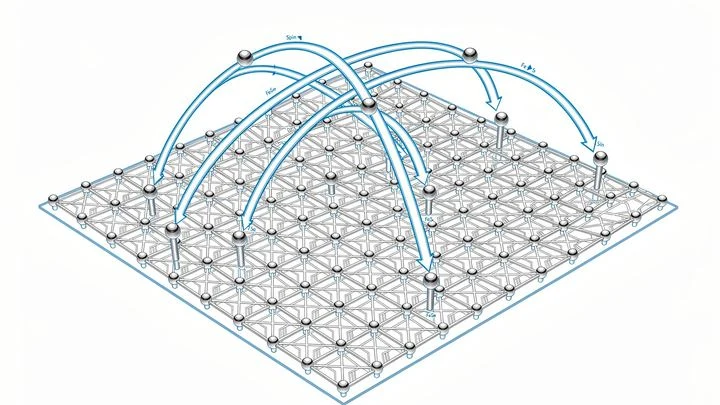
In some crystals, the magnetic moments of atoms oscillate in sync, like a wave in a stadium. It carries spin without charge current, without heating the material. This flow resembles an invisible river — silent and cold. Two-dimensional altermagnets are special materials: spin waves in them run differently along different axes.
Red giants are swollen, aging stars. Deep inside, an ocean of plasma churns: heat forces its way from the core to the surface, generating waves like a mighty surf. The star's magnetic field acts like an invisible seabed – it steers these waves, changing their height and speed.
Run a current through a spring of organic molecules, and the electrons that come out are almost all spinning the same way. This trick is called chiral spin selectivity, and it has long puzzled physicists. In light atoms, spin (the particle's intrinsic rotation) is too weakly coupled to charge motion to achieve nearly perfect sorting.
Two teams pull a rope with equal force in opposite directions — the rope doesn't move, and the net force is zero. That's how many antiferromagnets behave: the magnetic moments of atoms are aligned oppositely and cancel each other out.
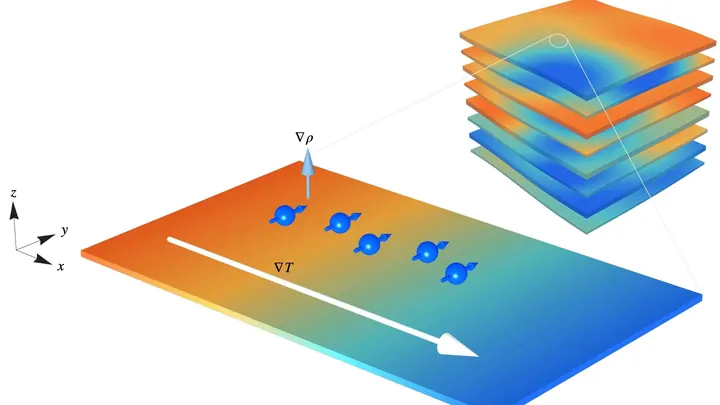
Inside a neutron star, matter is compressed so intensely that atomic nuclei fuse into long strands and flat sheets. Astrophysicists call these structures nuclear pasta. At their surface, the density of matter plummets to nearly zero, like diving out of thick jelly into thin air.
It's this sharp transition that creates the unusual effect.
A translator works in two worlds at once: to an outside observer, they are silent and unobtrusive, but inside their mind, a flurry of activity unfolds along clear lines of meaning. Altermagnets, a recently discovered class of magnetic materials, are much the same.
Each electron is a tiny magnet. In a single-atom-thick layer of iron chloride, they all align in the same direction, like dancers in a perfectly synchronized routine. Nature usually avoids such order (that's high entropy), but quantum forces compel them to comply.
The dance floor is full of couples waltzing. Usually, partners move in opposite directions: one steps forward, the other backward, to keep the overall rhythm.
A pot of water on the stove: the hotter the burner, the faster ice turns to water, and water to steam. Heat destroys order. But sometimes nature pulls a trick, and heating makes a liquid freeze, like a puddle turning to ice on a frosty morning.
The La3Ni2O7 crystal resembles a layered pie, where the filling of nickel and oxygen atoms alternates with lanthanum layers. At ambient pressure, it does not conduct without resistance, but squeeze it or grow it as a thin film, and high-temperature superconductivity emerges.
In a piece of ordinary magnet, all electron spins, tiny magnetic arrows, point in the same direction. It's a formation of soldiers facing their commander. This order is called a collinear altermagnet.
Imagine a line of people holding hands but facing in opposite directions: some look north, others south. That's how a p-wave magnet is arranged. Electrons in it align their magnetic moments (spins) not randomly but in a strict wave-like pattern.
In an ordinary crystal, atoms stand in neat rows like soldiers on a parade ground. Any deviation from this formation is usually considered harmful: disorder scatters waves and quickly dampens collective motions of particles.
A crystal is like a city: if the streets are crooked, traffic jams. In a crystal, the streets are atomic rows, and the traffic is the flow of electrons. Any tiny imperfection, impurity, or atomic displacement makes electrons scatter. Scientists from several labs have learned to grow crystals so that the "streets" are almost perfectly straight.
The method is called horizontal vapor transport.
Inside a superconductor, a magnetic field typically twists into tubes, vortices, each carrying one quantum of magnetic flux. That's how the classic Abrikosov lattice works. But in LiFeAs crystals, the picture is different.
Muon spectroscopy showed that the field penetrates not as individual vortices but as stripes. Each stripe contains pairs of 'coreless' vortices.
In a tiny magnet, information is encoded not in which way the arrow points, but in how the directions of its atoms alternate. In antiferromagnets, these arrows cancel each other out, so the material appears non-magnetic from the outside. The data is there, but you can't read it the usual way: the state is like a note written in invisible ink.
In the crystal Rb1-xV2Te2O, the spins of vanadium atoms arrange in a checkerboard pattern: each spin is surrounded by opposite spins. This pattern is called G-type antiferromagnetism. Neutrons passing through the sample scatter off this pattern and reveal its geometry, like light from a flashlight shining through blinds casting stripes on a wall.
Honeycombs are built from identical cells, but tweak the shape of just one, and the whole structure gains new properties. Researchers did something similar to create a magnet without a single metal atom. They took flat carbon molecules shaped like triangles, triangulenes, and arranged them in a hexagonal lattice, just as bees build honeycombs.
Imagine a triangular grid with tiny magnetic arrows at each node. Electrons, the charge carriers, run across this grid. Usually, the arrows align simply: all pointing the same way (ferromagnet) or alternating in the plane.
The dance floor is packed with people, each moving on their own. Suddenly, some of them break into pairs (spinning around, barely noticing their neighbors) while the rest line up in chains. That's roughly how atoms behave in the metal CsCr₃Sb₅, a member of the kagome metals, whose crystal lattice resembles a woven basket.
A regular fridge magnet attracts iron because all its tiny magnetic arrows point in the same direction. But there are materials where the arrows arrange themselves more cunningly: neighboring rows point in opposite directions, so from the outside it looks like there's no magnetism at all. Such materials are called altermagnets.
When particles collide at enormous speeds, they produce a shower of new particles. Among them are antiprotons — twins of ordinary protons but with the opposite charge. Each of these particles has its own spin, like a tennis ball sent with a twist. But whether antiprotons are actually spun up at birth has never been checked.
A crystal without inversion symmetry is like a room where one wall is mirrored and the other is frosted: the reflection doesn't match the original. Such materials often behave unusually because electrons feel the lattice distortion.