An altermagnet is a newly identified class of magnetic material in which electronspins alternate in direction, but in a way that is distinct from both ferromagnets (where spins align) and antiferromagnets (where spins cancel out). In an altermagnet, the alternating spin pattern is combined with a specific crystal structure that breaks certain symmetries, leading to unique electronic properties. This makes them promising for spintronics — devices that use electron spin rather than charge for information processing.
History
The concept of altermagnetism was formally introduced in 2022 by a team led by Jairo Sinova and Libor Šmejkal, building on earlier theoretical work on 'd-wave magnetism' and related ideas. The term 'altermagnet' was coined to highlight the alternating spin order combined with a non-relativistic spin-splitting.
How it works
In an altermagnet, the magnetic moments of atoms point in opposite directions on neighboring sites, like in an antiferromagnet, but the crystal lattice is arranged so that the electronic bands for spin-up and spin-down electrons are split in momentum space. This spin-splitting can be large, even though the net magnetization is zero. The result is that altermagnets can generate spin-polarized currents and exhibit phenomena like the anomalous Hall effect, but without producing stray magnetic fields that would disturb neighboring devices.
In practice
Altermagnets are being explored for next-generation spintronic devices, such as high-density magnetic memory and logic circuits, because they combine the advantages of antiferromagnets (no stray fields, ultrafast dynamics) with the ease of electrical readout found in ferromagnets.
Fun fact
Altermagnets were first experimentally confirmed in 2024 in manganese telluride (MnTe), a material that had been studied for decades but whose magnetic order was not fully understood until the altermagnetic concept was proposed.
Two dancers on one stage: one pulls the partner in one direction, the other in the opposite. In the crystal Cu2(OH)3Br, known as botallackite, copper atoms form chains where the spins (magnetic moments) of neighboring ions align either parallel, as in a ferromagnet, or antiparallel, as in an antiferromagnet.
Tuning a radio receiver to a station that changes frequency as you cross a phase boundary: that is how you might picture the challenge facing the researchers. In the metal YbRh2Si2, electrons behave as "heavy" particles: their effective mass is hundreds of times that of a free electron.
A door lock with two different keys: one turns easily, the other demands noticeable effort. That is how two layers of hexagonal boron nitride behave when twisted relative to each other. This material consists of boron and nitrogen atoms arranged in a hexagonal lattice, and its layers can sit in different registries, like two identical grids shifted by different angles.
Imagine a ladder whose rungs are tiny magnets. If neighboring magnets point in opposite directions, the ladder is "calm." But if you make them all point the same way, the whole structure becomes magnetized and "stubborn."
Scientists built such a ladder from germanium atoms — a semiconductor used to make transistors.
The magnetic framework of the EuMnSb2 crystal resembles scaffolding: manganese atoms form rigid vertical pillars, while europium atoms act as movable crossbars. Until now, there was no consensus on the angle at which these crossbars rest and how they rotate when a magnetic field presses on the scaffold.
A magnetic field usually acts like a strict traffic cop: for heat to turn into electricity, it must stand across the road. If the field lies along the heat flow, the effect disappears, or so it was believed for decades.
Scientists took an ultra-thin film of a magnetic oxide — a material where electron spins are aligned in a plane, like compass needles on a table.
The crystal is like a city with different streets: on some, cars drive fast and far, on others, they crawl and get stuck. In the layered material CrPS₄, magnetic waves that carry spin (a particle's intrinsic angular momentum) behave the same way.
A highway where opposing flows are separated not just onto different sides, but onto two independent roads: each with its own entrance and exit. Something similar happens to electrons in a new type of topological insulator described by the authors of the study.
A star's radius drops by a thousand kilometers. Not because its mass increased, but because its own magnetic field squeezed the crust like an invisible corset.
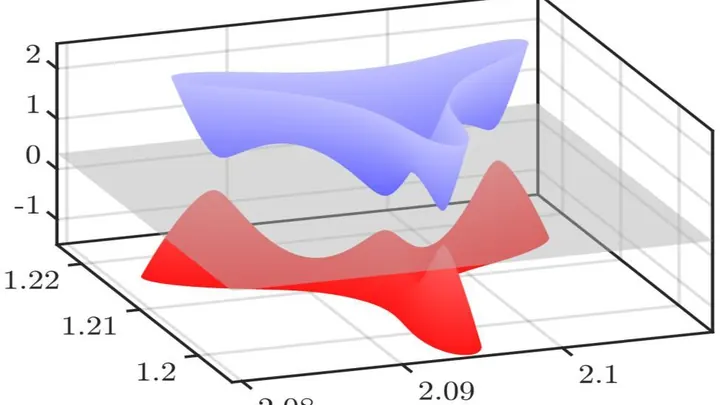
In 2022, physicists described a new type of magnetism — alternagnetism. In it, electrons with different spin directions are split in energy depending on their direction of motion, like runners who speed up on one track and slow down on another. But spin is not the only degree of freedom particles have.
A Tesla coil crackles, and a beam of light begins to rotate around it. The medium it passes through is still stable, but the field grows, and the rotation intensifies. This is not a trick but the behavior of special materials that couple electricity and magnetism. For such coupling, there is a fundamental limit — the Tellegen limit.
In a crystal that for centuries was called 'fool's gold,' physicists have spotted genuine treasure. The compound MnTe2 with a pyrite structure has become the stage for a quantum ballet: spin waves here twist into left- and right-handed vortices, with the twist direction firmly tied to momentum.
Some materials are internally like a Möbius strip: their electronic states are twisted in a special way. Such topological properties are usually manipulated with a powerful magnetic field, as if trying to flatten the strip with a sledgehammer. A group of researchers has found a more delicate tool.
In a world striving for chaos, rhythm sometimes arises. The Belousov–Zhabotinsky reaction has amazed for decades: in a test tube, color waves run on their own, as if a living organism breathing matter. Something similar lurks in crystals where iron atoms balance between two magnetic states — high-spin and low-spin.
In some crystals, the magnetic moments of atoms oscillate in sync, like a wave in a stadium. It carries spin without charge current, without heating the material. This flow resembles an invisible river — silent and cold. Two-dimensional altermagnets are special materials: spin waves in them run differently along different axes.
Two magnets on a table either attract or repel — depending on how their poles are oriented. Inside each piece hide tiny regions where all the magnetic arrows point in the same direction. These regions are called domains, and their arrangement determines how the material behaves in an electrical circuit.
In altermagnets, a new class of materials, domains are trickier.
A translator works in two worlds at once: to an outside observer, they are silent and unobtrusive, but inside their mind, a flurry of activity unfolds along clear lines of meaning. Altermagnets, a recently discovered class of magnetic materials, are much the same.
A thick rubber band is twisted tighter and tighter. At some point, it can't take it anymore — it snaps and whips around, releasing the stored energy. That's roughly how magnetic fields inside neutron stars — the ultra-dense remnants of exploded stars — behave.
A comb rubbed through your hair picks up scraps of paper. Physicists decided to apply this simple trick at the microscopic level — to control magnetic vortices called skyrmions. A skyrmion is like a tiny tornado in a sea of magnetization: at its center, compass arrows point up, while at the edges they twist downward.
If you toss a handful of coins onto a table, they land in a jumble. But in some crystals, atoms arrange themselves into a pattern reminiscent of a woven basket — the kagome lattice. In the metal MgMn₆Sn₆, manganese atoms form such a lattice, and at room temperature they act like tiny magnetic needles.
A stack of magnetic plates, each magnetized opposite to its neighbor, is like a layered sandwich where electrons move as a single organism. The whole material starts mimicking an axion — a ghost particle that physicists suspect might be dark matter.
Two sheets of paper stacked together start to creep ever so slightly over each other when heated. That's roughly how layers of molybdenum disulfide, a material one atom thick, behave. At room temperature, they spontaneously slide at a speed of about one meter per second.
A piece of magnetite, an ordinary iron stone, behaves strangely. At room temperature, it conducts electricity, but cool it below minus 150 degrees, and its resistance jumps sharply. This jump, discovered back in 1939, physicists could not explain for nearly a century.
A new study offers a solution.
In the crystal Rb1-xV2Te2O, the spins of vanadium atoms arrange in a checkerboard pattern: each spin is surrounded by opposite spins. This pattern is called G-type antiferromagnetism. Neutrons passing through the sample scatter off this pattern and reveal its geometry, like light from a flashlight shining through blinds casting stripes on a wall.
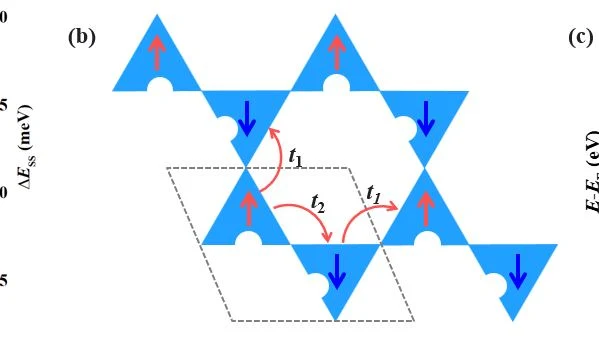
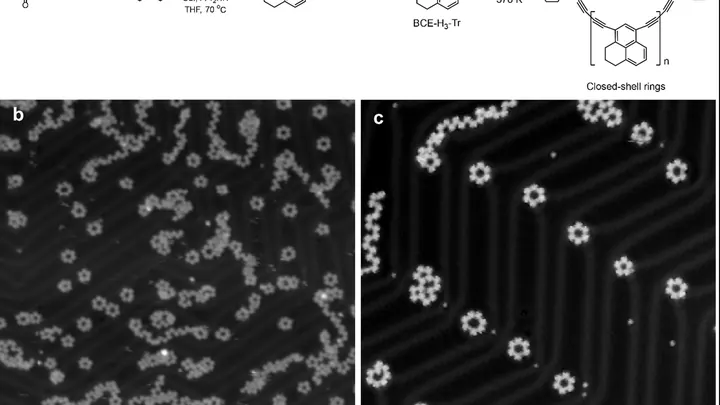
Honeycombs are built from identical cells, but tweak the shape of just one, and the whole structure gains new properties. Researchers did something similar to create a magnet without a single metal atom. They took flat carbon molecules shaped like triangles, triangulenes, and arranged them in a hexagonal lattice, just as bees build honeycombs.
Among magnets, there are quiet masters of disguise. An ordinary magnet attracts paperclips and has two poles — north and south. But there are materials that are internally arranged like a magnetic chessboard: their atoms are aligned in a strict order, yet externally the material behaves neutrally, as if no magnet exists at all. Such substances are called altermagnets.
A regular fridge magnet attracts iron because all its tiny magnetic arrows point in the same direction. But there are materials where the arrows arrange themselves more cunningly: neighboring rows point in opposite directions, so from the outside it looks like there's no magnetism at all. Such materials are called altermagnets.
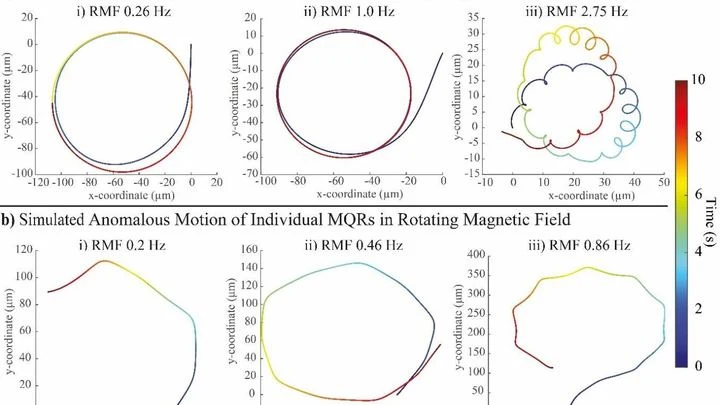
A small ball with an iron core lies on a surface while a magnetic field spins around it. The ball starts rolling like a wheel and usually goes in the direction the field rotates. But sometimes it suddenly turns around and rolls the other way — against the field.
Ruthenium oxide has long been regarded as a textbook altermagnet — a material where magnetic moments of neighboring atoms point in opposite directions but do not fully cancel due to the crystal's special symmetry. New measurements show that inside the crystal, there is no magnetism at all. All the magnetic action is confined to the surface.
A fridge magnet stays put because the tiny atomic arrows inside it all point in the same direction. But when those arrows start to argue (some pulling left, others right, and some spinning like tops) you get magnetic frustration. That disorder gives rise to whimsical patterns: stripes, spirals, vortices.
In a thin magnetic film, like in an overcrowded hall, each 'person' is a spin arrow that wants to align with its neighbors. But in the corners of the hall, jams occur — vortices where the arrows twist and cannot straighten out. These vortices live in pairs: one spins left, the other right, and together they prevent the hall from fully settling down.
A compass needle turns slowly, but inside some materials, tiny magnetic moments can flip over timescales that are hard to imagine. A team of physicists has calculated how to make them change direction in a quadrillionth of a second — faster than a lightbulb blinks.
Two sets of swings, rocking in opposite directions, don’t tilt the platform. Yet their motion creates invisible vortices that push a ball sideways. Alternagnets behave just like that: the atomic magnetic arrows are perfectly balanced, but a hidden symmetry bends the heat flow.
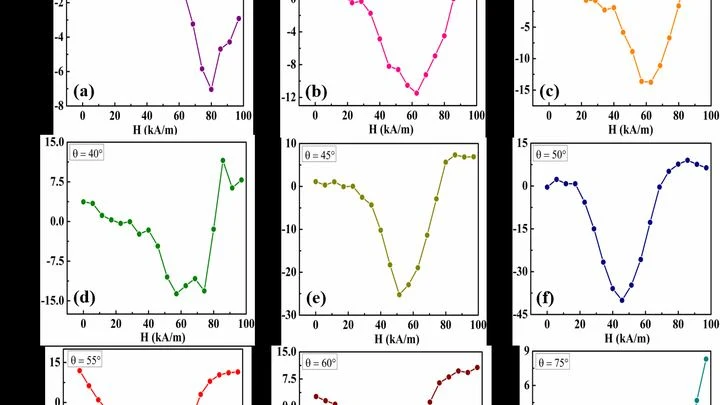
A piece of zinc oxide film lies on a table. A magnet is brought near, and slowly rotated around the film. The film, thinner than a human hair, begins to change its dimensions: now contracting, now stretching. This property is called magnetostriction — the ability of a material to deform under a magnetic field.
A sheet of graphene one atom thick is like a flexible metal mesh through which electrons zip almost unimpeded. Stack two such sheets with a slight twist, and the material's properties change dramatically: it can become an insulator that blocks current.
A ring of magnetic atoms resembles a round dance where each participant holds hands with their neighbors. In ordinary magnets, each atom has its own permanent magnetic moment, and they interact like little arrows striving to align opposite to each other.
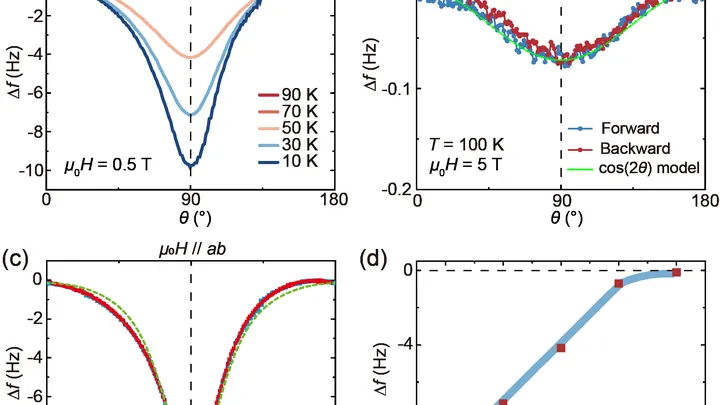
A magnet, like a compass needle, likes to point in a certain direction. But what if the material is layered, like a stack of pancakes? Scientists took just such a magnet made from a compound of chromium, germanium, and tellurium and set out to find out how stubbornly it resists having its magnetization turned.
A lithium cobalt phosphate crystal resembles a chessboard, where the black and white squares are regions with opposite directions of the magnetic moments of cobalt ions. These regions are called antiferromagnetic domains, and until now they have been hard to see: conventional methods required complex equipment or damaged the sample.
In a piece of manganese oxide just a few atomic layers thick, electrons behave like a crowd on an escalator: each moves by its own rules, but together they create a common flow. Physicists shone soft X-rays on such a film and knocked electrons out.
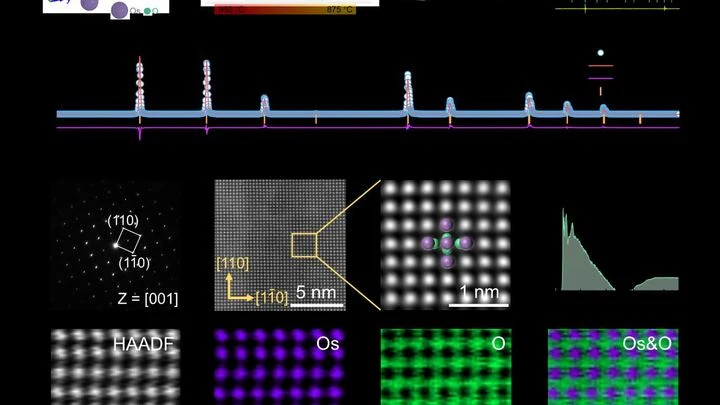
A crystal of osmium dioxide, OsO₂, is like a stubborn teenager: under ordinary conditions it behaves like a typical metal, but press hard enough and its character changes.