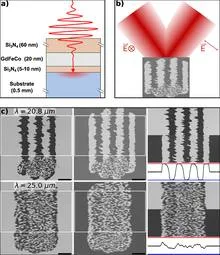
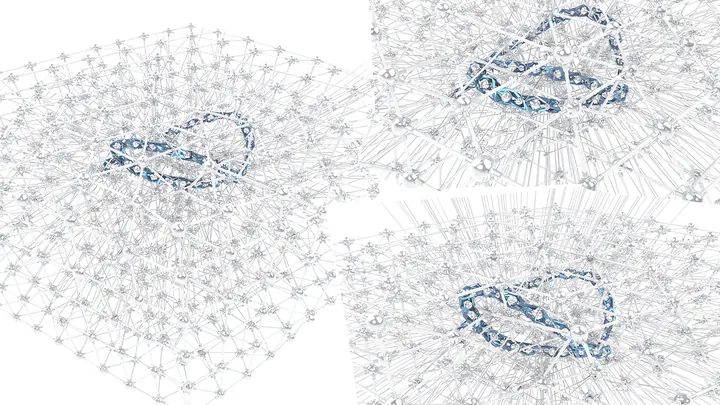
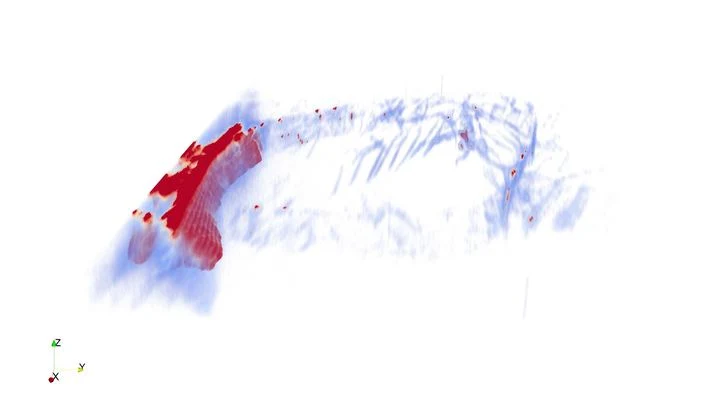
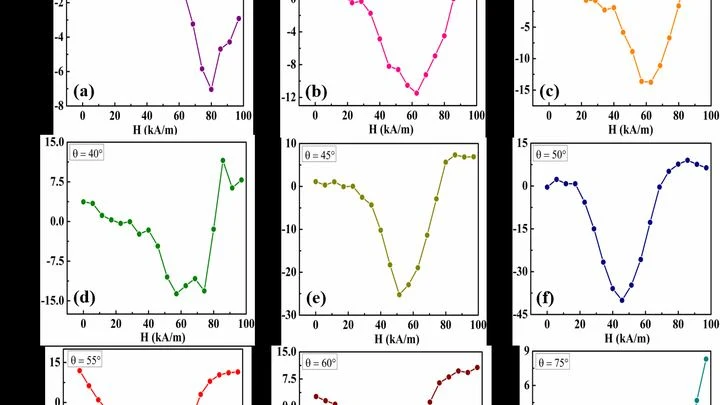
Demagnetization is the process by which a material loses its magnetic order, transitioning from a state with aligned magnetic moments to one where they are randomly oriented. This can be triggered by external stimuli such as heat, mechanical stress, or, as highlighted in recent research, light. The phenomenon is central to understanding magnetic materials, from everyday fridge magnets to advanced quantum systems, and it plays a key role in technologies like data storage and magnetic sensing.
History
The concept of demagnetization has been known since the 19th century, with early work by scientists like James Clerk Maxwell on magnetic fields. However, the specific study of light-induced demagnetization gained prominence in the 1990s with the advent of femtosecond lasers, allowing researchers to observe and manipulate magnetic order on picosecond timescales.
How it works
In a magnetically ordered material, atomic magnetic moments align in a regular pattern. Demagnetization disrupts this alignment. When light is used, photons can transfer energy to the electrons, breaking the exchange interactions that hold the moments in place. This can happen on ultrafast timescales, leading to a transient or permanent loss of magnetization. The specific mechanism depends on the material—for instance, in some molecular magnets, light can trigger a spin crossover that changes the magnetic state.
In practice
Light-induced demagnetization is used in ultrafast magnetic recording, where laser pulses can write data at terahertz speeds, and in spintronics, where controlling magnetic states is essential for developing faster, more energy-efficient electronic devices.
Fun fact
In some materials, a single laser pulse can demagnetize the sample in less than a trillionth of a second, a process that is faster than the time it takes for the material to heat up.
An orchestra without a conductor can sound harmonious if the musicians feel the common rhythm. In the world of solids, phonons play that role: quanta of crystal lattice vibrations. When atoms in a substrate start moving in circles, they can transfer their rotation to a magnetic layer on top and flip its magnetization.
A lake in a drought doesn't dry up all at once. First, islands of dry land appear on the water's surface, they expand and merge, and only then does the water recede from the exposed bed. A mirabilite crystal behaves similarly when it loses water: round patches of anhydrous salt appear on its surface, growing outward and then beginning to deepen.
In the layered crystal CrSBr, the magnetic moments of atoms are arranged like notes in a score: within each layer they point in the same direction, but between layers they point in opposite directions. This antiferromagnetic melody plays up to 132 kelvin, beyond which thermal motion destroys the order.
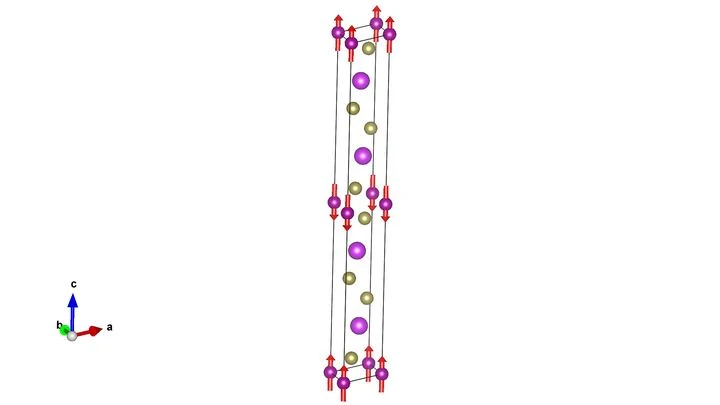
The magnetic framework of the EuMnSb2 crystal resembles scaffolding: manganese atoms form rigid vertical pillars, while europium atoms act as movable crossbars. Until now, there was no consensus on the angle at which these crossbars rest and how they rotate when a magnetic field presses on the scaffold.
A magnetic field usually acts like a strict traffic cop: for heat to turn into electricity, it must stand across the road. If the field lies along the heat flow, the effect disappears, or so it was believed for decades.
Scientists took an ultra-thin film of a magnetic oxide — a material where electron spins are aligned in a plane, like compass needles on a table.
Ion current through a membrane is like a queue at a turnstile. Sometimes the turnstile is free — ions pass through quickly. Sometimes it gets stuck — the flow drops. A weak magnetic field, it turns out, doesn't push ions from behind; it simply changes the number of open turnstiles.
A tuning fork struck once rings pure and long. But if you shake the fork itself while it sounds, the tone wavers and dies out quickly. Something similar happens to electrons in any piece of matter. Atoms in a lattice never stay put: thermal vibrations keep them jittering.
Glass lenses and mirrors appear perfectly smooth and still. But beneath the surface, a hidden life teems. Atoms in an amorphous material (a substance without a crystalline lattice) are packed haphazardly, and this disorder creates a complex energy landscape, like a mountainous region with countless hills and valleys.
A parquet floor where every other plank is turned the opposite way looks symmetric. But if you run your hand over it, in one direction your fingers glide along the grain, and in the other they catch. That's roughly how the new type of magnetism studied in the crystal AgCrP2S6 works.
A guitar string keeps vibrating even after the musician lets it go, and that vibration changes the sound the listener hears. Magnetic moments in a crystal behave much the same way: they align into a strict antiferromagnetic order (neighbors point in opposite directions), but they never completely freeze.
In the world of magnetism, a simple dichotomy long reigned: ferromagnets, where spins point in one direction, and antiferromagnets, where they line up in a checkerboard pattern, canceling each other out. But a recent 'third player' — altermagnets — forced a rewrite of the rules.
Diamond is a symbol of perfection, but its true magic is revealed through flaws. Perfect lattice purity gives transparency and hardness, while defects, such as color centers, open a portal to the quantum world, becoming the foundation for quantum computers and quantum sensors.
In a world striving for chaos, rhythm sometimes arises. The Belousov–Zhabotinsky reaction has amazed for decades: in a test tube, color waves run on their own, as if a living organism breathing matter. Something similar lurks in crystals where iron atoms balance between two magnetic states — high-spin and low-spin.
Two magnets on a table either attract or repel — depending on how their poles are oriented. Inside each piece hide tiny regions where all the magnetic arrows point in the same direction. These regions are called domains, and their arrangement determines how the material behaves in an electrical circuit.
In altermagnets, a new class of materials, domains are trickier.
A thick rubber band is twisted tighter and tighter. At some point, it can't take it anymore — it snaps and whips around, releasing the stored energy. That's roughly how magnetic fields inside neutron stars — the ultra-dense remnants of exploded stars — behave.
When you pull on a piece of metal, it changes shape and simultaneously becomes stronger. The secret lies in tiny defects in the crystal lattice called dislocations. They are like wrinkles in a rug: moving a wrinkle shifts the rug more easily than dragging the whole rug.
In a large gas cloud where stars are born, the magnetic field lines are roughly aligned in one direction, like the fibers in a piece of felt. But look inside, into the dense clumps that will eventually become stars, and the picture changes: there the lines are twisted every which way, like a ball of yarn after a kitten has played with it.
A piece of zinc oxide film lies on a table. A magnet is brought near, and slowly rotated around the film. The film, thinner than a human hair, begins to change its dimensions: now contracting, now stretching. This property is called magnetostriction — the ability of a material to deform under a magnetic field.
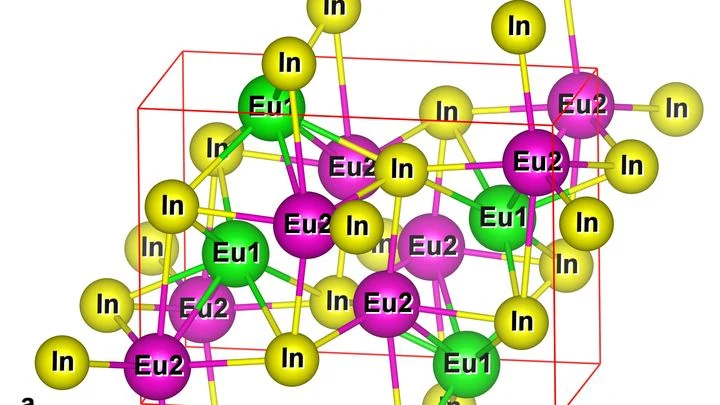
A piece of europium-indium alloy, when cooled in a magnetic field, behaves like water that does not freeze all at once but first in one corner of the glass, then in another.
The magnetic refrigerator of the future won't hum with a compressor. Instead, it will cool your groceries by exploiting a special material that heats up in a magnetic field and cools down when the field is removed. This cycle resembles the compression and expansion of gas in a conventional fridge, but here a magnet does the work of a piston.
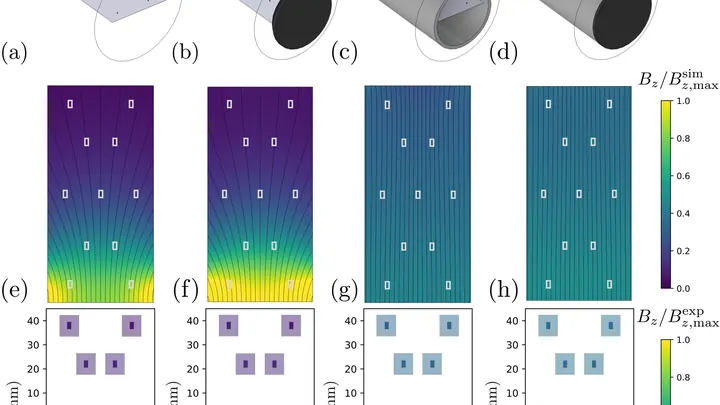
A magnetic field is like a shadow cast by an object: it changes with the shape of the source. But if you put a lens in the path of light, you can alter the shadow. Here, the authors devised a 'lens' for magnetic fields — an assembly of ordinary materials with different magnetic permeabilities (their ability to let the field through).
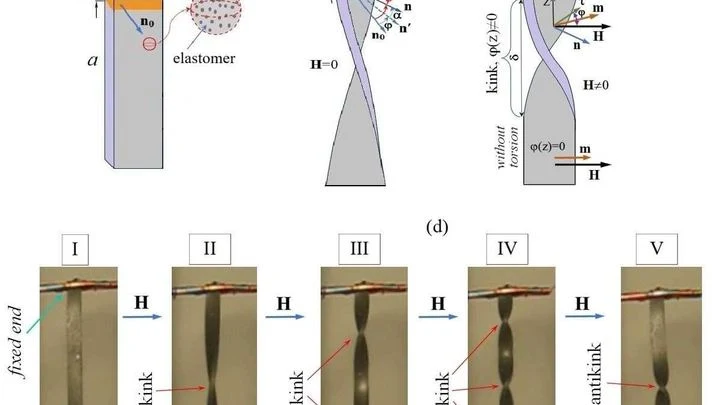
An ordinary rubber strip filled with fine iron filings doesn't just bend in a magnetic field: it ties itself into a stable knot. This effect was predicted and reproduced in experiments by physicists working with magnetoactive elastomers: a silicone base with carbonyl iron particles.
The crystal Ca2RuO4 resembles a stack of thin sheets. Inside each sheet, the electron spins are arranged in strict order, like rows of soldiers on a parade ground. The bonds between the sheets are weak, and their sign can be flipped by slightly pulling the crystal apart.
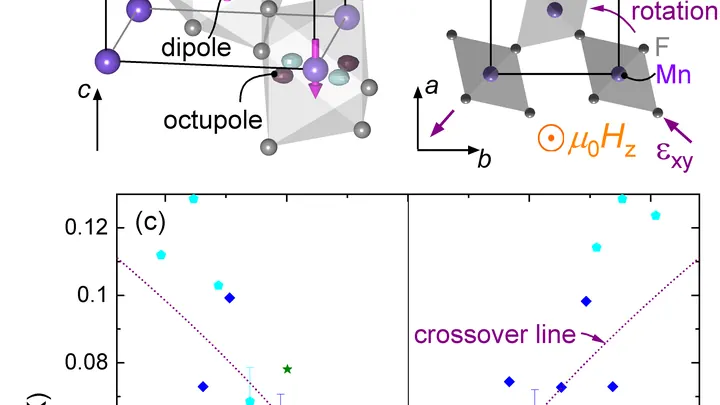
In a manganese fluoride crystal, atoms are lined up like soldiers in formation. But within this formation lies a hidden pattern: the magnetic moments of the atoms point in opposite directions, and the pattern itself changes when the crystal is rotated.
In a pot of boiling soup, small bubbles churn, but gradually large-scale flows come to dominate. Something similar happens in cosmic plasma, where magnetic fields behave like tangled threads.
An ordinary magnet can be imagined as a row of soldiers all facing the same direction. An antiferromagnet is arranged differently: neighboring 'soldiers' face opposite directions, but the row as a whole remains ordered. Flipping such a row is difficult: it doesn't respond to weak external fields.
The crystal of RbMn6Bi5 resembles a five-story building of manganese atoms, where the residents on each floor form a pentagon. At room temperature, the magnetic moments of the atoms fluctuate chaotically, like compass needles during a magnetic storm.
Metals are full of free electrons: they dart between atoms like a swarm of bees around a hive. If you poke such a metal with a thin magnetic filament, the electrons start to feel its field. A new calculation shows they don't just go around the field; they trap it inside, like a cork sealing water in a bottle.
A compass needle always points north because inside the material, all the atomic magnets are aligned in one direction. But there are materials where neighboring atoms face opposite ways, like rows of soldiers turned to face each other. Such materials are called antiferromagnets.
Dark matter is invisible, but according to calculations, it holds galaxies together. Catching its particles is like hearing a whisper in a noisy room. You need a material that responds loudly and noticeably to the slightest nudge.
Molecular magnets could be such a material — substances where each molecule acts as an independent tiny magnet.
In a typical magnet, all spins of electrons (internal ‘arrows’-magnets, discovered by Pauli) point one way. Altermagnets, like MnTe, are trickier: these arrows alternate direction, like ripples spreading from a pebble tossed into water. But here’s the twist — the ripple arises from the electrons’ own motion.