Exchange coupling is the energy parameter that quantifies the strength of the quantum mechanical interaction between the spins of neighboring magnetic atoms or ions. This interaction arises from the Pauli exclusion principle and the Coulomb repulsion between electrons, and it is responsible for the alignment of spins in ferromagnets, antiferromagnets, and other magnetic orders. The exchange coupling constant, often denoted J, determines whether spins prefer to align parallel (ferromagnetic coupling, J > 0) or antiparallel (antiferromagnetic coupling, J < 0).
History
The concept was developed in the late 1920s by Werner Heisenberg and Paul Dirac, who independently showed that the exchange interaction arises from quantum mechanics and can explain ferromagnetism.
How it works
The exchange interaction is not a direct magneticdipole-dipole force; it is a purely quantum effect. When two electrons occupy overlapping orbitals, the Pauli principle requires their total wavefunction to be antisymmetric. This constraint affects the spatial part of the wavefunction, which in turn changes the Coulomb energy. The energy difference between the spin-aligned and spin-opposed configurations is the exchange energy, and the exchange coupling constant J quantifies this difference. In a lattice of spins, the total energy is often modeled by the Heisenberg Hamiltonian, which sums J times the dot product of neighboring spin vectors.
In practice
Exchange coupling is fundamental to magnetic storage technologies, such as hard disk drives and magnetic random-access memory (MRAM), where the coupling between magnetic layers controls the read/write behavior.
Two dancers on one stage: one pulls the partner in one direction, the other in the opposite. In the crystal Cu2(OH)3Br, known as botallackite, copper atoms form chains where the spins (magnetic moments) of neighboring ions align either parallel, as in a ferromagnet, or antiparallel, as in an antiferromagnet.
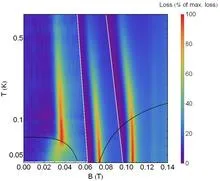
Tuning a radio receiver to a station that changes frequency as you cross a phase boundary: that is how you might picture the challenge facing the researchers. In the metal YbRh2Si2, electrons behave as "heavy" particles: their effective mass is hundreds of times that of a free electron.
A frozen orchestra where musicians swap seats when the conductor, magnetism, sets a new score. In a spinel crystal, iron and magnesium atoms sit in two types of seats: some surrounded by four neighbors, others by six. At room temperature, they barely stir, but cool the material to 5 K and a mass migration begins.
Two electrons that leave a metal needle tip almost simultaneously start to repel each other, like two people trying to squeeze through a narrow door at the same time. The closer they are, the more they get in each other's way.
A lone erbium atom sits on a silver substrate, and its spin, the electron's internal rotation, stores quantum information. Previously, flipping this spin required a magnetic pulse: a blunt tool that disturbs neighbors and works slowly. Now physicists from Germany and Korea have shown that a single electric voltage suffices.
Drop by drop from a faucet, or a steady stream without a single splash. That's roughly what the two regimes of current in a superconducting contact look like. Only here, the role of water is played by Cooper pairs — bound electrons that move without resistance.
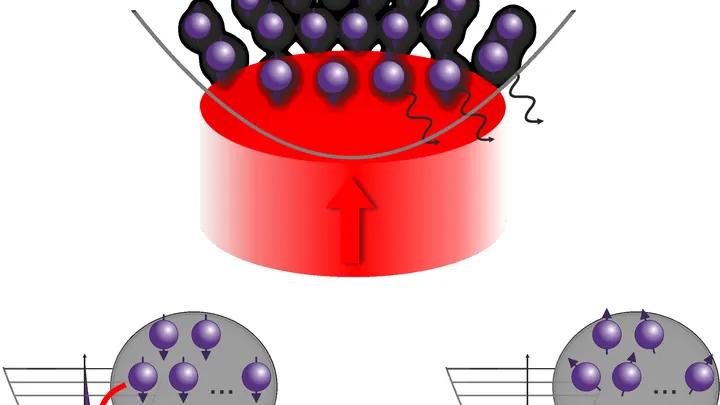
A cloud of cold atoms is trapped between two mirrors. Light is shone through it, and the atoms start to emit collectively: this effect is called superradiance. But the atoms don't just 'glow': their spins (internal magnetic arrows) interact with light in two distinct ways.
A parquet floor where every other plank is turned the opposite way looks symmetric. But if you run your hand over it, in one direction your fingers glide along the grain, and in the other they catch. That's roughly how the new type of magnetism studied in the crystal AgCrP2S6 works.
The cosmological kitchen is full of invisible ingredients. Dark matter, like an invisible scaffold, keeps galaxies from flying apart, while dark energy, like yeast in dough, makes space expand ever faster.
A tiny crystal of charged atoms, trapped in a trap, trembles with heat. Each ion oscillates like a ball on a spring, and these vibrations hinder using the crystal for precise quantum operations. Usually, excess energy is removed with a laser — the beam hits the ions and slows their motion, like a stream of air damping a pendulum.
Run a current through a spring of organic molecules, and the electrons that come out are almost all spinning the same way. This trick is called chiral spin selectivity, and it has long puzzled physicists. In light atoms, spin (the particle's intrinsic rotation) is too weakly coupled to charge motion to achieve nearly perfect sorting.
Two teams pull a rope with equal force in opposite directions — the rope doesn't move, and the net force is zero. That's how many antiferromagnets behave: the magnetic moments of atoms are aligned oppositely and cancel each other out.
In a dark room, a glass bead the size of a dust grain hangs on a laser beam. Beneath it are two mirrors: one aluminum, one silver. If axions (light, invisible particles that could make up the mysterious dark matter) whiz by, they exchange with the mirror atoms, and the bead shifts ever so slightly.
In a boron nitride crystal, the perfect atomic lattice is sometimes disrupted: an atom is missing here, or replaced by a foreign one there. Under a powerful microscope, these tiny imperfections appear as traps for electrons: they capture particles and start to emit light, and they also respond to magnetic fields.
Two swift streams of charged particles collide, and magnetic field lines begin to tear and reconnect. This process powers solar flares and auroras. It was usually assumed that all particles behave alike, like bullets from the same gun. But each particle has a tiny top: its intrinsic rotation, or spin.
The dance floor is packed: everyone moves on their own, no one holds hands. Suddenly the music gets louder and more rhythmic — neighbors start grabbing each other, forming pairs that spin in sync. That's roughly what the experiment looked like in the lab, where a cloud of lithium atoms, cooled to near absolute zero, was made to suddenly strengthen its mutual attraction.
Imagine a line of people holding hands but facing in opposite directions: some look north, others south. That's how a p-wave magnet is arranged. Electrons in it align their magnetic moments (spins) not randomly but in a strict wave-like pattern.
If you squeeze a handful of sand in your fist, it first compacts, but then starts to resist — the grains have nowhere left to go. In the depths of a neutron star, something similar happens, except instead of sand grains, you have elementary particles, and instead of your hand, you have monstrous gravity.
A stack of magnetic plates, each magnetized opposite to its neighbor, is like a layered sandwich where electrons move as a single organism. The whole material starts mimicking an axion — a ghost particle that physicists suspect might be dark matter.
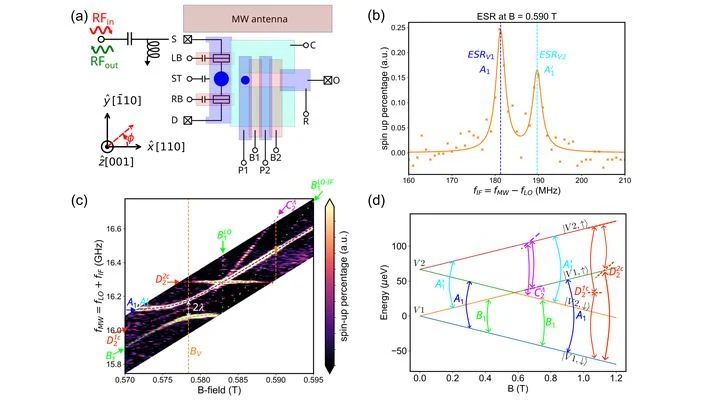
Silicon is the very material that powers the processors in every phone and laptop. Now, researchers have learned to trap a single electron in it and control its spin — a tiny magnet that can point 'up' or 'down'. It's like holding a spinning top: you can tilt and turn its axis, but here, instead of hands, you use an electric field.
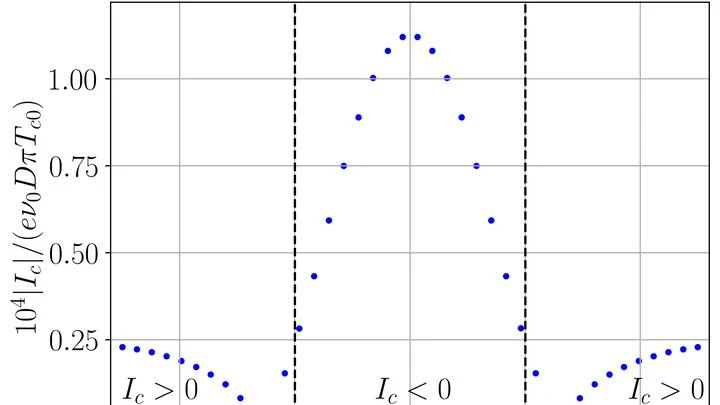
Two superconducting banks are connected by a bridge of magnetic material. Inside the bridge lies a domain wall: a narrow boundary where the magnetization rotates, like a column of soldiers changing their marching direction.
The crystal of perovskite iridate SrIrO₃ resembles a row of soldiers, where each iridium carries a magnetic moment. When some of the iridium 'soldiers' are replaced by tin, which has no magnetic moment, the row thins out.
A fridge magnet stays put because the tiny atomic arrows inside it all point in the same direction. But when those arrows start to argue (some pulling left, others right, and some spinning like tops) you get magnetic frustration. That disorder gives rise to whimsical patterns: stripes, spirals, vortices.
In a thin magnetic film, like in an overcrowded hall, each 'person' is a spin arrow that wants to align with its neighbors. But in the corners of the hall, jams occur — vortices where the arrows twist and cannot straighten out. These vortices live in pairs: one spins left, the other right, and together they prevent the hall from fully settling down.
An electron in an ordinary wire is like a courier carrying both a package and the recipient's signature at once: its charge and spin are always together. But if the wire is made just one atom thick, the courier gets cramped. In such a one-dimensional tube, electrons cannot overtake each other, and their collective behavior changes beyond recognition.
A tiny diamond hangs in the air, held by an electric field like a speck of dust in a beam of light. Hidden inside are defects — places where a carbon atom is replaced by nitrogen, with a vacancy nearby. These defects behave like little magnets that can be flipped with laser and microwaves.
When a fast proton slams into an atomic nucleus, new particles are born for an instant. One of them is the phi meson: a short-lived clump of matter that decays into an electron-positron pair. Catching this decay is like hearing the echo of a distant explosion: the blast itself is over, but its trace is still flying.
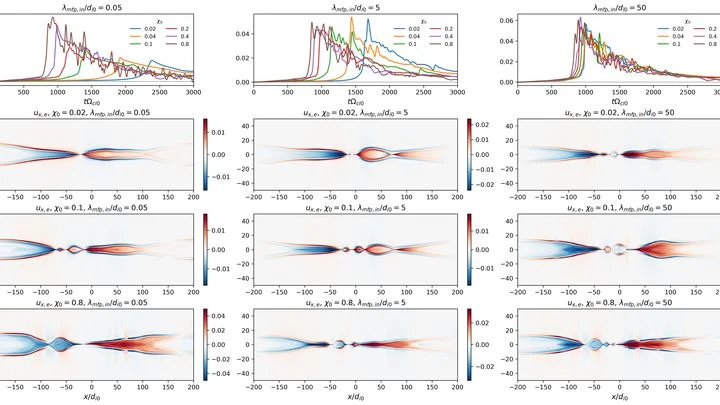
In plasma where some atoms remain neutral, magnetic field lines can rearrange at different speeds. This is like two rubber bands that are initially stuck together, then suddenly snap apart and contract, releasing energy.
A beam of circularly polarized light hits a MAPbI3 perovskite crystal. The electrons inside start behaving like tiny spinning tops, their axes aligning along the beam. This phenomenon is known as optical spin orientation.
A compass needle always points north because inside the material, all the atomic magnets are aligned in one direction. But there are materials where neighboring atoms face opposite ways, like rows of soldiers turned to face each other. Such materials are called antiferromagnets.
An electron in a molecule is like a top spun in the right direction. Chiral molecules, twisted one way like a spiral staircase, let electrons pass only if they spin in a particular direction. This property is called chiral-induced spin selectivity, and it allows controlling spin without magnets.
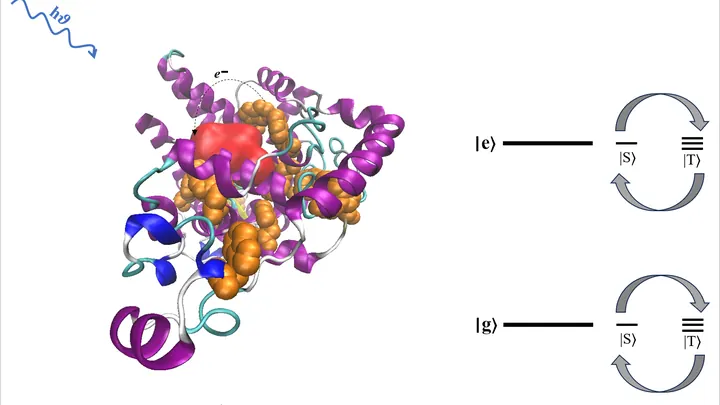
Birds migrate using the magnetic field. In their eyes, there's a protein called cryptochrome. It captures sunlight, especially blue light, and triggers a reaction. Absorption of light leads to the formation of a particle pair that is acutely sensitive to magnetic fields.
Quantum entanglement is like an invisible spring between particles — squeeze one, and the other twitches, no matter where it is. In the new work, physicists built a model of four spins (tiny magnetic arrows) in a chain, where the end spins are held by a local magnetic field.