Advanced

The Climate Swings of Ancient Mars ⚡ экспресс

Original: "Limit cycles and the climate history of Mars"
· Jacob Haqq-Misra
arXiv:2601.07159v2 · 2026-01-12 · CC BY · ⏱ 1 min · Exoplanets
The planet periodically heated up and was briefly covered with rivers and lakes.
Abstract

Geological data indicate the existence of rivers and lakes on ancient Mars, but climate models have struggled to reproduce warm conditions under the faint young Sun. Some models assume a constant greenhouse effect, others brief warm periods. This work explores the hypothesis of limit climate cycles driven by modulation of the greenhouse effect through the carbonate-silicate cycle. Using an energy balance model that includes this cycle, solar evolution, obliquity variations, and additional greenhouse gases, a schematic climate trajectory for Mars is calculated. It is shown that episodic cycles could have enabled the formation of valley networks during 4.1–3.5 billion years ago and delta deposits 3.3–3.0 billion years ago against a backdrop of long cold phases. The story ends with a late Amazonian CO₂ condensation regime. This model is consistent with the existing geological record, and future searches for warming mechanisms should consider the possibility of transient events triggered by the carbonate-silicate cycle.

Links in the knowledge graph 1

📄 Showing the "Simple" version — "Advanced" is not ready yet. Add it to favorites to help prioritize it.

For a long time, the climate of ancient Mars remained a mystery: the beds of dried-up rivers spoke of water, but models couldn't explain how it got there—after all, 4 billion years ago the Sun shone 30% dimmer. New research shows that the planet swayed, as if on a swing, between long glaciations and short wet epochs.

The culprit behind these swings was carbon dioxide. During cold periods it got bound up in rocks, and Mars froze. Then volcanoes spewed the gas back out, causing abrupt warming. Streams of water flowed across the surface, carving the valleys we see today. Each thaw lasted less than the entire existence of the human species—just a few million years, but that was enough to leave a noticeable mark.

Scientists accounted for the fact that the Sun brightened over time, and that Mars' axis wobbled greatly. Calculations showed that the climate swings occurred several times, explaining the different ages of the valleys. However, with each cycle, some of the atmosphere escaped into space, and eventually the planet froze for good. Today Mars is an icy desert, but remnants of ancient ice may still lurk beneath the surface.

🎯 Mars' axis wobbled greatly, sometimes exposing ice to direct sunlight—this added sharpness to the climate swings.

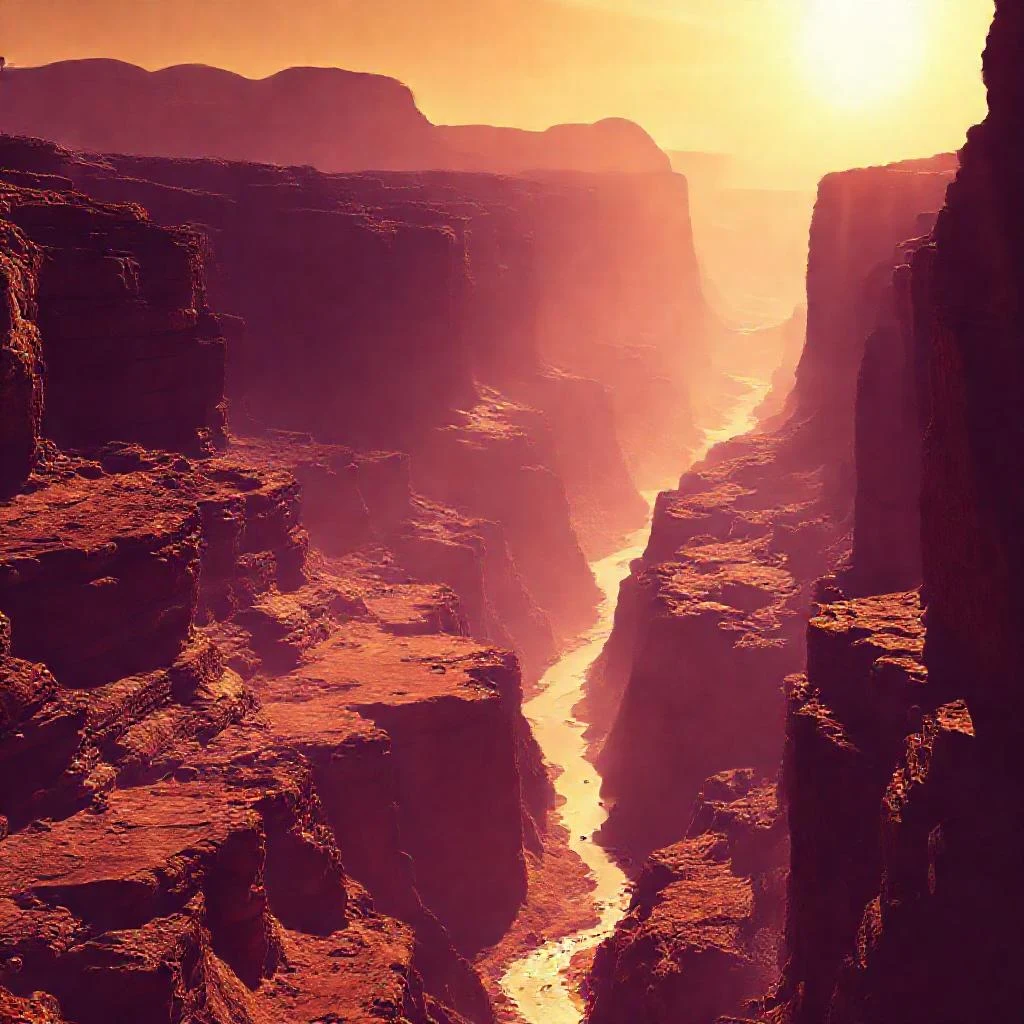
🎬 This picture echoes images of ancient Mars from science fiction, where a dying civilization struggled against encroaching drought.

Scientists
Ludwig BoltzmannDaniel BernoulliLeonhard EulerFred HoyleMargaret BurbidgeJoseph von Fraunhofer
Tags
Water carbon Sun
Laws
Stefan–Boltzmann lawBernoulli's principleArchimedes' principletriple-alpha process (Hoyle process)
Original: arXiv:2601.07159v2 · CC BY · bridge42worlds