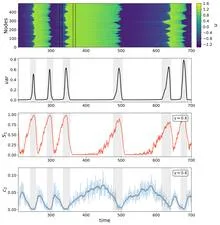
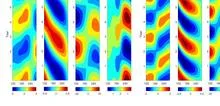
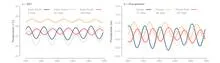
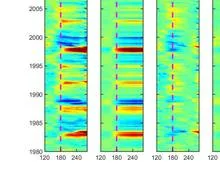
Mixed-mode oscillations are a type of dynamical behavior where a system alternates between phases of small-amplitude, nearly regular oscillations and phases of large-amplitude excursions or spikes. This pattern is common in many natural and engineered systems, from chemical reactions and neuronal firing to climate phenomena. In the context of El Niño, mixed-mode oscillations can describe how the tropical Pacific climate system produces decades of relatively mild variability punctuated by occasional strong El Niño events, rather than behaving uniformly.
History
The mathematical framework for mixed-mode oscillations was developed in the 1980s–1990s, notably by researchers like John Rinzel and later by Martin Wechselberger, building on earlier work in relaxation oscillations and singular perturbation theory.
How it works
The mechanism typically involves two timescales: a fast subsystem that can oscillate or spike, and a slow variable that modulates the fast dynamics. As the slow variable drifts, it moves the system through regions where the fast subsystem behaves differently—sometimes quiescent with small oscillations, sometimes spiking. In El Niño models, this can arise from the interaction between ocean heat content (slow) and sea-surface temperature or thermocline depth (fast), leading to bursts of strong warming events separated by calmer periods.
In practice
Beyond climate, mixed-mode oscillations are used to model cardiac arrhythmias, chemical oscillators like the Belousov–Zhabotinsky reaction, and to design better control strategies for systems prone to sudden large excursions.
Fun fact
Mixed-mode oscillations are also observed in the firing patterns of certain neurons, where they produce complex bursts that are thought to encode information differently than regular spiking.
An orchestra without a conductor: each musician tunes to a neighbor, and out of that comes a well-coordinated melody. In the world of microscopic magnets, the role of that orchestra is played by a tiny neodymium sphere levitating above a superconducting film.
A stack of pages that has been flipped through many times remembers it: some sheets lie flat, others stick up, and creases remain here and there. Layered materials behave much the same way when ions enter them.
In an aquarium the size of a dining table, two schools of black neon tetras swim in adjacent compartments separated by a transparent wall. They cannot touch each other, but they see every movement. And here's the surprising part: when one school decides to turn left, the other does the same a moment later. It's like two pendulums hanging behind glass, starting to swing in rhythm.
A superfluid gas is like a crowd of people marching in step: each atom knows where to go and doesn't fall out of the common rhythm. But this crowd has three 'valleys'—three different directions it can take. In a new experiment, physicists made one valley slightly more 'favorable' than the others and watched how the crowd darted between them.
Moiré patterns are familiar to everyone. Two combs with different spacing, placed on top of each other, show dark fringes. Something similar has emerged in time. Physicists took a cloud of Rydberg atoms, particles with unusually large electron orbits, and illuminated it with two lasers.
Dark matter remains one of the greatest mysteries of modern physics. Back when Vera Rubin observed galaxy rotation, she proved that visible matter is insufficient to keep stars from flying apart.
In a world striving for chaos, rhythm sometimes arises. The Belousov–Zhabotinsky reaction has amazed for decades: in a test tube, color waves run on their own, as if a living organism breathing matter. Something similar lurks in crystals where iron atoms balance between two magnetic states — high-spin and low-spin.
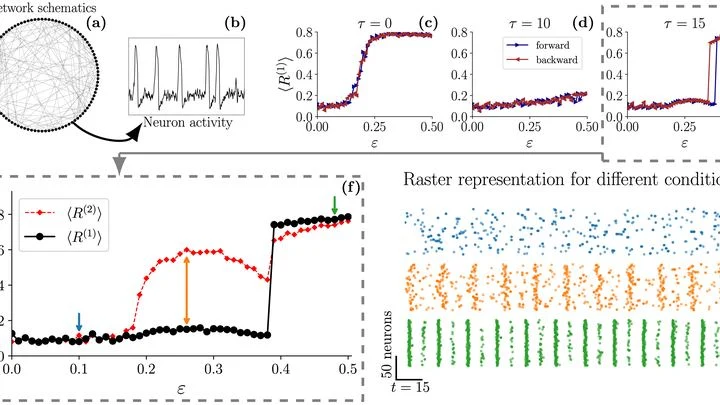
A neuron sends a signal to its neighbor. The neighbor doesn't respond immediately — the impulse travels along the process at a finite speed, like a letter delayed in transit. Usually, such a delay is considered a nuisance, but in this new work, it becomes the conductor.
When two excitable neurons are connected with a delay, a rhythm spontaneously emerges between them.
Toss a handful of coins on a table: each one lands heads or tails on its own. Now imagine the coins start flipping over, nudging each other. That's roughly how neutrinos behave in a very dense environment.
A swing can rock strongly or barely move. Usually, if left alone, it stays in its chosen mode. But in the microworld, things are different: a tiny membrane, oscillating under the action of a laser beam, can spontaneously jump from one amplitude to another.
The heart beats steadily, then slips into arrhythmia. The climate holds its familiar rhythm for decades, then shifts to a new state over a single summer. Such regime shifts are like a flick of a switch, but in real data we see only a noisy one-dimensional signal in which the moment of the break is hidden.
The Sun pulses in a slow rhythm, and that rhythm can be heard in the rains over Brazil. Sunspots on the solar disk thicken and thin roughly every eleven years, and along with them, pressure in the Pacific Ocean shifts, sea surface temperatures change, and then rainfall amounts in the northeast of the country follow suit.
A swimmer cutting through water at the speed of the waves running on it finds themselves in a strange position: the waves they themselves generate can neither overtake them nor fall behind. They pile up at the swimmer's bow and freeze. A similar phenomenon occurs when a light source moves inside a medium at a speed matching the speed of energy transfer of the waves.
Over the warm waters of the Indian Ocean, every six to eight weeks, a vast wave of moist air gathers. It moves eastward at a pedestrian pace—about five meters per second—and takes forty to ninety days to circle half the planet.
A Network That Decides When to Stop
A crowd grows: each new person joins the group with a probability that depends on how large the group already is. If the group is small, joining is easy; if it is huge, people start to hesitate, and growth slows down. This mechanism, called feedback, changes the entire behavior of the network.
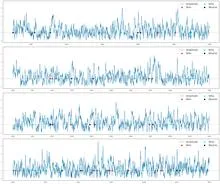
A student learned physics from a textbook and is taking an exam. The first two problems are solved brilliantly, but on the third, they err on something not covered in the book. That is roughly what the hybrid atmospheric model NeuralGCM faced when run through three levels of testing: cyclones, El Niño, and anomalous warming.
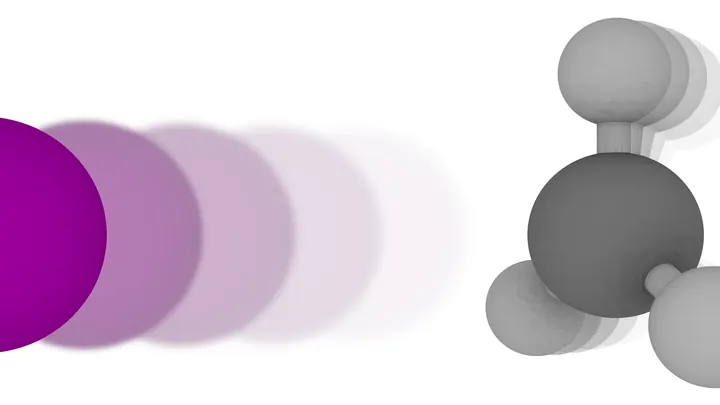
A chemical bond is like a stretched spring between atoms. When it's snapped, the molecular fragments fly apart, but they don't freeze: they keep vibrating, like a plucked string. That's exactly the vibration a team of researchers caught when they broke a methyl iodide molecule with an ultraviolet laser.
For a long time, the climate of ancient Mars remained a mystery: the beds of dried-up rivers spoke of water, but models couldn't explain how it got there — after all, 4 billion years ago the Sun shone 30% dimmer. New research shows that the planet swayed, as if on a swing, between long glaciations and short wet epochs.
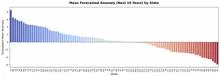
The climate of the United States is not a straight line creeping upward. It is an orchestra without a conductor, where every violin and every drum plays its own part, and together they create an intricate pattern of warm and cold, wet and dry years.
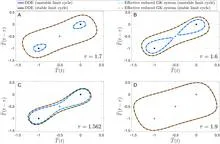
Imagine a pendulum that is pushed in time with the seasons: harder in winter, softer in summer. But this pendulum has a quirk: a switch that operates with a delay. When the pendulum passes through zero, the switch clicks and changes the direction of the push. That is exactly how the simplified El Niño model built by mathematicians works.
An invisible relay race runs through Earth's tropics: a wave of heavy rain and winds, which meteorologists call the Madden–Julian Oscillation, travels eastward at about five meters per second. Most runners tire quickly, but rare marathoners carry the torch all the way across the Pacific.
The tropical Pacific Ocean lives in two rhythms. The first is fast: a wave of thunderstorms born over the Indian Ocean races eastward and dies out off the coast of the Americas within a month or two. The second is slow: every few years, the ocean surface warms enough to alter weather across the entire planet. That is El Niño. Between these rhythms lies a bridge, and building it took climatologists decades.
You can sit on a seesaw and pump your legs, or you can just tip from one side to the other. The Pacific Ocean does both. Every few years, warm water off the coast of Peru gives way to cooler water, and rainfall patterns, winds, and entire ecosystems across half the planet reshuffle. These shifts are called El Niño and La Niña, together known as ENSO: Earth's climate seesaw.
The Pacific Ocean breathes. Every few years, its warm western "lung" exhales eastward, and from Peru to Indonesia, rains, droughts, and hurricanes shift. This breath is called El Niño–Southern Oscillation, or ENSO.
In winter, air over the Northern Hemisphere does not move haphazardly; it spends days at a time in the same pattern before rearranging itself. These patterns are like rooms in a maze: the system enters, lingers, then finds a door to another room. Each room has its own weather: somewhere over Europe it is warm and humid, while over Siberia it is frosty and clear.
An experienced navigator steers the ship by a well-tested chart, but in unfamiliar waters the chart lies. A cabin boy who has watched the navigator err for years learns to anticipate where the chart will fail. Together they plot a course more accurately than either could alone.
The tropical Pacific breathes in two rhythms. One lasts several years: the water off the coast of Peru warms and cools, which fishermen call El Niño. The second rhythm is fast: every month or two, a giant cloud wave is born over the warm waters of the Indian and Pacific Oceans, creeping eastward at a runner's pace and dying out near South America.
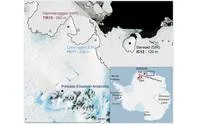
On the coast of Dronning Maud Land, two ice cores stand like two seismographs on one shore. One, FK17, was drilled on the crest of the Lokenryggen ice rise; the other, TIR18, on the crest of Hammaryggen. A hundred kilometers apart, they catch different tremors of the climate. One hears the Pacific, the other the Atlantic and Indian Oceans.
The Pacific Ocean remembers. Water warmed off the coast of Peru drifts slowly westward, and six months later its heat returns to South America. Scientists call this six-month journey the delay. It turns a simple climate model into a maze where the route depends not only on your current position but also on where you were half a year ago.
The Pacific Ocean is a vast pot of water that someone occasionally stirs, now at one edge, now at another. When warm water piles up off the coast of South America, fishermen call it El Niño, "the child," because it often arrives around Christmas.
A fisherman pulls on his net and listens to it ring. Each strand quivers in its own way, but before a strong tug, all the strands begin to vibrate in unison. So it is with complex systems: before a sharp state jump, the individual parts suddenly start to oscillate in concert, and that synchrony betrays the coming jump.
The ocean plays with three hands. One hand is fast: the surface temperature of the Pacific Ocean changes over weeks. Another hand is medium: the depth of the warm layer rearranges over months. The third hand is slow: the entire system tilts toward warm El Niño or cold La Niña, and that takes years.
Three pendulums hang from a long rope attached to the ceiling. One swings fast, another slow, and the third sometimes freezes and then lurches. But the rope is shared, so each jerk of one is felt in the motion of the others.
In 1960, a meteorologist at a station in Peru records water temperature, while a farmer in India watches the sky waiting for the monsoon. There is no direct link between these two events, but months later one will echo in the other.
An orchestra of three conductors governs the Pacific climate. The first conductor is intraseasonal wind bursts, blowing now from the west, now from the east, like random plucks on strings. The second is the interannual ocean dynamics, slowly rocking warm and cold waves.
The ocean off the coast of Peru warms and cools, and with it the whole planet runs a fever: rains flood deserts, and tropical forests dry out. This is El Niño, the most noticeable climate oscillation after the changing seasons. For half a century, it has been described by a single number: the water temperature in a small square of ocean.
Two orchestras play from the same score, but in different keys. The score is the warm El Niño current, which every few years heats the tropical Pacific. The key is the regime in which the midlatitude atmosphere responds to that heating. One orchestra plays steadily and predictably; the other keeps stumbling, yet its playing carries deep bass notes that the first lacks.
The ocean remembers its past. Heat given to the water off the coast of Norway does not vanish without a trace: it embarks on a long journey across the Atlantic, only to return decades later and alter the temperature at those same shores once again.
Every few years, the Pacific Ocean off the coast of Peru warms up, and then fields dry out in Australia while deserts in Chile get drenched. This phenomenon is called El Niño.
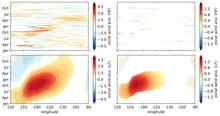
The tropics breathe with an annual rhythm: air temperature rises and falls, and within this breath lie two main pulses. The first pulse peaks in February and weakens in August; the second is shifted by half a year. These two pulses are not just background noise for the famous El Niño; they are its conductors.