Echo of a Silenced Black Hole express
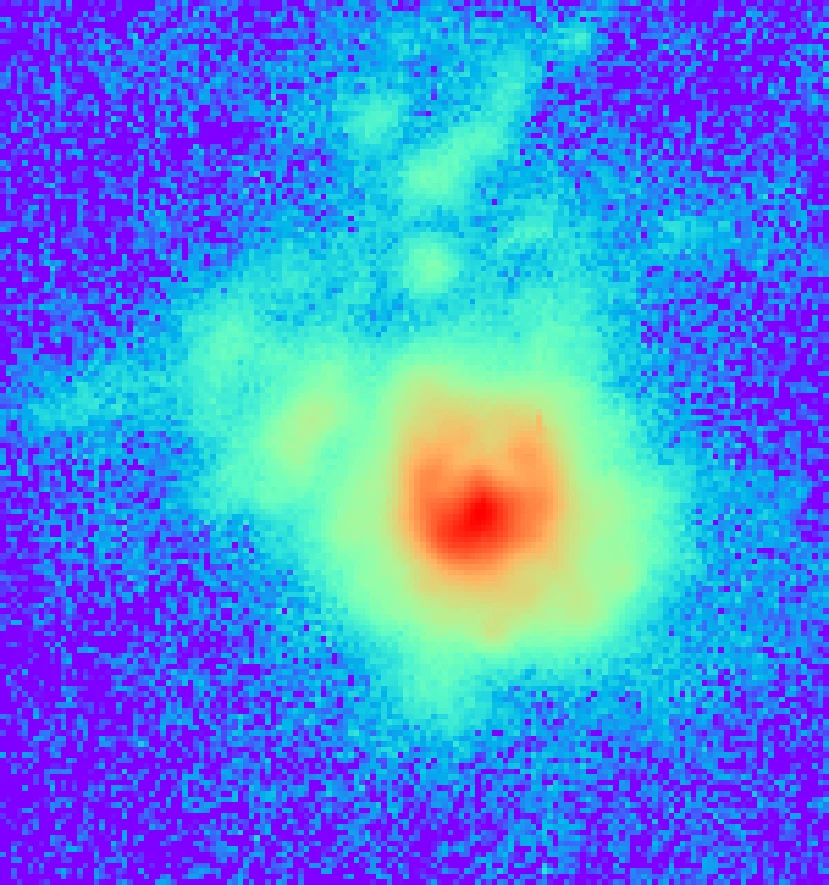
At the heart of every galaxy slumbers a supermassive black hole. When it devours matter, its surroundings flare up: this is an active nucleus. How can we learn about past outbursts if the black hole is silent? The answer lies in light echoes.
Like an echo in an empty hall, where reverberations linger after the source has gone quiet, radiation from a dead nucleus wanders through the galaxy. Astronomers caught it by measuring polarization — the orientation of light wave oscillations. In GSN 069, polarization grew stronger with distance from the center and was almost absent at the core. This means the light source has gone dark, but reflected rays still carry its story.
A combined analysis of spectroscopy and photometry revealed that the nucleus of GSN 069 wasn't just tearing apart passing stars: it shone steadily, surrounded by a gas 'doughnut' that focused its radiation. Most surprising: the black hole fell silent when ancient civilizations already existed on Earth. Its current slumber is just a brief pause in a turbulent life.
Original abstract
as written by the authors arXiv:2601.08940v1
Context. X-ray quasi-periodic eruptions (QPEs) are repeating, high-amplitude, soft X-ray bursts observed from the nuclei of a dozen nearby low-mass galaxies. Their origin remains a puzzle in the physics of accretion variability. Observational data indicate that X-ray and/or optical tidal disruption events (TDEs) may precede QPE detections. Although both kinds of outburst are driven by supermassive black holes, they are more frequently detected in faded active galactic nuclei (AGNs), when the TDE is not happening in a dormant galaxy. In the case of the QPE discovery source, GSN 069, it remains debated whether its past activity arose from a previous AGN phase or from an enhanced TDE rate. Aims. We investigated the origin of the past nuclear activity in GSN 069. Methods. Past AGN activity imprints detectable polarization in optical light, due to the expected delay between direct and scattered light. On 6 September 2019, we targeted GSN 069 with VLT/FORS2 in both imaging polarimetry and spectropolarimetry modes so that its optical polarization could be investigated while the first detected QPE phase was still active. Results. We measured a rising polarization, from ~0% to ~1.5%, as moving away from the nucleus of GSN 069. This rise is probed to be intrinsic to the central engine, confirming the already detected extended emission line region (EELR) by integral field unit data. Conclusions. The increasing radial polarization demonstrates a switched-off nucleus. The polarization angle traces an axis aligned with elongated [OIII], [NII], and H{\alpha} gas distributions, revealing an EELR that may be consistent with relic polarization cones, therefore suggesting the presence of a torus-like structure in the past. Thus, optical polarization echoes geometrically favor a faded AGN as the origin of the EELR rather than a past elevated TDE rate, although the latter cannot be excluded.
Light echoes expose cosmic events with a delay that makes us witnesses of the distant past, as if we're watching a film shot thousands of years ago.