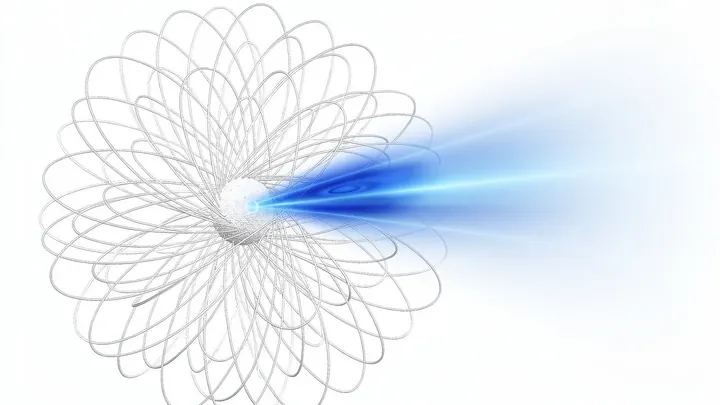
Magnetars are neutron stars with extremely strong magnetic fields, and their pulsations can be observed in gamma-ray bursts (GRBs). These pulsations provide a unique window into the internal structure and equation of state of neutron stars, as well as the physics of extreme magnetic fields. The detection of periodic signals in GRBs from magnetars helps distinguish between different models of GRB progenitors.
History
The first evidence of pulsations in a GRB from a magnetar was reported in 2019 in GRB 190114C, though earlier hints existed. The concept of magnetars was proposed in 1992 by Robert Duncan and Christopher Thompson.
How it works
When a magnetar is formed or undergoes a giant flare, it can emit a burst of gamma rays. The rotation of the magnetar modulates this emission, producing periodic pulsations in the GRB light curve. By analyzing the period and its evolution, astronomers can infer the magnetar's spin period, magnetic field strength, and the properties of the surrounding environment, such as the presence of a fallback disk or a wind nebula.
In practice
These observations help constrain the equation of state of dense nuclear matter, which is crucial for understanding neutron stars and the behavior of matter at nuclear densities.
Fun fact
The magnetic field of a magnetar is so strong that it can distort atoms into needle-like shapes and slow down the star's spin by emitting gravitational waves.
A beacon at the edge of the galaxy blinks without a schedule: sometimes silent for years, sometimes emitting hundreds of flares in a single day. Such a beacon needs a watchman who never sleeps and never gets distracted.
A particle with an energy of $$10^{18}$$ eV hitting Earth's atmosphere is like a tennis ball traveling at 200 km/h slamming into a wall. Astrophysicists have debated for decades where such projectiles come from. Gamma-ray bursts, brief and powerful explosions of gamma radiation, have long been suspected as accelerators.
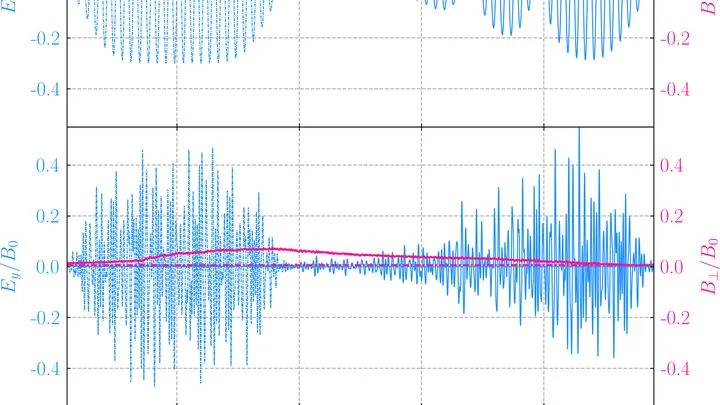
Radio waves from a distant pulsar travel through the interstellar medium, encountering invisible magnetic structures the size of the distance from the Sun to Earth. One such structure is a current sheet, where the magnetic field abruptly changes direction, like a compass needle flipping from north to south.
It's like a sprint record: to break it, you need a perfect run-up. But for sub-millisecond pulsars, the run-up is too short. The fastest known pulsar, PSR J1748-2446ad, spins 716 times per second — faster than a kitchen blender. If it were the size of Earth, a point on its equator would move at about 0.24 times the speed of light. But why doesn't any pulsar spin even faster?
In the layered crystal CrSBr, the magnetic moments of atoms are arranged like notes in a score: within each layer they point in the same direction, but between layers they point in opposite directions. This antiferromagnetic melody plays up to 132 kelvin, beyond which thermal motion destroys the order.
A sculptor shapes mountains from magnetic fields and heat, but the stone resists. A neutron star, the ultra-dense remnant of a supernova explosion, in a binary system pulls matter from its companion star. This infalling matter heats the star's crust unevenly, while the magnetic field tugs from within.
An avalanche in a sandpile starts with a single grain. No one knows exactly where it will slip or how big the slide will be. But if you keep pouring sand, the pile itself reaches a state where avalanches of all sizes, from tiny trickles to massive collapses, follow the same law.
A lighthouse doesn't flash steadily but in short, bright pulses. The neutron star in the system 4U 1323-62 is such a lighthouse in the X-ray range. It pulls gas from a companion star, and when enough material accumulates on its surface, a thermonuclear explosion occurs — an X-ray burst.
A lighthouse flashes for a fraction of a second and goes dark again. The MeerKAT telescope in South Africa catches such flashes in the radio band. During its observations, it picked up 27 new sources that no one had seen before. Neutron stars are the remnants of exploded stars, compressed to the size of a city.
The night sky looks smooth, but it's actually clumpy — vast communities of galaxies that bend light from distant objects like lenses. When a short, powerful radio burst goes off somewhere in the universe, its path to an Earth telescope can pass near such a clump.
Imagine a lottery where instead of money, you win black holes. Each ticket is a random spot on the sky, and the prize is a gravitational wave from the merger of two giants. The chance of hitting the jackpot is minuscule, but if you do, the wave is heard across the entire universe.
After a supernova explosion, a dense ball the size of a city remains at the center — a newborn neutron star. It is hot, compressed, and rings like a bell after being struck. These tremors, the star's oscillations, emit gravitational ripples that sensitive detectors on Earth can catch.
Pulsars are rapidly spinning neutron stars that emit radio pulses like a lighthouse. But some of them stay silent almost all the time, occasionally emitting a single pulse. Such objects are called rotating radio transients (RRATs). They were discovered nearly twenty years ago, but they remain a mystery.
Somewhere in the depths of space, two supermassive black holes are circling each other. Their dance is not smooth — the orbit is stretched, like a rubber band that alternately tightens and relaxes. Each revolution sends ripples through the fabric of spacetime — gravitational waves.
Radio astronomy began with the mysterious noise caught by the antenna of Karl Jansky and the rhythmic pulses that Jocelyn Bell Burnell playfully called 'little green men'.
89 milliseconds. That's how long a vortex avalanche lasts that abruptly speeds up the rotation of the Vela pulsar — one of the most famous 'glitching' pulsars. Pulsars are rapidly spinning neutron stars born in the collapse of supernovae.
In June 2024, the CHIME radio telescope recorded over 700 radio bursts per hour from source FRB 20240114A. Such a hyperactive repeater releases in one hour nearly all the magnetic energy of a typical magnetar (a neutron star with an ultra-strong field).
Dark matter remains the inaudible bass line of the cosmic symphony — it emits no light, but its gravitational pull shapes galaxies. Vera Rubin first caught this rhythm in the 1970s by observing the rotation of stars.
Two neutron stars spiral closer and collide. The result: a gravitational wave, a ripple in spacetime, a short gamma-ray burst, and a faint glow astronomers call a kilonova. But sometimes the signal passes by a massive galaxy.
Two ultradense spheres, each the size of a city, whirl in a dance. Their masses are less than the Sun's, but inside them is matter compressed to unimaginable limits. One sphere is a neutron star; the other is a strange star, made entirely of quarks — the elementary particles that build up protons and neutrons.
Fast radio bursts — millisecond radio pulses arriving from distant galaxies — long remained a puzzle. Their colossal energy, compressed into instants, pointed to cataclysms on neutron stars, perhaps pulsars or magnetars.
Think of a merry-go-round: it's easier to spin a light one, harder to spin a heavy one. Neutron stars, the ultra-dense remnants of exploded stars, behave in a similar way. Astronomers looked at fifty binary systems where one neutron star orbits another and noticed: the heavier the star, the longer its spin period. The link isn't strict, but it's statistically noticeable.
Two neutron stars, ultra-dense remnants of massive stars, merge into one, and the space around them shudders: a gravitational wave is born, a ripple in the very fabric of spacetime. Almost simultaneously, a narrow stream of matter, the jet, erupts from the scene.
Somewhere deep in space, a radio beacon flashes for a fraction of a second, and then goes dark. Such signals are called fast radio bursts. They come from other galaxies and last from microseconds to milliseconds.
In a world striving for chaos, rhythm sometimes arises. The Belousov–Zhabotinsky reaction has amazed for decades: in a test tube, color waves run on their own, as if a living organism breathing matter. Something similar lurks in crystals where iron atoms balance between two magnetic states — high-spin and low-spin.
Active galactic nuclei (AGN) are the universe’s powerhouses: their X-ray coronae blaze millions of times hotter than stellar atmospheres. But what strikes the spark? A ten-day X-ray campaign by the XRISM and XMM-Newton satellites, aimed at NGC 3783, provided the answer: it’s actual thunderstorms.
The enigma of fast radio bursts (FRBs) is not just a question of 'what exploded?' It’s a drama of energy transfer under extreme conditions, where the slightest stumble leads to collapse.
A massive star doesn’t simply fade away — it blows up as a supernova, leaving behind an expanding remnant and a wildly spinning neutron star — a pulsar. In this cosmic storm, astonishing patterns emerge, and the 'Nimbus'–'Thunder' system is a dazzling illustration.
Hidden in the globular cluster Terzan 5 is the binary system IGR J17480-2446. One of its members is a neutron star that behaves strangely. It spins at just 11 hertz (11 revolutions per second) and cools suspiciously slowly after an outburst. Usually, such stars spin hundreds of times faster and cool briskly — here, it's the opposite.
A lighthouse sends its beam through a storm of its own mirrors: that's roughly how fast radio bursts behave when trying to leave a magnetar's vicinity. A magnetar is a neutron star with a magnetic field a quadrillion times stronger than Earth's.
A hum resonates across the universe. It is not sound, but a trembling of space itself — the gravitational wave background. It is produced by pairs of supermassive black holes circling each other at the centers of distant galaxies. Each pair is like a bass instrument in a vast orchestra.
Blazars are long-lasting beams from black holes at the centers of galaxies. Gamma-ray bursts are the briefest flashes from supernova explosions or neutron star mergers. The former act like eternal spotlights, the latter like camera flashes.
The Sun is not just a source of light but a giant laboratory where ghostly particles are born. Every second, billions of neutrinos fly through your body, barely noticing you. But inside the Sun, these particles behave differently: they change their type on the fly, like an actor playing three roles in a single play.
At the heart of nearly every large galaxy lives a supermassive black hole — a silent giant around which stars, gas, and other, smaller black holes orbit. From time to time, one of these objects breaks free from its orbit and begins to fall toward the central monster in a tightening spiral.
A tightly twisted phone cord snaps and scatters sparks. Magnetic fields on the Sun behave the same way: they twist, break, and reconnect, powering flares. For the first time, astronomers have witnessed this process directly. One loop was twisted by 540 degrees — one full turn and then half again. That’s three times more than previously thought possible.
A dead star with a magnetic field billions of times stronger than Earth's is a magnetar. Its crust cracks, sending a powerful X-ray burst into space. But some of that light doesn't reach us in its usual form. In an ultra-strong field, photons can turn into gravitational waves — the trembling of space itself.
Pulsars are dead stars spinning with flawless rhythm. Their radio blips are more precise than atomic clocks. However, gravitational waves — ripples in the fabric of spacetime, predicted by Einstein — disrupt that rhythm.