The Imaging X-ray Polarimetry Explorer (IXPE) is a space telescope that measures the polarization of X-rays from cosmic sources. Polarization describes the direction in which light waves oscillate, and X-ray polarization carries unique information about the geometry, magnetic fields, and physical processes in extreme environments like neutron stars, black holes, and magnetars. Launched in 2021, IXPE is the first satellite dedicated to this measurement in the X-ray band, opening a new window on the universe.
History
IXPE was developed by NASA in collaboration with the Italian Space Agency, with principal investigator Martin Weisskopf. It launched on December 9, 2021, from Kennedy Space Center.
How it works
IXPE uses three identical telescopes, each with a mirror assembly that focuses X-rays onto a gas pixel detector. When an X-ray photon hits the detector gas, it knocks out an electron whose initial direction is correlated with the photon's polarization angle. By tracking these electron tracks, the instrument reconstructs the polarization of the incoming X-rays. The spacecraft can also observe how polarization changes over time, revealing the rotation of neutron stars or the geometry of accretion flows around black holes.
In practice
IXPE data help astrophysicists test models of extreme physics, such as quantum electrodynamics in strong magnetic fields, and constrain the equation of state of neutron star matter.
Fun fact
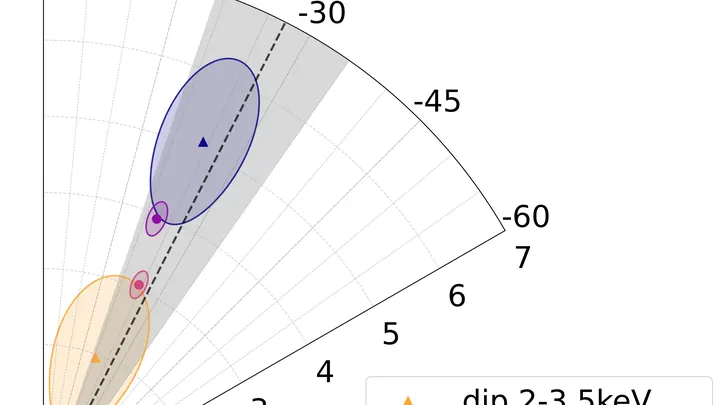
IXPE's first observations of the magnetar 4U 0142+61 confirmed that the vacuum around it becomes birefringent, acting like a crystal due to quantum effects.
Eight sky maps taken by different detectors of the Planck telescope resemble eight road atlases of the same city drawn by different cartographers. Each atlas is rotated by its own angle: one cartographer held the tablet slightly tilted, another slightly turned. If you overlay the atlases, the streets won't align. But if you know how each atlas is rotated, you can align them perfectly.
From 1987 to 1991, astronomers last measured how Jupiter's icy moons reflect radio waves. Then came a long pause. In 2011–2024, researchers aimed a radar beam at Europa again: this time using the 70-meter antenna at Goldstone and the Green Bank Telescope.
Ice is nearly transparent to radio waves, like clear window glass is to light.
Pulsar PSR J1740+1000 is a city-sized star spinning faster than a kitchen blender. After a supernova explosion, it left behind a dense core that accelerates particles to near-light speeds. These particles fly into space, and previously it was thought they scatter in all directions, like splashes from a stone thrown into water.
May 2022. The space polarimeter IXPE, the spectroscope NuSTAR, and the monitor NICER simultaneously stared at one spot in the sky — at the black hole in the Cygnus X-1 system, where it orbits a blue supergiant in a close binary system with a period of 5.6 days.
An ordinary flashlight emits light whose waves oscillate in all directions at once. But pass that light through a special filter, and you get a beam that oscillates strictly in one plane: that's polarized light. When such a beam travels through biological tissue, the tissue's internal structure slightly alters the orientation of the oscillations.
Night on La Palma. The 4.2-meter William Herschel Telescope is aimed at Venus. At the focus is the experimental polarimeter ExPo, designed to catch the ghostly light of exoplanets.
The early universe expanded at a breakneck pace: this phase is called inflation. But how exactly did it do it? Some models describe the expansion as a steep exponential surge, others as a more gentle power-law motion.
In a close binary system, the hot star, like a searchlight, illuminates its cooler companion. Some of the light scatters off free electrons in its atmosphere — this is Thomson scattering — and acquires linear polarization. As the stars orbit each other, this polarization rotates, like the hand of a peculiar cosmic metronome.
A spinning top whirling so fast that it forces light around it into spirals: that's a fitting image for what happens near a black hole's horizon. Hot plasma falls in and emits radio waves. Their polarization (the plane in which the wave oscillates) becomes an arrow pointing in the direction of energy flow.
Gravitational waves are the trembling of spacetime itself. Usually we only catch their overall hum, but each wave also has a direction of oscillation – polarization. Old maps were built only from signal loudness, which led to errors. It's like trying to see the bottom of a pond through sun glare.
Tiny invisible bullets pass straight through the Sun, barely noticing its matter. These are axions — hypothetical particles so light and elusive that they are often compared to ghosts.
Light from a distant star is not just a steady stream. It oscillates like a wave and can vibrate in different directions. Usually these oscillations are indistinguishable, but a magnetar can sort them out.
A pair of figure skaters spins while holding hands. If their path is a perfect circle, each push from a partner is predictable. But stretch that path into an oval, and the effort becomes uneven: a jerk as they come together, a lull as they pull apart. Something similar happens with two black holes in the final minutes before they merge.
Deep in space, a rapidly spinning neutron star, a pulsar nicknamed the Lighthouse, speeds through tenuous gas. Like a motorboat cutting through water, it leaves a glowing trail of charged particles behind. In X-rays, this trail appears as a bright tail and a thin filament stretching over many light-years.
The neutron star 4U 1735-44 is gobbling up matter from a companion star. The matter spirals into a flat disk, like water going down a bathtub drain. But this disk shines in X-rays, and astronomers have for the first time measured how "combed" those rays are: that is, how polarized.
Light from distant stars travels for millions of years, but X-rays can't be caught with ordinary glass: they pass right through it like a bullet through paper. That's why X-ray telescopes need special lenses: stacks of tiny prisms that gently deflect the rays and focus them to a single point.
A radio telescope picks up a signal from the center of the Milky Way. The source MAXI J1744-294 flares in X-rays and radio waves, but where it actually resides is a mystery. It could be near the black hole, or it could just lie along the same line of sight, thousands of light-years away.
Neutron stars are the compressed cores of dead stars — city-sized objects with staggering density. Some of these stars become pulsars, cosmic lighthouses emitting strictly periodic radiation pulses.
For half a century, astronomers puzzled over the nature of the powerful X-ray emission from Gamma Cassiopeiae — a bright beacon in its constellation whose X-ray glow didn't fit models of single stars. An invisible companion was suspected, but direct evidence was lacking.
A flashlight beam in fog breaks into thousands of faint specks. Each speck is light that has bounced off countless water droplets before reaching your eye. To make sense of this mess, physicists construct a special table — the scattering matrix. It records how each incoming ray turns into a set of outgoing ones.
Cosmic rays are not light but charged particles bombarding Earth from all directions. Most of them are protons (hydrogen nuclei), but heavier nuclei also show up: helium, nitrogen, iron.
Laser light is like a perfectly aligned row of soldiers on parade: all waves oscillate in the same plane. Such light is called polarized. In a new study, physicists have for the first time produced polarized gamma rays by colliding electrons with a powerful laser pulse.
A giant cosmic funnel sucks in gas from its surroundings. But not all of that gas falls in — some is spat back out, like splashes from boiling water. That's exactly what the ultraluminous X-ray source NGC 5204 X-1 does: a compact object (likely a black hole) feeds so voraciously that the excess escapes in powerful jets.
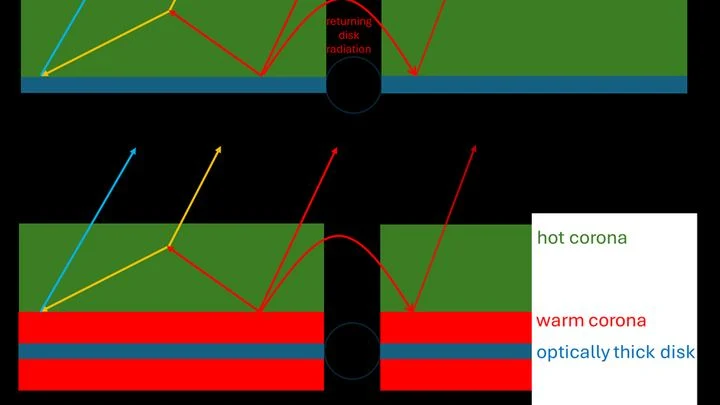
The black hole Cygnus X-1 is one of the most studied in our galaxy. It pairs with a normal star, pulling matter from it. The gas spirals into a glowing disk, like water down a drain, and above the disk hangs a scorching corona — a cloud of electrons at temperatures of hundreds of millions of degrees.
A neutron star the size of a city spins thirty times per second. Its magnetic field is trillions of times stronger than Earth's. Such conditions could spawn a cloud of axions around the star — light particles that no detector has caught yet, but which neatly explain the hidden mass of the Universe.
To align particle spins in one direction, physicists usually cool a substance to near absolute zero and place it in a strong magnetic field. That is expensive and bulky.
A new method resembles tuning many spinning tops with a gentle touch: mediator molecules temporarily bind to target atoms and pass on their order.
The Sun is not a calm sphere. Waves constantly ripple through its interior, like a bell after being struck. These oscillations reach the surface and reveal what's happening on the far, invisible side. Astronomers have long been able to 'listen' to this ringing and find large sunspot groups there.
The X-ray pulsar Centaurus X-3 is a neutron star that spins rapidly and emits pulses of X-ray light like a lighthouse. Scientists pointed three space telescopes at it and studied the polarization of its emission — how the electric field of the light wave oscillates.
According to Einstein's theory, massive objects cause spacetime curvature, like a heavy ball warping a rubber sheet. As they accelerate, they create ripples — gravitational waves, akin to the circles from a stone dropped in a pond.
The black hole GS 1354-64 in the constellation Musca woke up in 2025 and began greedily pulling matter from its companion star. The orbiting X-ray telescope IXPE caught it at a rare moment: the outburst had already subsided, but the system had not yet settled down.
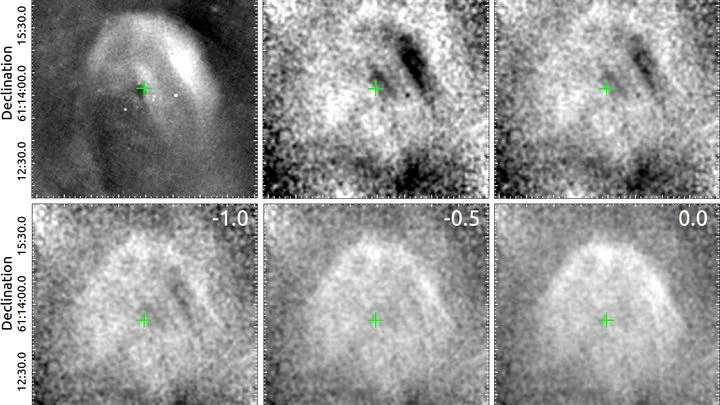
The VLA radio telescope peered into the Boomerang Nebula — a cloud inflated by the wind from a rapidly spinning neutron star. The new images reveal details as small as a lunar disk on the sky: an elongated core around the pulsar and a long arc curving around it from the north.
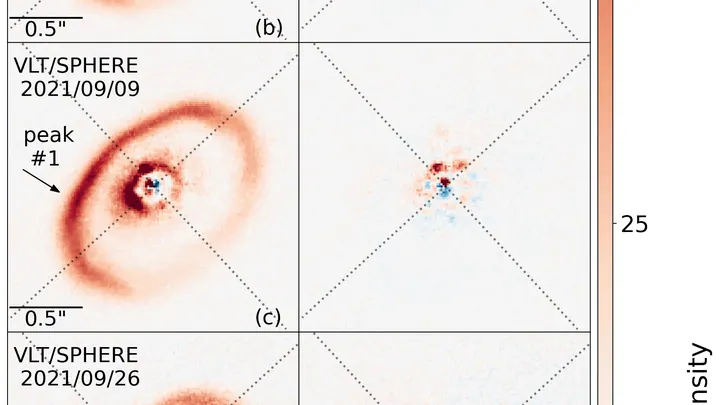
Around young stars, flat clouds of gas and dust swirl — the building material for future planets. Starlight reflects off these clouds, and astronomers see them as faint disks. But sometimes bright spots or dark bands appear in such disks. Fresh observations with the Subaru Telescope show these patterns can change within a matter of months.
The edge of the supernova remnant RCW 86 is where the shock wave from a star's explosion slams into the surrounding gas. The IXPE telescope looked at the southwestern part of this boundary in X-rays and tried to catch polarization — the way these rays oscillate.
In a giant particle accelerator, where protons traveling at nearly the speed of light smash into a neon target, charmed baryons are born — particles that live for less than a billionth of a second.
Deep inside the accelerator, neutrons are sped up and fly toward a target like a swarm of tiny tops. Each top has an axis of rotation: its spin. If all the tops are spun in the same direction, the beam is called polarized.
Light from the star HD 163296 passes through the surrounding gas-and-dust disk like a flashlight beam through murky water. The disk's particles scatter the light, giving it a special property — polarization: the waves begin to oscillate in a single plane, like a rope shaken strictly up and down.
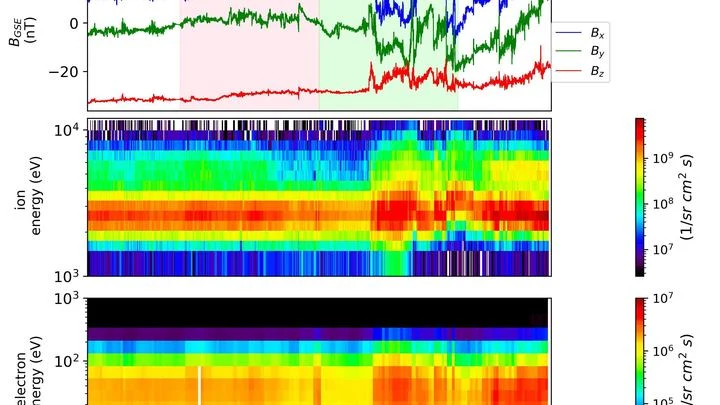
October 10, 2024. The Sun hurled a cloud of magnetized plasma toward Earth, and four spacecraft, stationed at a single point between the Sun and Earth, simultaneously recorded how that cloud churned. The distance between the outermost probes was just 80 Earth radii, about half a million kilometers.
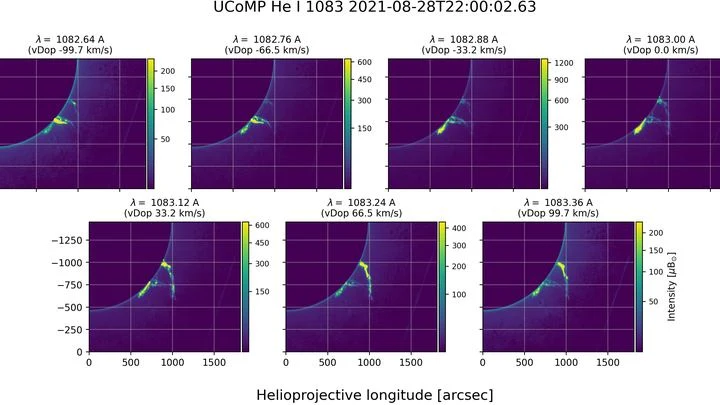
The Sun occasionally hurls enormous clouds of plasma into space — coronal mass ejections. Often tangled within these clouds are prominences: cooler, denser clumps of material. These contain plenty of neutral atoms that shine brightly in specific spectral lines.
Terahertz radiation sits between microwaves and infrared light. It passes through clothing, paper, and plastic but is blocked by water and metal. That's why these waves are used in security scanners and for quality control of materials.