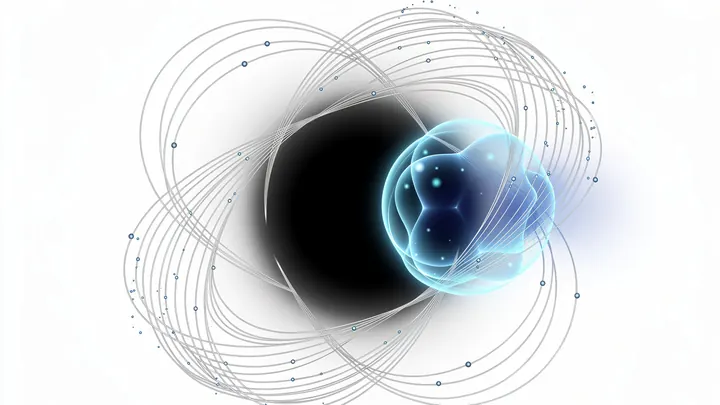
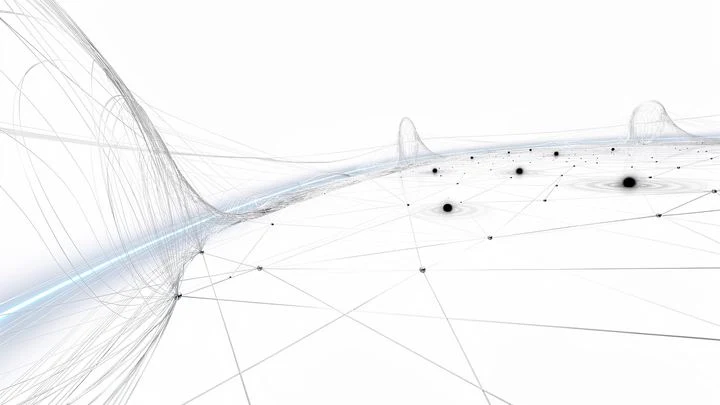
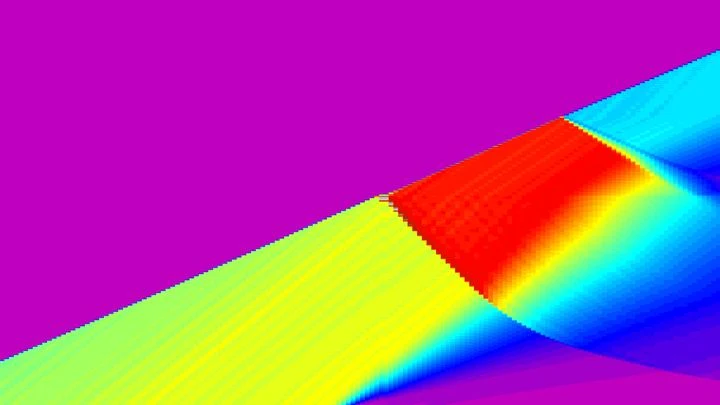
Iron K-alpha reverberation is a technique that uses X-ray echoes from iron atoms near black holes to map the structure of the accretion disk. When a black hole's corona flares in X-rays, it illuminates the inner disk, causing iron atoms to fluoresce at 6.4 keV. The time delay between the flare and the fluorescence, and its spectral shape, reveal the disk's geometry, radius, and inclination. This method provides a direct probe of the strong gravity regime near the event horizon.
History
The iron K-alpha line was first detected in the 1990s by the ASCA satellite, and the reverberation mapping technique was developed in the early 2000s, notably by Andrew Fabian and colleagues.
How it works
A sudden X-ray flare from the corona irradiates the accretion disk. Iron atoms in the disk absorb these X-rays and re-emit fluorescent lines, primarily at 6.4 keV. Due to relativistic effects (Doppler boosting, gravitational redshift), the line is broadened and skewed. By measuring the time lag between the continuum flare and the iron line, astronomers infer the light travel time from corona to disk, giving the disk's radius. The line profile encodes the disk's inclination and the black hole's spin.
In practice
Used to measure black hole masses and spins, test general relativity in strong fields, and study accretion disk physics in active galactic nuclei and X-ray binaries.
Fun fact
The iron K-alpha line is so broadened near a black hole that its width can correspond to velocities exceeding 30% of the speed of light.
Every five hours in the binary system IPHAS J190812.63+045728.1, one star completely hides the other. For 18 minutes, the white dwarf and its scorching disk vanish from sight, leaving only a modest red neighbor in the dark. This is a natural shutter that switches off the spotlight to reveal what usually hides in its glare.
A stack of pages that has been flipped through many times remembers it: some sheets lie flat, others stick up, and creases remain here and there. Layered materials behave much the same way when ions enter them.
You don't hold a ruler right up to an invisible disk; you measure it across the entire universe. Light from a distant quasar, a blazing gas swirling around a supermassive black hole, passes through a lensing galaxy on its way to us.
Galaxy Mrk 590 behaves like a radio receiver that sometimes picks up a signal and sometimes fades into static. Its supermassive black hole has been brightening and dimming for decades, and astronomers caught every such 'switch-on.' In 2017, the receiver came alive again, but the VLA radio telescope heard not the signal they expected.
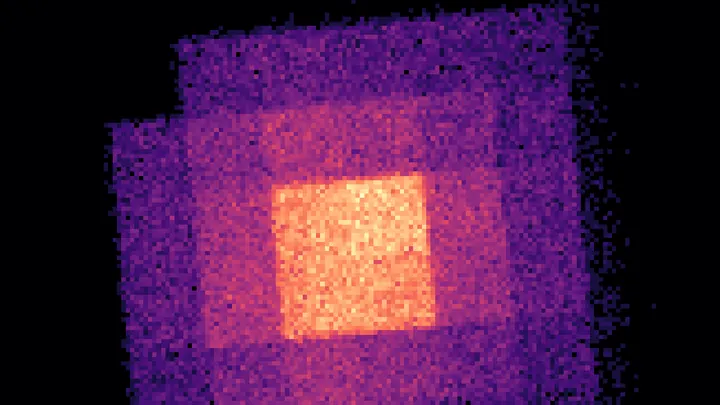
A laser beam strikes a thin target hidden inside layers of another material. Within billionths of a second, the material is compressed to a density of 25 grams per cubic centimeter, as if a piece of lead became more than twice as heavy without moving an inch.
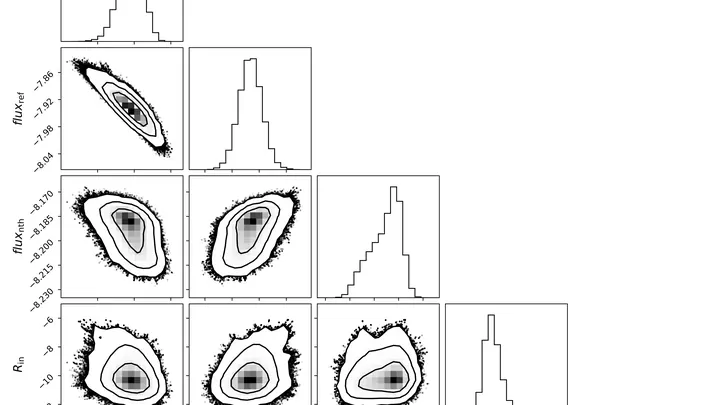
The XMM-Newton X-ray telescope stared at galaxy Mrk 1044 for two straight hours. Inside it, a black hole is surrounded by a swirling disk of superheated gas. This gas glows in X-rays, and its light flickers — brighter, then dimmer.
For the first half hour, the flickering of soft and hard X-rays was in step.
A black hole paired with a star works like a pump: it pulls gas from its companion, swirls it into a glowing disk, and occasionally ejects some of that matter in two narrow jets. In 2021, the system 4U 1543-475 put on such a show.
A cosmic object spins, but its shadow isn't round. Astrophysicists examined a black hole in an unusual version of gravity — the so-called brane world (where our universe is a three-dimensional surface in a space of higher dimensions).
In a distant galaxy about 290 million light-years away, the object HLX-1 lies hidden. It once flared brighter than hundreds of billions of suns, but now it has quieted down. From 2018 to 2022, the Hubble, Chandra, and Swift space telescopes tracked its fading.
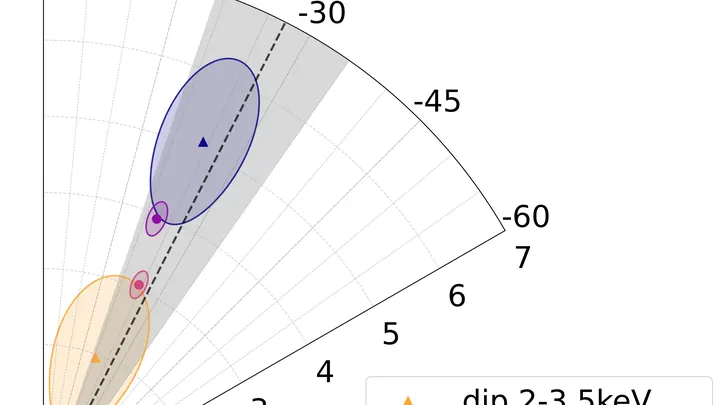
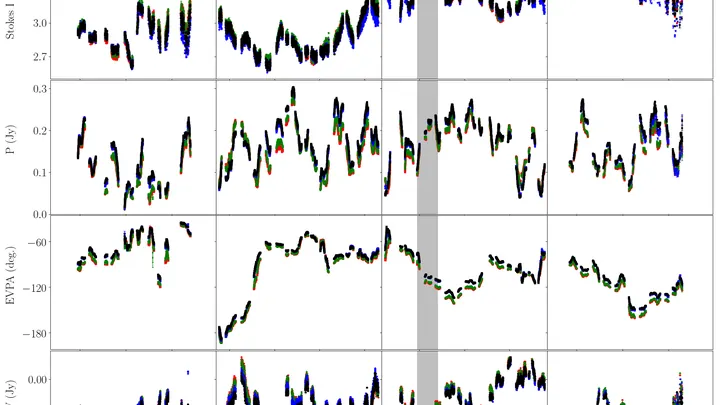
May 2022. The space polarimeter IXPE, the spectroscope NuSTAR, and the monitor NICER simultaneously stared at one spot in the sky — at the black hole in the Cygnus X-1 system, where it orbits a blue supergiant in a close binary system with a period of 5.6 days.
A black hole is a place from which nothing can escape. But some theories allow that deep inside, at the quantum level, it might bounce and turn into its opposite — a white hole, which only spews out matter and light.
A group of physicists built a computer model of such a transformation.
The universe cooled like a giant bathtub after a hot start. At 400 000 years after the Big Bang, hydrogen was ready to recombine — protons capturing electrons to become neutral atoms. But somewhere in this dark water, a tap kept dripping.
At the center of most galaxies lurk supermassive black holes — the overlords of gravity. Since 2019, thanks to interferometry with very long baselines, we’ve glimpsed their shadows: dark silhouettes set against a blazing gas backdrop. But what exactly is painting that shadow?
In a close binary system, the hot star, like a searchlight, illuminates its cooler companion. Some of the light scatters off free electrons in its atmosphere — this is Thomson scattering — and acquires linear polarization. As the stars orbit each other, this polarization rotates, like the hand of a peculiar cosmic metronome.
A black hole is not a frozen void, but a living magnetic engine. Its 'heart'—the accretion disk, pulsates: inhale, matter spirals into the funnel, exhale — magnetic reconnection tears the field lines, and plasma shoots away from the horizon.
A classical black hole has a temperature and other thermodynamic properties. When physicists began accounting for changes in the cosmological constant, the energy of empty space, a strange coupling emerged in the equations.
A powerful laser strikes a diamond like a sledgehammer, with matter itself serving as the anvil. The impact lasts only an instant but generates pressures a million times greater than atmospheric. Physicists have long dreamed of peering into that moment to see how atoms rearrange under the onslaught.
The X-ray beam here is like a camera flash.
In the early Universe, tiny black holes could have been born — mountain-mass but atomic-nucleus-sized. Today they could serve as factories for dark matter. There are two mechanisms: the familiar evaporation (Hawking radiation) and the lesser-known superradiance.
A powerful spotlight flickers on and off. Light reflects off surrounding clouds, and by measuring the delay of the reflected signal, you can figure out how far away the clouds are. That's roughly how astronomers study the hot corona — a scorching cloud of plasma above the black hole at the center of an active galaxy.
But there's a catch.
A giant black hole tore apart a star, leaving behind a lopsided disk of scorching gas — like a vinyl record warped by the heat. Now a tiny black hole (or a star) zips around and repeatedly pierces that disk. Each puncture is a bright X-ray flare.
Around an invisible fire, glowing gas swirls. The fire itself is hidden, but its outline can be guessed from the way the flames dance. That's roughly how astronomers 'see' black holes — not the object itself, but the superheated matter that, before plunging into the abyss, accelerates to enormous speeds and shines.
Strike a bell, and it rings. But the sound isn't arbitrary: the bell itself picks out the notes to which its metal is tuned. It turns out a black hole behaves the same way. When something falls into it, or its spacetime gets warped, it starts to oscillate.
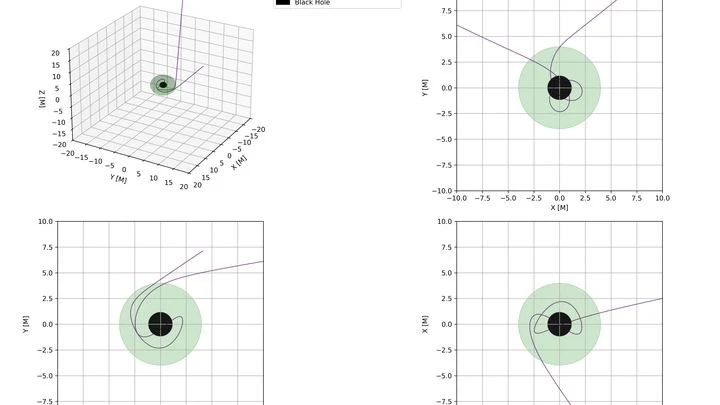
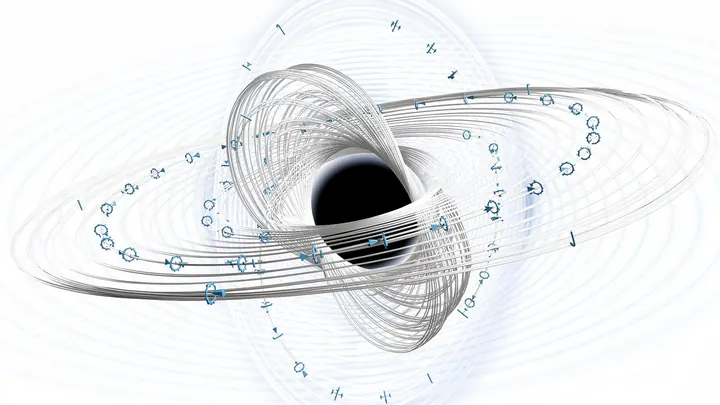
Light passing by a black hole falls into a gravitational trap: its trajectory curves and the particle bounces along a nearly closed orbit, like a pinball.
The beacon flares up and then nearly goes out, even though the lamp inside burns steadily. That is exactly what astronomers saw when they pointed their telescopes at the galaxy I Zwicky 1. At its center sits a supermassive black hole that devours gas and dust so greedily that a scorching disk forms around it, shining brighter than an entire galaxy.
A sponge thrown into a bucket of water eagerly soaks up moisture and swells before your eyes. But if you keep adding water and squeeze and release the sponge, absorption becomes harder and takes longer. That's roughly how tiny black holes behaved at the very beginning of the universe.
The XRISM X-ray telescope spent 170,000 seconds staring at the core of galaxy Cygnus A — one of the most powerful radio sources in the sky. At its center lurks a supermassive black hole that sucks in matter and heats it until it glows in X-rays. The instrument caught light from iron atoms that had lost electrons.
When two black holes merge, they shake the very fabric of spacetime. The newborn giant doesn't settle instantly (it rings like a cosmic bell, emitting a characteristic pattern of damped gravitational waves) the so-called ringdown.
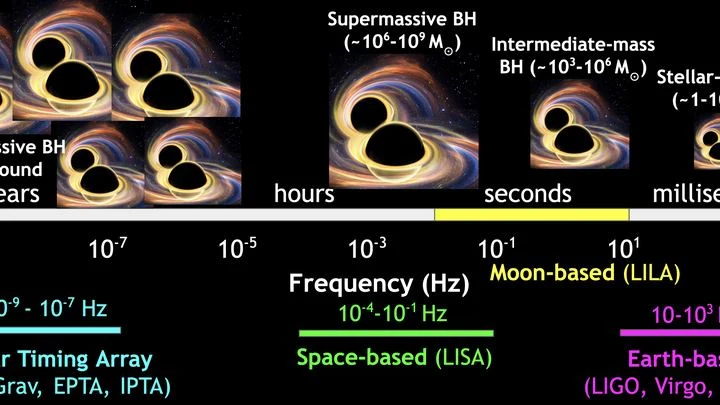
Gravitational waves are ripples in the fabric of space, like circles on water from a thrown stone. On Earth, they are drowned out by traffic, tides, and earthquakes, like a storm beating on a lake, making it impossible to notice faint splashes. The LILA project moves the detector to the Moon, where windless silence reigns.
A lantern shines through thick fog. Light scatters off water droplets, and the lantern appears blurred. Something similar happens around a black hole: hot gas, like fog, envelops it, while X-rays from the inner parts of the disk struggle through this cloud. Only here, the "droplets" are electrons, and the "fog" itself is called the corona.
At the center of a vast funnel sucking everything in, a small ball spirals inward. As it orbits, a low hum arises: it's spacetime itself trembling, and we call that trembling gravitational waves. The frequency rises, the pitch climbs, just like the sound of a siren from a passing ambulance.
Gas falling into a black hole spirals inward like water down a drain. In this flow, magnetic loops constantly form and pop — somewhat like solar flares, but far more powerful. Each loop is a tiny magnet living its own life. When many of them are present, they start to influence each other: their north and south poles attract and repel in turn.
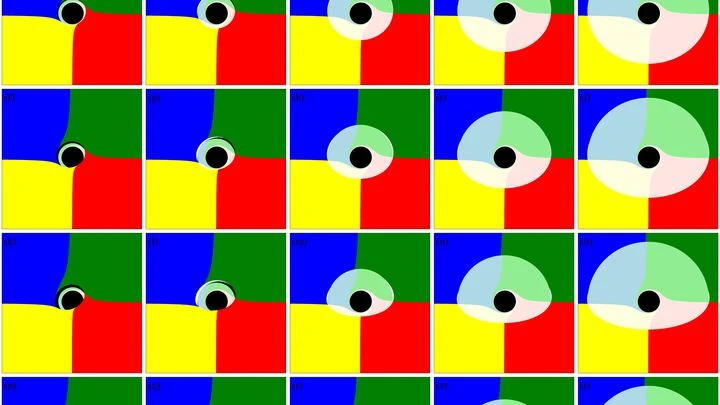
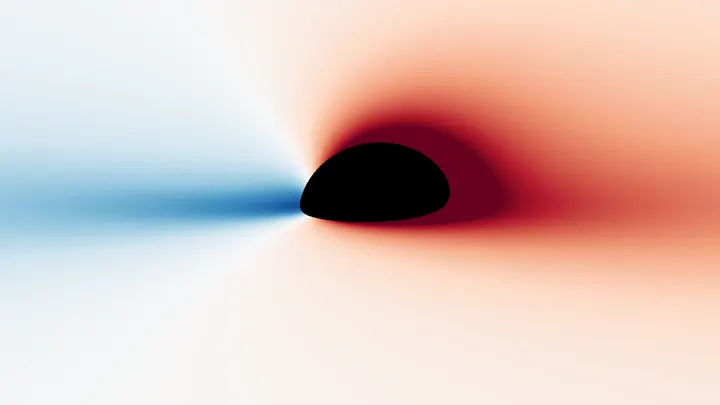
A black hole is not just a dark sphere in space. If there is gas and dust nearby, they swirl into a flat, glowing disk that gradually falls inward. This disk acts like a lamp, illuminating the hole itself, and against the bright background you can see its shadow — a dark silhouette with sharp edges.
But what if the disk is not flat but torn into pieces?
The black hole GRS 1915+105 usually hides behind a dense gas curtain: its X-ray emission is heavily absorbed on its way to us. But in April 2023, it suddenly flared: the X-ray flux jumped nearly tenfold.
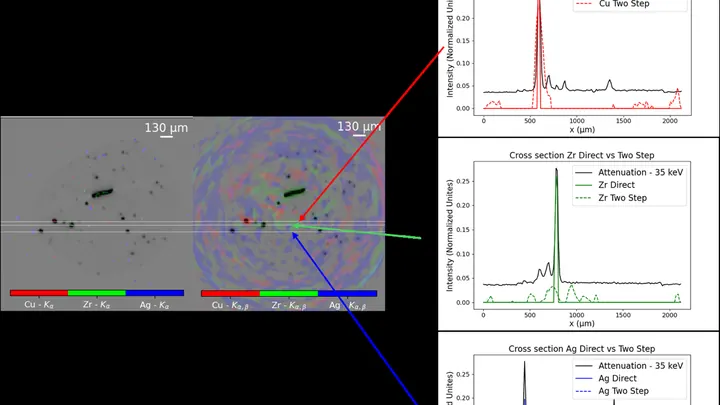
Conventional X-ray fluorescence analysis works like a meticulous scribe: to learn the composition of a picture, it walks over every square centimeter and logs whether lead or copper is present. For a flat sheet, that's tolerable, but for a three-dimensional object, it's torture.
At the center of the Milky Way lies the supermassive black hole Sagittarius A*. It is four million times more massive than the Sun, but by cosmic standards it behaves quietly: it only occasionally flares up when it swallows a clump of gas.
At the center of galaxy PDS 456 shines a quasar — a black hole devouring gas that glows brighter than hundreds of billions of stars. The X-ray telescope XRISM peered into this light and saw a picket fence of dark bands, like shadows cast by a fence at sunset.
At the center of the distant galaxy MCG-6-30-15 lies a supermassive black hole. Around it swirls a disk of incandescent gas, and above the disk hangs a cloud of even hotter particles — the corona. In February 2024, three X-ray telescopes (XRISM, NuSTAR, and XMM-Newton) observed this system simultaneously.
The night sky looks still, but sometimes one of the stars suddenly begins to brighten. That's what happened with the system AT 2019wey: it was spotted by the TESS telescope, which usually hunts for planets around other stars, but happened to be imaging that patch of sky every half hour.
During its 2021 outburst, the black hole in the GX 339-4 system behaved like an actress changing costumes between scenes. In the hard state, it wore two coronas at once: a hot, rarefied one, and over it, a warm, dense one. In the soft state, only the hot corona remained.