Simple

Echo of a Silenced Black Hole express
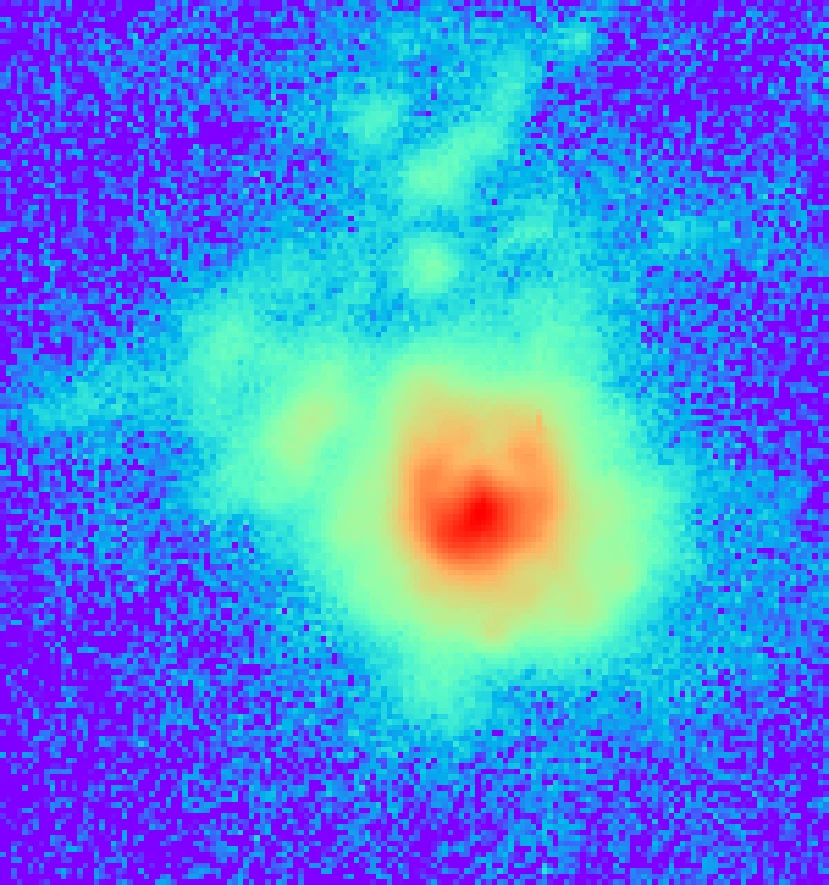
Original: "Polarization echoes from past nuclear activity in the quasi-periodic eruption source GSN 069"
arXiv:2601.08940v1 · 2026-01-13 · CC BY 4.0 · 1 min · Galaxies
Light from the center of galaxy GSN 069, like an echo, brought news: the giant black hole was recently active but has now fallen asleep.
Abstract

Scientists studied a galaxy where mysterious X-ray 'bursts' occur. They found that light from its center behaves like an echo from a switched-off flashlight: polarization (the directionality of light waves) gets stronger farther from the core, showing that it once shone brightly but has now faded. It seems the ancient active 'heart' of the galaxy left behind a glowing, misty trail. What else might these cosmic echoes reveal?

Links in the knowledge graph 1

At the heart of every galaxy slumbers a supermassive black hole. When it devours matter, its surroundings flare up—this is an active nucleus. How can we learn about past outbursts if the black hole is silent? The answer lies in light echoes.

Like an echo in an empty hall, where reverberations linger after the source has gone quiet, radiation from a dead nucleus wanders through the galaxy. Astronomers caught it by measuring polarization—the orientation of light wave oscillations. In GSN 069, polarization grew stronger with distance from the center and was almost absent at the core. This means the light source has gone dark, but reflected rays still carry its story.

Light echoes are a cosmic chronicle: from delayed reverberations, we read what the galaxy was like thousands of years ago.

A combined analysis of spectroscopy and photometry revealed that the nucleus of GSN 069 wasn't just tearing apart passing stars—it shone steadily, surrounded by a gas 'doughnut' that focused its radiation. Most surprising: the black hole fell silent when ancient civilizations already existed on Earth. Its current slumber is just a brief pause in a turbulent life.

🎯 Light echoes expose cosmic events with a delay that makes us witnesses of the distant past—as if we're watching a film shot thousands of years ago.

Scientists
Christian DopplerD. B. McLaughlinDidier QuelozMichel MayorR. A. RossiterStephen Hawking
Tags
black hole galaxy spectroscopy photometry
Laws
Doppler effectHawking radiationgravitational lensingBekenstein-Hawking entropyEinstein field equationsMaxwell's equations
Original: arXiv:2601.08940v1 · CC BY 4.0 · bridge42worlds