Invisible Glue: How Order Attracts Disorder express
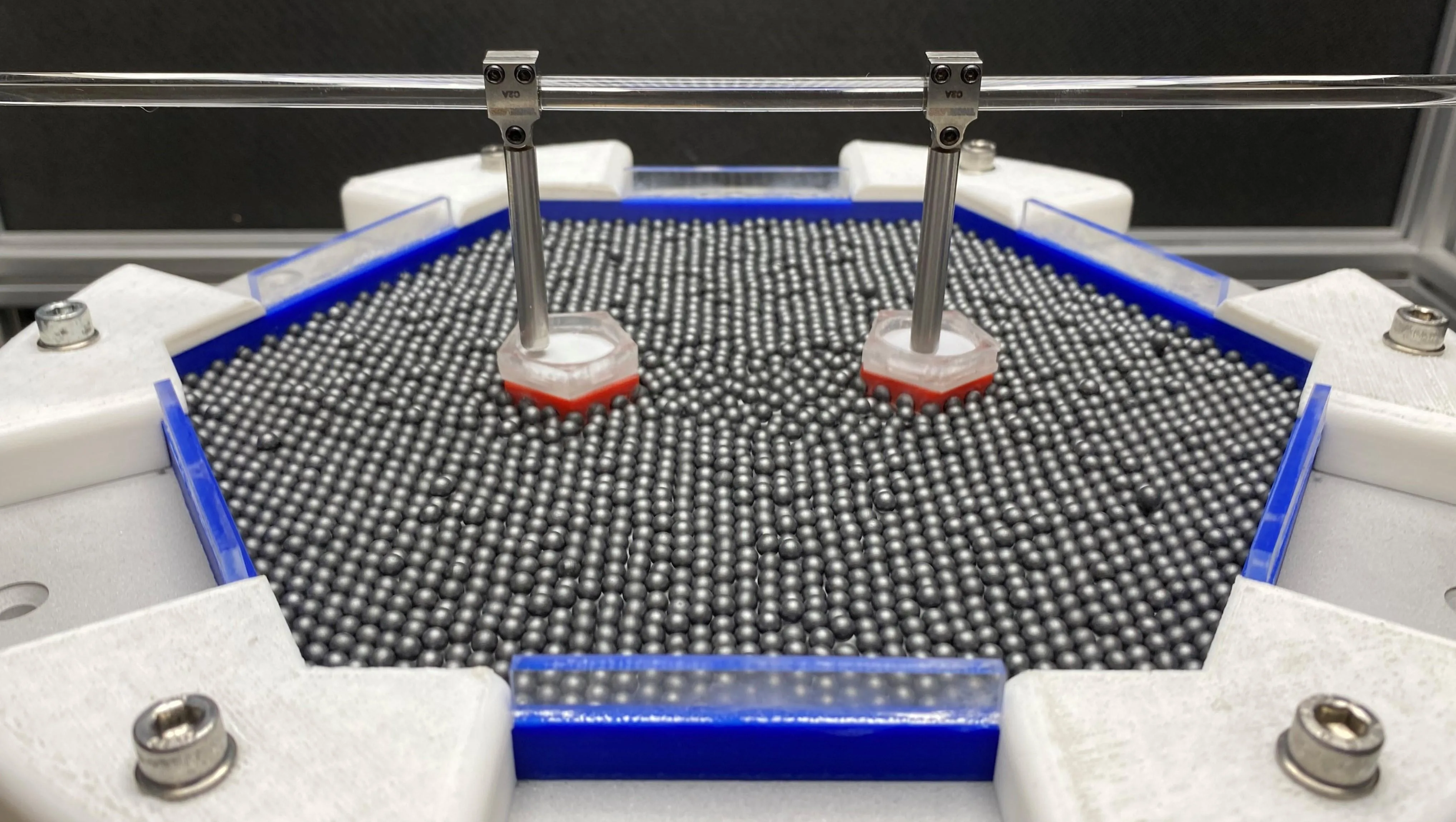
Shake a jar of sand and marbles, and you'll see large objects float or sink depending on their size. But if you shake it cleverly, you can make the marbles gather into pairs and chains, as if glued together. It's this kind of 'invisible glue' that physicists from India and Germany have now caught and measured for the first time.
They used a flat container filled with grains, small disks, vibrated so that they moved chaotically, like molecules in a liquid. Into this 'granular liquid' they placed two larger 'guest' disks. Around each guest, the grains lost their order: an island of disorder formed, like a bubble. The two bubbles began to attract and merge, dragging the guests along. The attractive force turned out to be tiny, on the order of one billionth of a newton, but it was enough to bring the disks together and hold them.
This effect has been dubbed 'orderphobic'—literally 'fearing order.' It is universal: it works in liquids, colloids, and biological systems. Now that we know its strength, we can control the assembly of microparticles, create new materials, and even influence the behavior of cells in tissues. So give that jar of sand a shake: you might just see the birth of a future smart material.
The attractive force between two 'disorder bubbles' in the experiment was a billion times weaker than the weight of a grain of sand, yet it was enough to hold together two disks, each the size of a coin.