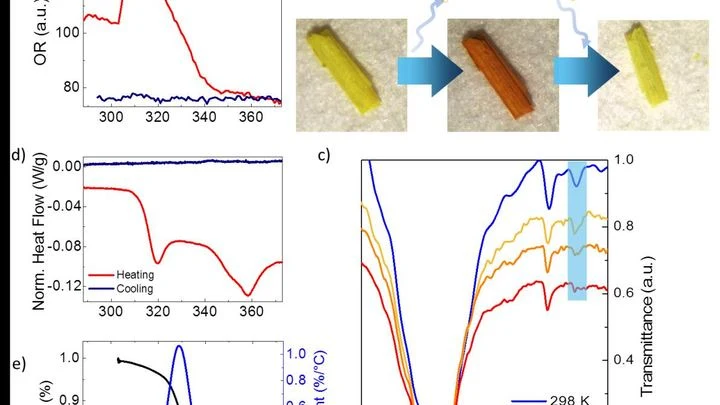
Smart materials are solids that sense a change in their environment and respond by altering their physical properties — shape, stiffness, color, or conductivity. Unlike ordinary materials that passively obey external forces, these are engineered to have a built-in feedback loop: a stimulus triggers a structural or chemical change that modifies the material's behavior. Examples include shape-memoryalloys that recover their shape when heated, piezoelectric crystals that generate voltage under pressure, and hydrogels that swell or shrink with pH.
History
The term 'smart material' was popularized in the 1980s, but the first shape-memoryalloy (Nitinol) was discovered in 1959 by Buehler at the Naval Ordnance Laboratory. Piezoelectricity was discovered by the Curie brothers in 1880.
How it works
The mechanism is typically a reversible phase transition or a molecular rearrangement. In shape-memoryalloys, a martensitic transformation changes the crystal structure, and heating restores the austenitic phase. In stimuli-responsivepolymers, external conditions (temperature, light, chemical) alter the balance of hydrogen bonds or hydrophobic interactions, causing the polymer network to expand or contract. The key is that the response is programmable: by tuning the chemistry or microstructure, the material can be designed to react at specificthresholds.
In practice
Used in actuators for robotics, self-healing coatings, adaptive optics, drug delivery systems, and vibration dampers in aerospace structures.
Fun fact
Some smart materials can 'remember' two different shapes at different temperatures — a phenomenon called the two-way shape memory effect, used in heat engines and deployable space structures.
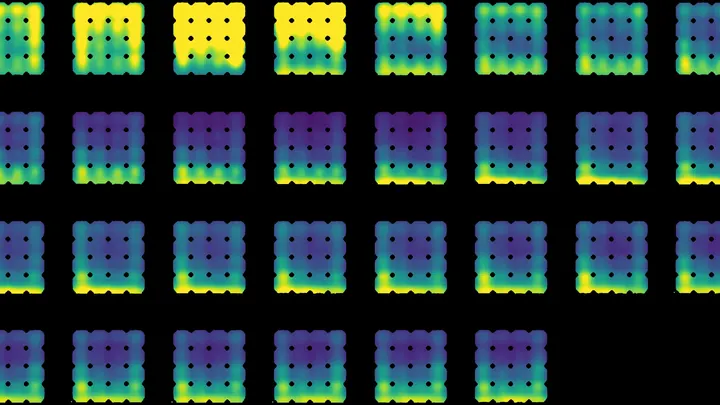
Imagine a book with latches on its pages: you can only flip a page if you know how to click its edge. That is roughly how the mechanical metamaterial we are about to discuss works. Each cell is a small mass inside a larger one, connected by an elastic beam. The beam can sit in two stable positions, like a switch.
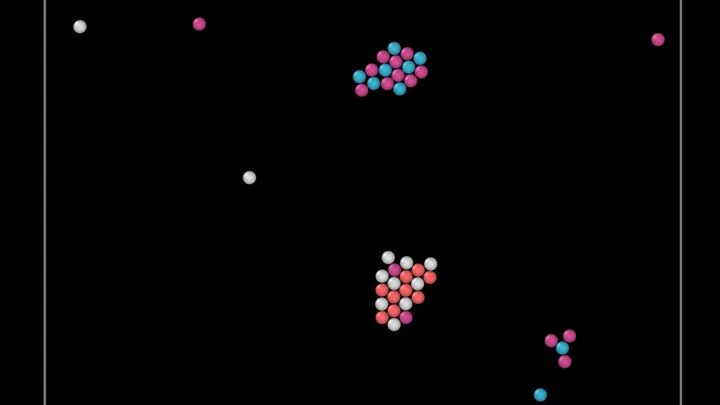
An octopus waits with tentacles spread wide. No central controller directs its arms, but the moment prey touches one, all eight wrap around it. Physicists have recreated a similar trick in the lab with a body that has neither neurons nor muscles: a star polymer with self-propelled arms.
The polymer was assembled from small cylindrical vibrobots on a vibrating plate.
In a pot of water, microscopic spheres, colloidal particles, are floating. Each sphere is coated with long polymer chains that look like a brush and carries an electric charge. If you get the temperature and solution composition right, the spheres start arranging themselves into ordered patterns — crystals.
A drop of water on glass trembles and shimmers: it seems to have a life of its own. Similar behavior can now be observed in the world of colloids: tiny particles suspended in a liquid. Researchers simulated particles that emit chemical signals. These signals, like scents in the air, spread around and cause neighbors to either draw closer or move apart.
A solid electrolyte is not just a crystal lattice: it’s a bustling metropolis for ions. Each act of conduction resembles a trip through the city: there are wide highways with low energy barriers, gridlocks in bottlenecks, and tricky detours where an ion can get stuck.
Any measuring device is spoiled by quantum noise — the chaotic jitters of elementary particles. To tame it, physicists used a trick on calcium fluoride molecules, much like squeezing a balloon: press in one spot, and it bulges in another.
The crystal Co2SeO3Cl2 resembles a layered cake, with each layer being a buckled honeycomb grid of cobalt atoms. When cooled to 25.4 K (−247.75 °C), the magnetic moments of the atoms begin to align like compass needles, but not all at once — rather in four steps, at 25.4, 16.8, 11, and 3 K. Each step brings a new pattern of magnetic order.
An ordinary rubber pad dampens vibration the way a thick blanket muffles sound: the thicker and heavier, the better. Engineers have long dreamed of a material that is light yet "eats" oscillations as well as a massive damper.
In the air of factory floors and laboratories, invisible solvent molecules drift. One of them, acetonitrile, has a faint smell, but at high concentrations it can harm health. Typical sensors for it are bulky and expensive, but here we have a thin crystalline film that responds on its own to the presence of vapor.