At a distance of 10 nanometers, two mirror plates are compressed with a pressure of one atmosphere, even though there is an absolute vacuum around them. This is the Casimir effect: quantumfluctuations give rise to a real force in the void. The vacuum constantly boils with pairs of particles and antiparticles that exist for instants. In the gap between the plates, only those fluctuations fit whose wavelength is a multiple of the distance—like standing waves on a string. Outside, however, the spectrum is unrestricted. As a result, the 'population' of particles is larger outside, and it presses on the plates, pushing them together. The force quickly weakens with increasing gap—inversely proportional to the fourth power.
History
The idea came to Casimir during discussions with Bohr about the properties of colloidal solutions. Together with Dirk Polder, he derived a formula for the force between two perfectly conducting plates. Later, Evgeny Lifshitz generalized the theory to real materials, taking into account finite conductivity and roughness. The first confident measurement was made by Steve Lamoreaux in 1997 using torsion balances; it was followed by experiments with an atomic force microscope that confirmed the dependence on distance and surface properties.
How it works
Quantization of the electromagnetic field in the presence of boundaries leads to a renormalization of the zero-point energy. The mode density between the plates is lower than in the outer space, and the integrated pressure difference yields an attractive force. In the formula, the force is inversely proportional to the fourth power of the distance. For real metals at small distances, retardation starts to play a role, and the force transitions to the van der Waals force. At higher temperatures, thermal fluctuations enhance the effect.
In practice
The effect causes tiny parts in microchips to stick together without any lubricant.
Fun fact
If the plates were perfectly smooth and infinite, the Casimir force at microscopic distances could reach tens of atmospheres.
Molecules in an ultracold gas are like tiny magnets: they attract when far apart, but when they get close they can stick together for good. Such sticking destroys the gas: particles drop out of the game, and you never reach the quantum regime where all of them behave as one.
In a narrow corridor, people walk in rows rather than as a crowd. The number of rows depends on the width of the passage. In graphene, this corridor is a quantum point contact — a constriction where electrons move ballistically without scattering.
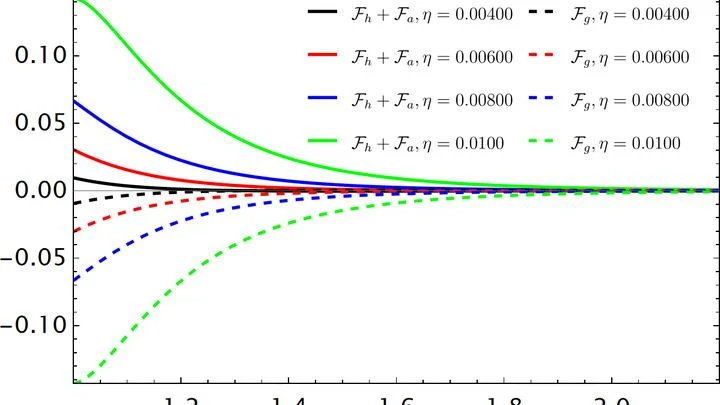
Drop a pebble into a pond, and ripples spread across the water. In much the same way, any body, even the tiniest, perturbs the gravitational field around it. In empty, cold space, these perturbations, like ripples on a calm surface, make two nearby objects always repel each other.
A sheet of paper stretches rapidly in all directions. On it are drawn tiny arrow-particles, and the stretching makes them move and interact differently than they would on a stationary table. That's roughly how space behaves in an expanding universe, where curvature isn't just an abstraction but a real factor influencing the very foundations of matter.
Take two thin sheets of a semiconductor. One is saturated with free electrons, like a packed café where every table is taken. The other, by contrast, is full of empty spots—'holes' eager to be filled. When these sheets are brought close together, a spark of attraction jumps between them: electrons and holes begin to feel each other across the thin gap.
Two transparent sheets with circles drawn on them. If you stack them exactly, the circles align. But give one sheet a slight twist, and a new pattern emerges: in some places the circles bunch together, in others they spread apart. That's roughly how moiré works — an unexpected pattern born from rotating two periodic structures.
The furnace is white-hot, but the ceramic powder remains loose. Turn on the electric field, and within seconds the material settles, hardens, and turns into a solid monolith. This technique is called flash sintering (from the English "flash"), and it saves hours of firing and gigawatts of energy. But what exactly happens to the atoms at the moment of the flash remained a mystery.
Two metal plates in a vacuum attract each other without any magnets or charges. This is the Casimir effect: the void is not empty; particles constantly pop in and out of existence, and there are fewer of them between the plates than outside. The pressure difference pushes the plates together.
Two tiny weights, each about the mass of a grain of sand, hang in the dark at a temperature colder than deep space. They don't touch, but an invisible thread connects them — gravity. The experiment physicists are now building aims to catch the moment when that thread tugs one weight due to the motion of the other.
A mosaic of squares and triangles covers the floor without gaps, yet it never settles into a simple repeating pattern. Such a pattern is a quasicrystal — a solid where atoms are arranged not periodically but according to a pattern of several waves of different lengths. These waves are incommensurate with each other, and together they create long-range order.
Glass lenses and mirrors appear perfectly smooth and still. But beneath the surface, a hidden life teems. Atoms in an amorphous material (a substance without a crystalline lattice) are packed haphazardly, and this disorder creates a complex energy landscape, like a mountainous region with countless hills and valleys.
A lead sphere hangs above another lead sphere. According to the usual laws of gravitation, they attract each other exactly along the vertical — along the line connecting their centers.
Quantum vacuum is not absolute emptiness. It is more like a taut membrane that constantly ripples from invisible particles popping in and out of existence. Even in total darkness, this membrane trembles. Physicists decided to see how it behaves around a thin spherical shell, inside which is ordinary flat space, like in our room.
Electric charge is not like a number chiseled in stone. In the vacuum around any charged particle, pairs of particles and antiparticles are constantly born and annihilated, like the foam in a glass of champagne. The bubbles screen the true charge, making it appear smaller or larger depending on how close we get.
When two dark matter particles approach each other, they can attract more strongly than expected. This phenomenon is called Sommerfeld enhancement — it works like an invisible spring that compresses before impact. For a long time, it was believed that the spring compresses more strongly the slower the particles approach each other.
After the Big Bang, the universe may have been stuck in a false vacuum — a temporary state like a soap bubble ready to pop. A rare true vacuum bubble could then erupt, stretching space in the blink of an eye.
A sheet of rubber is squeezed from two sides. At first glance, it's just deformation. But inside, deep within the material, a hidden order awakens. This is not just wrinkles on the surface. It's the birth of special zones where vibrations become trapped, as if in a cage.
Previously, it was thought that such effects require intricate lattices and periodic structures.
Wormholes — tunnels through curved spacetime, allowed by general relativity. To be stable, they need repulsive energy — the kind that pushes apart rather than attracts.
An empty glass on the table seems reliable. But if there's a microcrack in the bottom, one day it will break — not with a crash, but quietly, spreading in a web of lines. So too with the vacuum: it may not be the true vacuum but a false one — temporarily stable, yet ready to transition to a deeper, real state.
Two floats on the waves. Throw a stone into water, and the ripples will spread, rocking both floats one after another — not simultaneously. In the quantum world, such rocking is called entanglement: particles, like floats, begin moving in sync.
Light hits a crystal and knocks an electron out of its rightful place. A void remains — a hole that behaves like a positive charge. The electron and hole attract each other and circle around one another, like a pair in a slow dance. Such a pair is called an exciton (from the word "excitation").
But this dance is not in a vacuum.
The cosmic vacuum is not emptiness but a living ocean: its energy swells and subsides, echoing the expansion. Like a lunar tide, vacuum density sensitively responds to Hubble’s tempo — the conductor’s baton of the universe.
Two antennas in a soundproof room pick up only noise. But if you spin them, especially in opposite directions, a common signal emerges from the static. Quantum sensors in a vacuum work similarly: acceleration helps them pull quantum entanglement out of the void — an invisible link akin to what forms near the horizon of a black hole.
A warp bubble compresses spacetime in front of the ship and stretches it behind, like a boat pushing through water. The ship doesn’t accelerate to the speed of light; instead, it glides inside the bubble.
Two tiny mirrors in a vacuum are like figure skaters in a pairs routine. Their oscillations are synchronized by an invisible gravitational thread. When cooled to millionths of a degree above zero, this thread turns them into a single quantum link — the motion of one instantly echoes in the other.
A crowd is trapped in a narrow corridor between two rows of mirrors. Every now and then, someone shoves the wall hard, and a rumble rolls down the corridor — similarly, in the plasma of galaxy clusters, whistler waves and ion-cyclotron waves appear.
A superconductor carries current without resistance, like water running through a pipe without friction. The secret lies in electron pairs: two electrons stick together as one, even though they normally repel. In an ordinary superconductor, the spins of the electrons in a pair point in opposite directions: this is the singlet state.
Normally, by rapidly oscillating a mirror in a vacuum, you can conjure real particles from nothing: this is the dynamical Casimir effect. But near a black hole, things are different. The spacetime curvature itself stifles any attempt to create something.
Hold a magnet near a pile of iron filings, and they line up along invisible lines — the field wraps around the magnet from pole to pole. In a similar way, you can visualize gravity around massive bodies: instead of filings, it's space itself; instead of a magnet, a star or a black hole. The authors propose decomposing gravity into two fields.
The riddle of quantum gravity has troubled minds for nearly a century. A classical field that curves spacetime refuses to fit into the probabilistic world of superpositions. Can gravitation, while remaining macroscopic, give rise to microscopic entanglement?
When an electric field reaches monstrous strength, emptiness ceases to be empty. Back in the mid-20th century, Julian Schwinger showed that the vacuum literally explodes with pairs of particle-antiparticle if the field is intense enough.
Sometimes an unwelcome guest sneaks into the equations, like a creaky floorboard that unsettles the whole house. In gravity theories, if you add curvature-squared terms to the equations (which you need to describe very strong fields), a ghost particle appears — heavy but with negative energy.
Picture a crowded hall where each person is a molecule, and their private conversation is the motion of electrons within it. Normally, everyone talks to themselves, and the overall buzz is chaotic. But if a bright spotlight is turned on in the center, it begins to conduct the crowd: people synchronize their movements, even though the light merely reflects off the walls.
Imagine a long corridor with an uneven floor: bumps here, pits there. If you roll a toy car along it, it will get stuck in the deepest pit, not where you gave it a push. That's roughly how sound behaves in a phononic crystal — a material made of periodically arranged elements that controls the propagation of elastic waves.
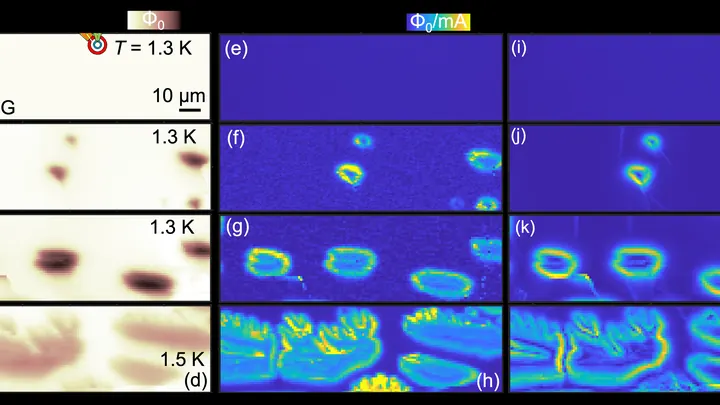
A magnetic field penetrates a superconductor not as a continuous flux but as thin filaments — vortices. Usually, they repel each other and arrange into a neat triangular lattice, like floats on water. But in CaSb₂, things went differently: vortices bunched into tight clusters, with almost empty space between them.
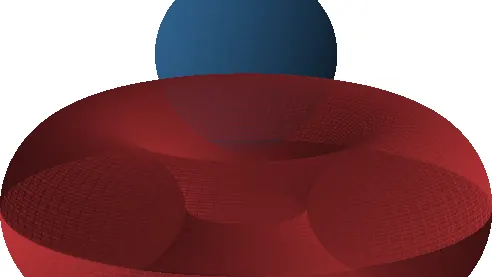
An invisible film, a quantum field, is stretched over a rubber bagel. While the bagel is small, the film stays taut and doesn't sag anywhere: the vacuum remains empty. But once you stretch the bagel to a certain size, a dent spontaneously appears in the film — the field starts to be felt at every point.
This dent is not random.
Physicists are trying to hear a whisper in a noisy room. They build a soundproof booth, but even inside, their own breathing and heartbeat create interference. That's roughly how the search for quantum gravity goes: they want to see gravity bind two particles into a single whole — entangle them.
A drummer beats a rhythm, and the drumhead vibrates in time. If you strike often enough, the vibrations overlap, and a nearly stationary zone, a node, forms at the center. A similar effect occurs with microwaves in a material whose properties change over time. When the changes resonate with the wave, its motion freezes.