Disorder-induced phenomena refer to emergent properties in materials that arise from the presence of atomic or molecular disorder, rather than being destroyed by it. While disorder is often seen as detrimental to material properties, in certain cases it can lead to novel and useful behaviors, such as superfluidity, enhanced superconductivity, or improved light absorption. These phenomena challenge the traditional view that order is always necessary for desirable material properties.
History
The study of disorder-induced phenomena has roots in the 1950s with Philip Anderson's work on localization, but the idea that disorder can be beneficial gained traction in the late 20th century with discoveries in high-temperature superconductivity and other correlated electron systems.
How it works
In disordered systems, the lack of long-range order can lead to localization of quantum states, known as Anderson localization. However, in some cases, disorder can also create new pathways for interactions or alter the density of states in a way that enhances certain properties. For example, in a superfluid, disorder can create a 'supersolid' phase where superfluidity coexists with a crystalline structure, or it can enhance the critical temperature of a superconductor by increasing the density of states at the Fermi level.
In practice
Disorder-induced phenomena are exploited in the design of advanced materials, such as high-efficiency solar cells that use disordered perovskite structures to absorb more light, and in the development of quantum memory devices that use disordered diamond lattices to store information.
Fun fact
The phenomenon of 'superabsorption' in disordered perovskite crystals allows them to absorb light more efficiently than perfectly ordered crystals, which is counterintuitive to traditional expectations.
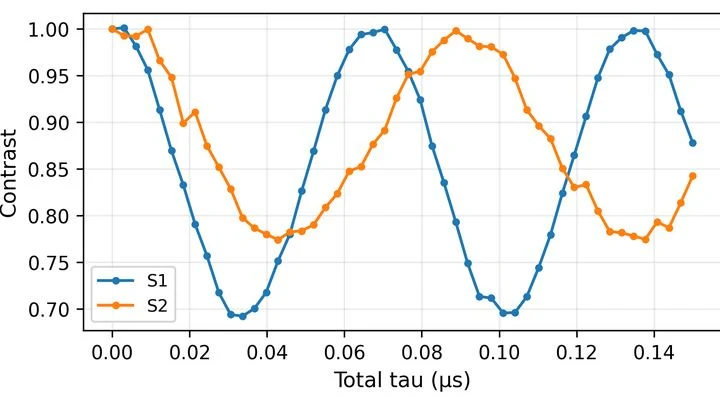
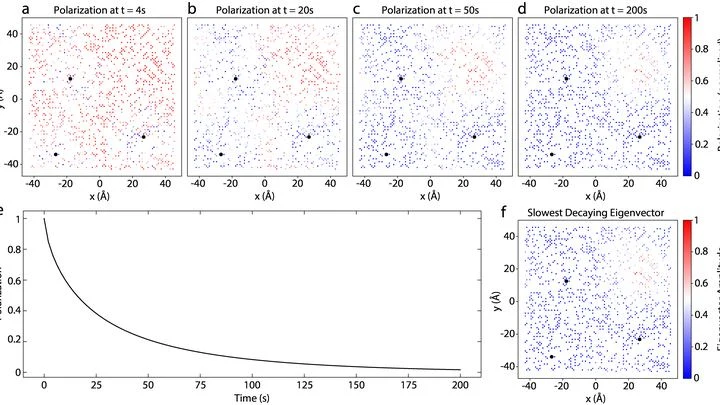
Imagine an orchestra where every musician is a tiny magnetic sensor inside a diamond. To play cleanly, they need silence: no extra vibrations, no background noise. But when creating such orchestras, thin diamond films with nitrogen defects, dissonance bursts into the material.
An international team of physicists studied how this disorder arises.
A thin silver thread nearly as long as a hair's width, and inside it, pristine quantum laws hold sway. Physicists built a conductor where electrons can only move forward or backward, like on a perfectly straight single-lane road with no shoulders. On such a road, any pothole or pebble would normally destroy the fragile quantum state.
A jazz ensemble: at first, a cacophony of random notes. Then — a catchy riff that plays over and over. Such is the riddle of the origin of life — only in the language of chemistry.
A solid under a microscope is not a monolith at all. In glass, polymer, or solidified resin, atoms are arranged randomly, and as a result, the material's properties vary from point to point. On large scales, we are used to describing them with smooth fields, like temperature or pressure in a room. But when you zoom down to a few atomic layers, that smoothness disappears.
Graphene, a two-dimensional carbon crystal, has long tantalized physicists with the hope of high-temperature superconductivity. Its electrons obey the relativistic equation of Paul Dirac, racing at tremendous speed, barely noticing each other.
Imagine a skyscraper assembled not from individual bricks but from entire studio apartments. That's exactly how the Au₆Te₁₂Se₈ crystal is built: its nodes are not atoms but superatomic clusters of gold and chalcogens that behave as single quantum objects.
A string sounds perfectly pure until a draft touches it. That's roughly how a superradiant laser works: a beam of atoms, pre-charged with energy, flies through a room made of two mirrors — an optical resonator (a trap where light bounces back and forth).
A swarm of fireflies rarely collides, yet they synchronously change color by exchanging signals. This is how neutrinos behave in dense streams from collapsing stars: they collectively transform from one type to another, even though individually they interact extremely weakly.
If you check where an electron is every second, its quantum properties change. It's like a child playing hide-and-seek but constantly being called by name: they freeze and stop running. In the particle world, such a "caller" is a measurement. It prevents particles from freely forming a shared quantum state, or entanglement.
A sheet of graphene is a mesh of carbon atoms one atom thick. Even the slightest contamination shows up on it, like dust specks on eyeglass lenses. Ten years ago, researchers learned to hide graphene between layers of boron nitride, like placing a fragile sheet between two pieces of plastic wrap.
A semiconductor film one atom thick is like a tightly stretched membrane. Light makes it flash: luminous points (excitons) are born, which quickly fade. Where the membrane is torn or crumpled, the glow flickers and stutters, like a string with a knot sounding off-key.
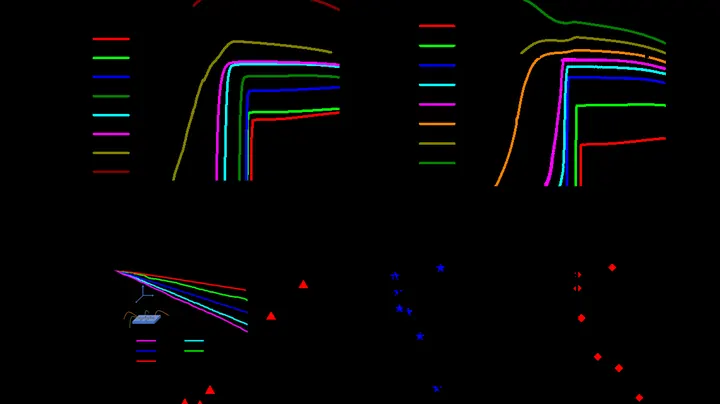
A thin film of niobium and tin conducts electricity without resistance — until you make it really thin. Then it suddenly becomes an insulator. A team of physicists tested what happens when you add a bit more tin to the film than the formula calls for.
A crystal that inside resembles a sponge with a labyrinth of pores turns out to be capable of performing computations. The material, named DUT-8, consists of metal nodes and organic linkers forming an intricate lattice. Under the influence of different gases, this lattice slightly changes shape, like a house of cards that rearranges with a gentle breath.
A thin superconducting wire, cooled to near absolute zero, can sense a single particle of light. Such detectors are indispensable for quantum computing and secure communication, but their temperament is spoiled by disorder — random irregularities and impurities that cannot be completely removed.
Instead of fighting disorder, physicists decided to tame it.
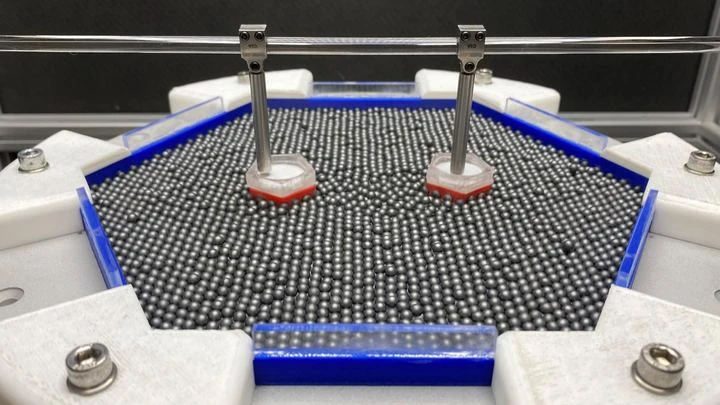
Shake a jar of sand and marbles, and you'll see large objects float or sink depending on their size. But if you shake it cleverly, you can make the marbles gather into pairs and chains, as if glued together. It's this kind of 'invisible glue' that physicists from India and Germany have now caught and measured for the first time.
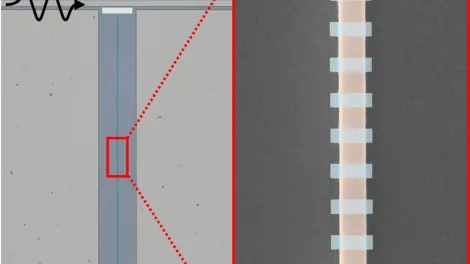
An ordinary wire at high frequencies is like a road full of potholes: the signal jumps, and some energy is lost as heat. A superconducting chain made of aluminum and indium arsenide (a semiconductor) turned out to be a smooth highway for microwaves.
Quantum particles in a strongly disordered environment behave like dancers executing steps in sync: each knows its own move and never collides with others. This kind of coordinated, frictionless flow, superfluidity, unexpectedly emerged in an experiment on a superconducting quantum chip.
In the everyday world, order preserves and disorder destroys. But in quantum computing, this logic is turned on its head. Consider a diamond: carbon atoms with their nuclei and electrons behave like tiny magnets capable of storing a quantum "whisper"—information encoded in the orientation of their spins.