Cosmic Laser Blinks express
In a dense gas cloud where a star heavier than the Sun is forming, there is a tiny source of radio waves. It works like a laser: methanol molecules amplify the radiation, and we see a bright spot. But this spot behaves strangely: its brightness jumps up and down within a matter of hours.
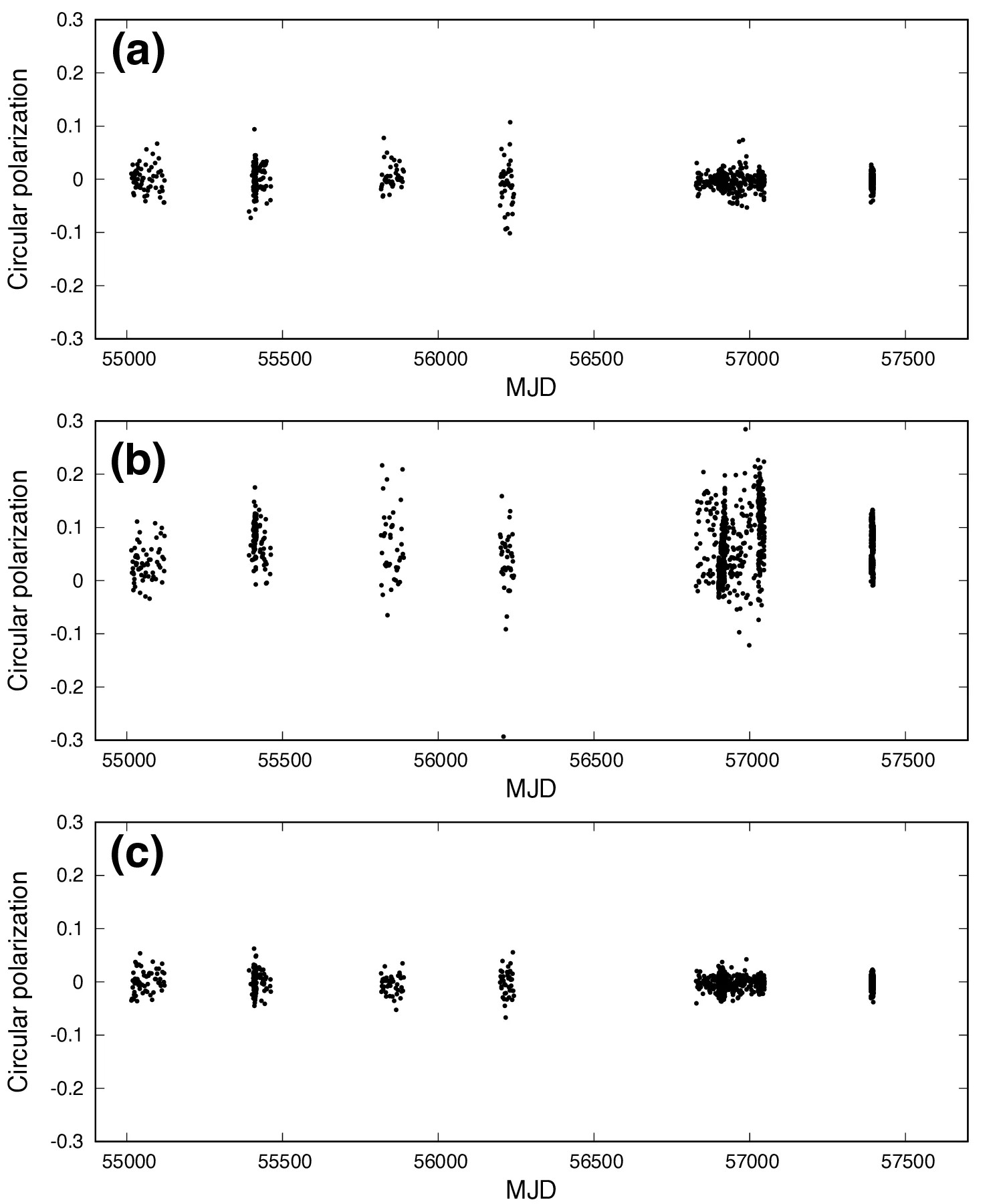
Scientists monitored the source G33.641-0.228 from 2009 to 2016. They noticed that during a flare, the brightness changes within 0.3 days — about seven hours. Also, the light from the source turned out to be partially twisted. The fraction of such twisted light reached 20 percent, but during quiet periods it dropped to zero.
To explain this, scientists proposed the following picture. Behind the maser cloud, an explosion occurs — similar to a solar radio flare. This explosion generates twisted light. Then this light passes through the methanol cloud, and the cloud amplifies it like a sound amplifier. That is why we see both rapid flashes and twisted light at the same time.
This scheme explains why the twist disappears when brightness increases: the explosive light temporarily overpowers the cloud's own emission. Now astronomers have a key to unraveling the mystery of these blinking cosmic lasers.
Original abstract
as written by the authors arXiv:2601.20371
The 6.7 GHz methanol maser in a high-mass star-forming region G33.641$$-$$0.228 is known to exhibit burst-like flux variability due to an unknown mechanism. To investigate the burst mechanism, we conducted high-cadence flux and circular polarization monitoring observations, simultaneously using left- and right-hand circular polarizations. We found that the flux density increased and decreased on a short timescale of 0.3 d during a burst. We also found strong circular polarization, reaching up to 20\% in the component exhibiting the bursts. Circular polarization of 0--20\% was continuously observed from 2009 to 2016, even in the quiescent period. The polarization also varied on timescales of less than one day. When a burst occurred and the flux density increased, the circular polarization decreased to zero. To explain the observational properties of the flux variability and circular polarization, we propose a model in which an explosive event similar to a solar radio burst occurs on the line of sight behind the maser cloud, producing circularly polarized continuum emission due to gyro-synchrotron or gyro-resonance radiation, which is then amplified by the maser.
Methanol masers are hundreds of thousands of times brighter than any human-made laser, even though all the energy comes from ordinary molecules in a gas cloud.
A similar principle of light amplification is described in Lem's novel "Solaris": the planet's ocean generates coherent radiation that scientists try to decipher.